LEARN · PRACTICE · EXPLORE
Pennsylvania Grade 3 English
Learn to distinguish literal and nonliteral language with an original Grade 3 reading example, a worked explanation, Pennsylvania English references, and printable resources.
Focused lessons · Useful practice · Clear next steps
What do Pennsylvania 3rd graders learn in ELA?
In 3rd grade, Pennsylvania English language arts centers on main idea and details, vocabulary from context, and writing organized paragraphs. Students take the PSSA grade 3 ELA test in the spring. This page explains each Pennsylvania grade 3 ELA standard and pairs it with short lessons, printable worksheets and a full-length practice test.
Printable Pennsylvania grade 3 ELA books:
Standards source: Pennsylvania adopted content standards.
Distinguish Literal and Nonliteral Language
Learn to distinguish literal and nonliteral language with an original Grade 3 reading example, a worked explanation, Pennsylvania English references, and printable resources. Use the teacher’s reading and writing assignments to build this skill across longer texts.
Curriculum reference: Pennsylvania Core Standards for English Language Arts, March 1, 2014, from the Pennsylvania English language arts standards page.
Pennsylvania Grade 3 references for this activity
Pennsylvania’s education department links the March 1, 2014 PA Core English documents for Pre K–5 and Grades 6–12. The state board identifies March 1, 2014 as the effective date. The code linked here is a selected Pennsylvania reading reference, not a generic Common Core label. Standards guide locally developed curricula; check the school’s reading, writing, language, speaking, and listening sequence.
| Selected Pennsylvania reading reference | Activity focus | State-linked standards document |
|---|---|---|
| CC.1.3.3.F | Use context to distinguish literal and nonliteral meanings and shades of meaning | Read the state-linked document (PDF page 14) |
These selected reference labels identify an activity focus, with the correct grade and PDF page linked separately. Read the complete standards selected by the school and its learning sequence, including reading, writing, language, speaking, and listening. This short original example does not fulfill the entire curriculum or establish a student’s grade-level proficiency.
A mountain on the desk
This original classroom example is separate from official assessment questions.
Mila placed the finished paper model on her desk. Its little mountain stood beside a blue lake. Then she looked at six unfinished pages. “I have a mountain of work left,” she said. She chose the shortest page and began.
Try the activity
Compare “mountain” in the two sentences. Which refers to a feature of the model? Which means a large amount of work? Explain how the surrounding words help. How would “a little work left” change the meaning?
Follow the reasoning
The model’s little mountain represents a landform within the paper scene. In “a mountain of work,” Mila is not reporting another paper landform or a real mountain on her desk. The six unfinished pages and her decision to start one show that she means a large amount still to do. The phrase emphasizes the amount or challenge more strongly than “a little work left.” The same word therefore has different uses in this passage. The desk, model, and pages provide context for choosing the appropriate meaning instead of applying one definition everywhere.
Notice what needs more practice
A model represents a landform; it is not the full-sized landform itself. Six pages may feel like a lot to Mila, but the phrase supplies no measured height or guaranteed difficulty. The story does not report how many pages she completes afterward.
Grade 3 English worksheets
Choose printable practice that matches the skill being taught. Check the task, reading difficulty, and directions before assigning it; the collection is independently published.
Use the next session to build independence
- Read before and after the word.
- Explain the literal reference and the nonliteral idea.
- Compare a replacement phrase and its effect.
Find a teacher-selected story phrase with a nonliteral meaning. Explain what it means in that scene, then compare it with a milder or stronger phrase. Keep your explanation tied to the text.
For more general reading and writing resources, visit the Grade 3 English Online Center.
Pennsylvania Grade 3 English: useful planning questions
Does nonliteral language mean the writer made an error?
No. It can express an idea by comparison or emphasis. Use context to explain the intended meaning rather than take every phrase as a physical description.
Which standards does the school use?
Pennsylvania’s education department links the March 1, 2014 PA Core English documents for Pre K–5 and Grades 6–12. The state board identifies March 1, 2014 as the effective date. The code linked here is a selected Pennsylvania reading reference, not a generic Common Core label. Standards guide locally developed curricula; check the school’s reading, writing, language, speaking, and listening sequence. The school’s sequence also includes reading, writing, speaking, listening, and language work beyond this example.
Sources checked October 6, 2026. Pennsylvania’s PSSA overview includes English and mathematics in Grades 3–8, including Grade 3. Its current calendar lists April 26–30, 2027 for English and May 3–7, 2027 for mathematics, science, and make-ups, with an optional May 10–14 extension. Confirm the school’s actual assignments and dates; the combined calendar does not mean every subject is tested in every listed grade. This reading example is independently authored. Read the Pennsylvania English assessment overview and English standards guidance. Independently published practice has its own directions and scoring. Its result does not predict a state performance level, and this original activity is not an official assessment item.
Grade 3 English in other states
When moving between school systems, compare the official curriculum and the school’s learning sequence. Use the national Online Center’s map to find another state’s resources.
Recommended Pennsylvania Grade 3 resources
Build a Strong Pennsylvania Grade 3 PSSA English Practice Library
These independently published resources have their own coverage and editions. Check the contents alongside Pennsylvania’s current English standards before choosing assessment preparation.
Use these Pennsylvania Grade 3 resources for reading comprehension, language, writing, and full-length practice where available. Click any cover to open the resource page.
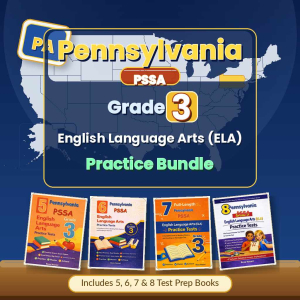 Pennsylvania Grade 3 English Language Arts (ELA) Preparation Bundle
 6 Pennsylvania PSSA English Language Arts (ELA) Grade 3: Full Practice Tests
 Pennsylvania PSSA Grade 3 ELA: 8 Full Practice Tests
 Pennsylvania PSSA Grade 3 ELA: 7 Full Practice Tests
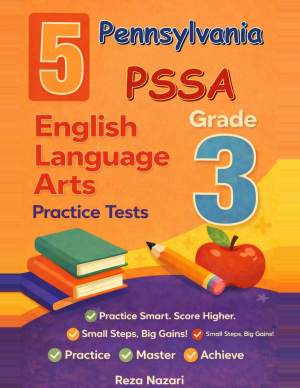 Pennsylvania PSSA Grade 3 ELA: 5 Full Practice Tests
More Grade 3 resources
A USEFUL NEXT STEP
Pennsylvania Grade 3 English: study questions
Does nonliteral language mean the writer made an error?
No. It can express an idea by comparison or emphasis. Use context to explain the intended meaning rather than take every phrase as a physical description.
Where are the complete Pennsylvania Grade 3 requirements?
Pennsylvania’s education department links the March 1, 2014 PA Core English documents for Pre K–5 and Grades 6–12. The state board identifies March 1, 2014 as the effective date. The code linked here is a selected Pennsylvania reading reference, not a generic Common Core label. Standards guide locally developed curricula; check the school’s reading, writing, language, speaking, and listening sequence.
Official source ↗Resources from Effortless Math · Editorial standards