LEARN · PRACTICE · EXPLORE
Oregon Grade 7 English
Analyze the roles of sections in an original Grade 7 information text, with Oregon English references and a worked explanation of its organization.
Focused lessons · Useful practice · Clear next steps
What do Oregon 7th graders learn in ELA?
In 7th grade, Oregon English language arts centers on how ideas and characters develop, comparing texts, and arguments with claims and counterclaims. Students take the OSAS grade 7 ELA test in the spring. This page explains each Oregon grade 7 ELA standard and pairs it with short lessons, printable worksheets and a full-length practice test.
Printable Oregon grade 7 ELA books:
Standards source: Oregon adopted content standards.
Trace How Sections Develop an Idea
Analyze the roles of sections in an original Grade 7 information text, with Oregon English references and a worked explanation of its organization. Connect the activity with the books and writing work assigned by the school.
Curriculum reference: Oregon English Language Arts and Literacy Standards, 2019 (transition reference), from the Oregon English language arts standards and transition page.
Oregon Grade 7 references for this activity
Oregon adopted new K–12 English language arts and literacy standards on June 18, 2026, with implementation scheduled for 2028–2029. This activity uses a selected 2019 reference during the transition. Confirm the school’s course sequence and edition before assigning standards-specific work. The adopted 2026 document has revised coding; do not treat an old reference label as a complete crosswalk.
| Selected Oregon reading reference | Activity focus | State-linked standards document |
|---|---|---|
| 7.RI.5 | Analyze how major sections contribute to the whole and develop ideas | Read the state-linked document (PDF page 65) |
For the upcoming implementation, read the 2026 adopted K–12 English language arts and literacy standards (PDF) and the state’s implementation timetable.
These selected reference labels identify an activity focus, with the correct grade and PDF page linked separately. Read the complete standards selected by the school and its learning sequence, including reading, writing, language, speaking, and listening. This short original example does not fulfill the entire curriculum or establish a student’s grade-level proficiency.
A plan for the shared supply drawer
This original classroom example is separate from official assessment questions.
The problem
A shared supply drawer can become difficult to use when materials have no clear places. A person may search through several compartments for one item.
A proposed arrangement
One class plans to sort supplies by task: measuring tools in one compartment, marking tools in another, and fastening tools in a third. This makes a likely use the organizing principle.
A complication
A tool may serve more than one task. Scissors, for example, can prepare material for measuring or cut pieces to fasten. The class proposes keeping a short index beside the drawer so readers can locate such items without guessing the category.
A next check
After trying the arrangement, the class should collect examples of items that were hard to find. Those examples can show whether the categories or index need revision.
Try the activity
Explain each section’s contribution to the whole text. How does “A complication” change the reader’s understanding of the proposed arrangement? Why does the final section follow it?
Follow the reasoning
The opening defines a practical access problem. The proposal then explains task-based sorting as a possible response. The complication qualifies that response: some tools do not fit one task neatly, so categories alone may leave uncertainty. Introducing an index addresses that limitation without claiming the first proposal must be abandoned. The final section turns the qualified plan into something to evaluate through actual examples of difficulty. Together the sections move from problem to proposal to limitation to a next check. The order develops an idea about organizing for use while accounting for exceptions. A response should show this progression instead of merely repeating the headings as a list.
Notice what needs more practice
This is an invented planning text, not a report of a tested arrangement. No search-time data or user results are supplied. The index is a proposal whose usefulness still needs checking; the final paragraph does not guarantee success.
Grade 7 English worksheets
Choose printable practice that matches the skill being taught. Check the task, reading difficulty, and directions before assigning it; the collection is independently published.
Use the next session to build independence
- Describe the purpose of each major section.
- Explain how the complication qualifies the proposal.
- Connect the final check with that unresolved limitation.
Read a teacher-selected article with major sections. Explain how its organization develops an idea, including any qualification or shift. Use details to show why the sections belong in that sequence.
For more general reading and writing resources, visit the Grade 7 English Online Center.
Oregon Grade 7 English: useful planning questions
Do headings alone explain an article’s structure?
No. They help locate sections, but the analysis must explain how their content connects and contributes to the whole.
Which standards does the school use?
Oregon adopted new K–12 English language arts and literacy standards on June 18, 2026, with implementation scheduled for 2028–2029. This activity uses a selected 2019 reference during the transition. Confirm the school’s course sequence and edition before assigning standards-specific work. The adopted 2026 document has revised coding; do not treat an old reference label as a complete crosswalk. The school’s sequence also includes reading, writing, speaking, listening, and language work beyond this example.
Sources checked October 6, 2026. The state’s English assessment overview includes the OSAS English summative test in Grades 3–8 and 11, including Grade 7. It also describes local speaking and writing performance assessments in Grades 3–8. Confirm the school’s assigned assessment pathway, current directions, and accommodations; this independent activity is not an official OSAS or local performance assessment. Read the Oregon English assessment overview and English standards and transition guidance. Independently published practice has its own directions and scoring. Its result does not predict a state performance level, and this original activity is not an official assessment item.
Grade 7 English in other states
When moving between school systems, compare the official curriculum and the school’s learning sequence. Use the national Online Center’s map to find another state’s resources.
Recommended Oregon Grade 7 resources
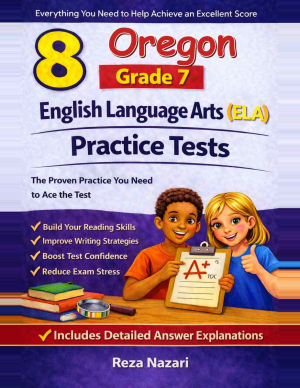
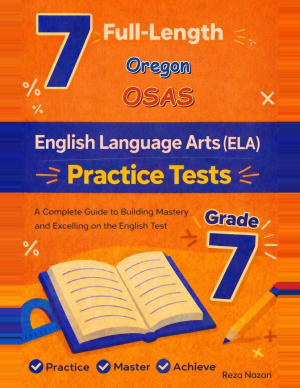
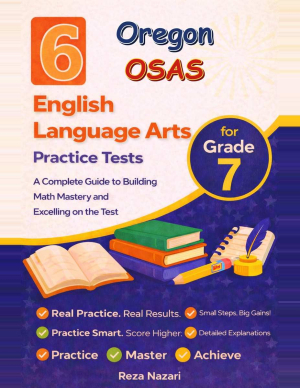
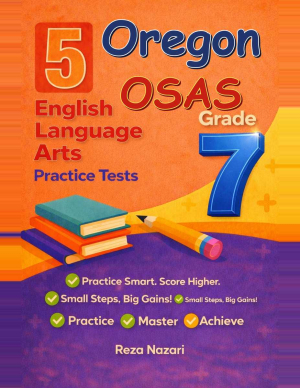
Build a Strong Oregon Grade 7 OSAS English Practice Library
These independently published resources have their own coverage and editions. Check the contents alongside Oregon’s current English standards before choosing assessment preparation.
Use these Oregon Grade 7 resources for reading comprehension, language, writing, and full-length practice where available. Click any cover to open the resource page.
More Grade 7 resources
A USEFUL NEXT STEP
Oregon Grade 7 English: study questions
Do headings alone explain an article’s structure?
No. They help locate sections, but the analysis must explain how their content connects and contributes to the whole.
Where are the complete Oregon Grade 7 requirements?
Oregon adopted new K–12 English language arts and literacy standards on June 18, 2026, with implementation scheduled for 2028–2029. This activity uses a selected 2019 reference during the transition. Confirm the school’s course sequence and edition before assigning standards-specific work. The adopted 2026 document has revised coding; do not treat an old reference label as a complete crosswalk.
Official source ↗Resources from Effortless Math · Editorial standards