LEARN · PRACTICE · EXPLORE
New Jersey Grade 7 English
Use New Jersey Grade 7 English resources to analyze an original archive article, connect several details to its central idea, and write an objective summary.
Focused lessons · Useful practice · Clear next steps
What do New Jersey 7th graders learn in ELA?
In 7th grade, New Jersey English language arts centers on how ideas and characters develop, comparing texts, and arguments with claims and counterclaims. Students take the NJSLA grade 7 ELA test in the spring. This page explains each New Jersey grade 7 ELA standard and pairs it with short lessons, printable worksheets and a full-length practice test.
Printable New Jersey grade 7 ELA books:
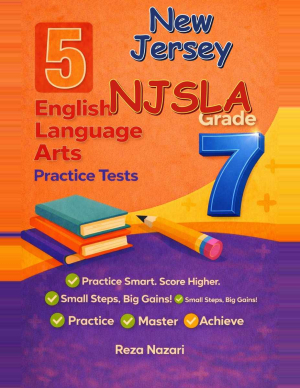
- 5 New Jersey NJSLA Grade 7 English Language Arts (ELA) Practice Tests
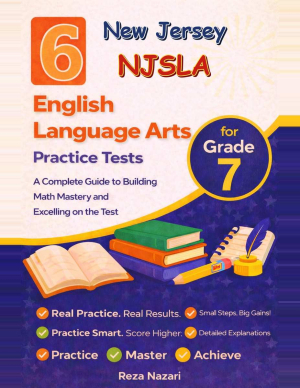
- 6 New Jersey NJSLA Grade 7 English Language Arts (ELA) Practice Tests
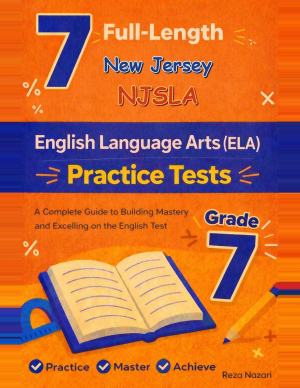
- 7 New Jersey NJSLA Grade 7 English Language Arts (ELA) Practice Tests
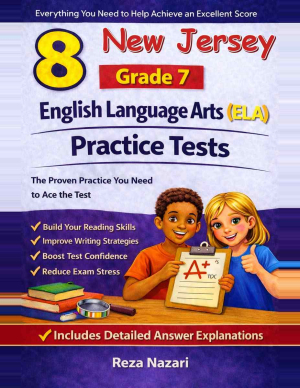
- 8 New Jersey NJSLA Grade 7 English Language Arts (ELA) Practice Tests
- New Jersey Grade 7 ELA Preparation Bundle
Standards source: 2023 New Jersey ELA standards.
Summarize a central idea without replacing it with your opinion
Use New Jersey Grade 7 English resources to analyze an original archive article, connect several details to its central idea, and write an objective summary. The selected 2023 New Jersey standards identify this activity’s focus; use the complete grade expectations and the school’s teaching sequence for broader planning.
Curriculum reference: 2023 New Jersey Student Learning Standards for English Language Arts, official grade page, from the official New Jersey ELA standards directory.
New Jersey Grade 7 references for this activity
The 2023 New Jersey Student Learning Standards for English Language Arts define grade-specific end-of-year expectations. These selected references point to the activity’s reading focus; the complete grade page also includes language, writing, speaking, and listening. Use the full expectations and the school’s teaching sequence when planning instruction.
| Selected state reference | Activity focus | Official grade page |
|---|---|---|
| RI.CR.7.1 | Cite several pieces of informational evidence | Read the complete grade expectations |
| RI.CI.7.2 | Explain a central idea and summarize without personal judgment | Read the complete grade expectations |
These selected reference labels identify an activity focus, with links to the official grade page. Read the complete New Jersey standards and the school’s learning sequence, including reading, writing, language, speaking, and listening. This short original example does not fulfill the entire curriculum or establish a student’s grade-level proficiency.
Why the archive kept the handwritten labels
This original classroom example is separate from official assessment questions.
A small school archive scanned its old sports photographs so classes could view them without handling the originals. The files included clear images, but the archive team soon noticed a problem. Some handwritten labels had been removed from the picture frames before scanning, leaving names and dates disconnected from the images.
The team photographed each loose label and linked it to the matching image when the match could be verified. If a label’s match was uncertain, the record said so instead of attaching it as a fact. Students could then see both the photograph and the information that helped explain it.
The archive kept the originals and recorded where each one was stored. Scanning made access easier, but the team treated the digital files as part of a larger record, not as replacements for every feature of the objects. Its revised instructions asked volunteers to record captions, labels, and uncertainty along with each scan.
Try the activity
Determine the article’s central idea. Explain how at least three details convey it. Then write a two-sentence summary that keeps the main development and excludes your personal opinion of the archive’s work.
Follow the reasoning
A supported central idea is that making a useful digital archive requires preserving and connecting contextual information, not only producing clear pictures. The missing names and dates show the problem created by separating labels from photographs. Linking verified labels helps restore that context. Marking uncertain matches protects readers from treating a guess as a fact. Keeping originals and their storage records preserves information beyond the scan. An objective summary can say: “A school archive found that some scanned photographs had become separated from their handwritten labels. The team linked verified labels to images, marked uncertain matches, and revised its instructions to record context as well as scans.” That summary states the article’s main development without adding “They did an amazing job” or “Scanning is always a mistake.” Those judgments are not needed to explain what the article says.
Notice what needs more practice
“The article is about old photographs” names the topic but misses its central idea. Listing every detail also fails to prioritize the main development. An objective summary can describe the archive’s actions and the reason for them without endorsing or condemning the project. The article does not claim every handwritten label is accurate; it focuses on retaining context and identifying uncertain matches. The school archive is invented for this reading activity.
Grade 7 English worksheets
Choose printable practice that matches the skill being taught. Check the task, reading difficulty, and directions before assigning it; the collection is independently published.
Use the next session to build independence
- Draft the central idea as a complete sentence about what the article explains.
- Choose details that show the initial problem and the response.
- Write a short summary, then remove personal praise, blame, and claims the article never makes.
Read a longer assigned informational article and make the same distinction among topic, central idea, supporting details, and personal response. Keep your own response in a separate paragraph. Check that the summary remains understandable to someone who has not read the full article.
For more general reading and writing resources, visit the Grade 7 English Online Center.
New Jersey Grade 7 English: useful planning questions
What makes a summary objective?
It represents the text’s central development and relevant details while keeping your personal judgments separate. It should neither add unsupported claims nor treat the author’s position as your own opinion.
Which standards does the school use?
The 2023 New Jersey Student Learning Standards for English Language Arts define grade-specific end-of-year expectations. These selected references point to the activity’s reading focus; the complete grade page also includes language, writing, speaking, and listening. Use the full expectations and the school’s teaching sequence when planning instruction. The school’s sequence also includes reading, writing, speaking, listening, and language work beyond this example.
Sources checked October 6, 2026. The official 2026–2027 schedule lists NJSLA-A ELA for Grades 3–9, including Grade 7. NJDOE describes ELA and mathematics as adaptive assessments. Confirm the learner’s assigned pathway and school directions. Read the official adaptive assessment overview, 2026–2027 statewide schedule, and 2023 ELA standards directory. Independently published practice has its own timing and scoring and does not predict a state performance level. Use the teacher’s sequence for further reading, writing, speaking, listening, and language work. This original activity is not an official assessment item.
Grade 7 English in other states
When moving between school systems, compare the official curriculum and the school’s learning sequence. Use the national Online Center’s map to find another state’s resources.
Recommended New Jersey Grade 7 resources
Build a Strong New Jersey Grade 7 NJSLA English Practice Library
These independently published resources have their own coverage and editions. Check the contents alongside New Jersey’s current English standards before choosing assessment preparation.
Use these New Jersey Grade 7 resources for reading comprehension, language, writing, and full-length practice where available. Click any cover to open the resource page.
More Grade 7 resources
A USEFUL NEXT STEP
New Jersey Grade 7 English: study questions
What makes a summary objective?
It represents the text’s central development and relevant details while keeping your personal judgments separate. It should neither add unsupported claims nor treat the author’s position as your own opinion.
Where are the complete New Jersey Grade 7 requirements?
The 2023 New Jersey Student Learning Standards for English Language Arts define grade-specific end-of-year expectations. These selected references point to the activity’s reading focus; the complete grade page also includes language, writing, speaking, and listening. Use the full expectations and the school’s teaching sequence when planning instruction.
Official source ↗Resources from Effortless Math · Editorial standards