LEARN · PRACTICE · EXPLORE
Missouri Grade 7 English
Practice Missouri Grade 7 English with an original authors’ organization of a shared topic lesson, worked response, state references, worksheets and study guidance.
Focused lessons · Useful practice · Clear next steps
What do Missouri 7th graders learn in ELA?
In 7th grade, Missouri English language arts centers on how ideas and characters develop, comparing texts, and arguments with claims and counterclaims. Students take the Missouri MAP grade 7 ELA test in the spring. This page explains each Missouri grade 7 ELA standard and pairs it with short lessons, printable worksheets and a full-length practice test.
Printable Missouri grade 7 ELA books:
Standards source: Missouri English Language Arts, Missouri Department of Elementary and Secondary Education.
Compare authors’ choices about structure
Two writers can discuss the same topic while organizing information differently. The original passages below concern a school’s found-property shelf. Compare how their order and wording guide the reader, rather than only listing facts they share.
Curriculum reference: Missouri Grades 6–12 English Language Arts expectations, from the Missouri Department of Elementary and Secondary Education ELA directory.
Missouri Grade 7 references for this activity
DESE’s current directory links the Missouri English Language Arts expectations adopted in April 2016. The Grades 6–12 PDF identifies a June 2020 update. References here name the selected strand, section, letter, and grade column in the state document; the 2026 download path is not a new adoption date. Read the complete expectations and the school’s curriculum to plan beyond this activity.
| Grade-level expectation | Activity focus | Official requirement |
|---|---|---|
| Reading Informational Text 3B · Grade 7 | Authors’ organization of a shared topic | Read the state framework (PDF page 11) |
These selected reference labels identify an activity focus, with the grade column and PDF page linked separately. Read the complete state requirements and the school’s sequence, including reading, writing, language, speaking, and listening. This short original example does not fulfill the entire curriculum or establish a student’s grade-level proficiency.
A worked Grade 7 reading investigation
This original classroom example is separate from official assessment questions.
Text A — How a lost item returns
A student brings a found item to the office. Staff record where it was found and place it on the found-property shelf. When someone asks about an item, staff check the description with them before returning it. These steps connect a found object with a person’s request.
Text B — Why descriptions matter
Several coats on a found-property shelf may be the same color. Color alone can leave staff uncertain which coat a person means. Describing another feature, such as a named label or a distinctive pocket, helps narrow the match. A description is therefore useful because it adds information beyond a broad category.
Try the activity
Compare the authors’ structural choices. How does each organize its explanation, and what does that choice help a reader understand? Identify a wording choice that supports each structure.
Follow the reasoning
Text A follows a process from arrival to recording to a possible return. Its order helps readers trace what happens at each stage. When introduces the point where a person’s request enters the process, while before clarifies the check preceding return. Text B begins with a difficulty: similar coat colors. It explains why that difficulty matters and how another descriptive feature can narrow a match. Therefore brings the explanation back to its conclusion about information. Both discuss identification, but A emphasizes a sequence and B explains a need and response. A comparison should connect each structural choice to its effect on the explanation, with evidence from both texts.
Notice what needs more practice
Text A does not guarantee that every found item is returned, and Text B does not say a distinctive pocket proves ownership on its own. These are invented reading passages, not a school’s actual policy. A time word in A is useful evidence because it supports the broader sequence; one isolated signal word would not be enough to classify every text. Text B’s example is part of its reasoning, not a report that all coats share one color. Calling both texts “about lost things” identifies the common topic but leaves the authors’ choices unexplained.
Grade 7 English worksheets
Choose printable practice that matches the skill being taught. Check the task, reading difficulty, and directions before assigning it; the collection is independently published.
Use the next session to build independence
- Describe what each passage does first, next, and last, using the actual ideas.
- Identify a structural choice and a supporting wording choice in each text.
- Write a comparison explaining how those choices shape what the reader understands.
Compare longer texts about a shared topic in the next session. Consider order, examples, transitions, and emphasis. If more than one structure appears, describe the main arrangement and explain where another approach contributes to it.
For more general reading and writing resources, visit the Grade 7 English Online Center.
Missouri Grade 7 English: useful planning questions
Is comparing shared facts enough to compare structure?
No. Explain how each author arranges those facts or ideas and how that arrangement supports the explanation. Use evidence from both texts.
Where are the complete state requirements?
DESE’s current directory links the Missouri English Language Arts expectations adopted in April 2016. The Grades 6–12 PDF identifies a June 2020 update. References here name the selected strand, section, letter, and grade column in the state document; the 2026 download path is not a new adoption date. Read the complete expectations and the school’s curriculum to plan beyond this activity. The school’s sequence also includes reading, writing, speaking, listening, and language work beyond this example.
Sources checked October 6, 2026. DESE lists MAP grade-level ELA assessments in Grades 3–8, including Grade 7. Follow the school’s assigned assessment pathway and current administration directions. Read the Missouri MAP grade-level overview and the DESE ELA directory for current guidance. Independently published practice may use its own timer, question count, and scoring; those features are not official administration specifications or a prediction of a state performance level. Use the complete standards and the school’s learning sequence to choose further reading, writing, speaking, listening, and language work. This original classroom activity is not an official assessment item.
Grade 7 English in other states
When moving between school systems, compare the official curriculum and the school’s learning sequence. Use the national Online Center’s map to find another state’s resources.
Recommended Missouri Grade 7 resources
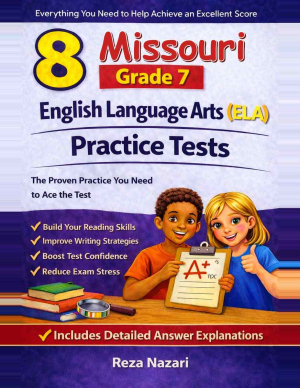
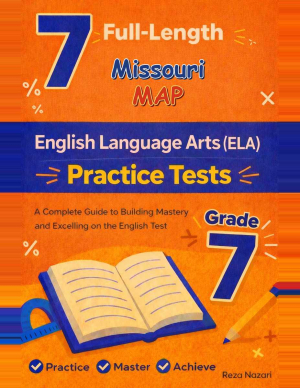
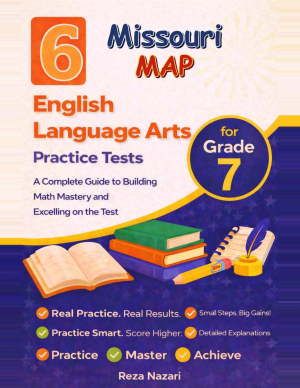
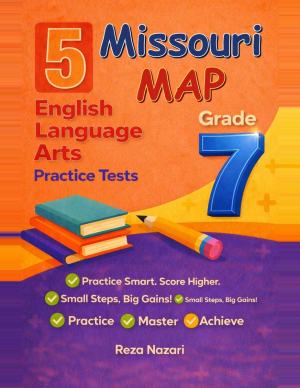
Build a Strong Missouri Grade 7 MAP English Practice Library
These independently published resources have their own coverage and editions. Check the contents alongside Missouri’s current English standards before choosing assessment preparation.
Use these Missouri Grade 7 resources for reading comprehension, language, writing, and full-length practice where available. Click any cover to open the resource page.
More Grade 7 resources
A USEFUL NEXT STEP
Missouri Grade 7 English: study questions
Is comparing shared facts enough to compare structure?
No. Explain how each author arranges those facts or ideas and how that arrangement supports the explanation. Use evidence from both texts.
Where are the complete Missouri Grade 7 requirements?
DESE’s current directory links the Missouri English Language Arts expectations adopted in April 2016. The Grades 6–12 PDF identifies a June 2020 update. References here name the selected strand, section, letter, and grade column in the state document; the 2026 download path is not a new adoption date. Read the complete expectations and the school’s curriculum to plan beyond this activity.
Official source ↗Resources from Effortless Math · Editorial standards