LEARN · PRACTICE · EXPLORE
Minnesota Grade 7 English
Compare two original versions of a kite-repair scene, analyze connotation, and explore Minnesota Grade 7 English learning benchmarks and resources.
Focused lessons · Useful practice · Clear next steps
What do Minnesota 7th graders learn in ELA?
In 7th grade, Minnesota English language arts centers on how ideas and characters develop, comparing texts, and arguments with claims and counterclaims. Students take the Minnesota MCA grade 7 ELA test in the spring. This page explains each Minnesota grade 7 ELA standard and pairs it with short lessons, printable worksheets and a full-length practice test.
Standards source: Minnesota English Language Arts, Minnesota Department of Education.
Compare the judgments carried by two words
Two words can describe a similar action while suggesting different judgments about it. Read these original literary versions and explain how the narrator’s choice affects your response.
Curriculum reference: 2020 Minnesota K–12 English Language Arts Standards, February 2024 corrected edition, from the Minnesota Department of Education academic standards directory.
Minnesota Grade 7 references for this activity
Use Minnesota’s 2020 English Language Arts standards, February 2024 corrected edition. The state implementation page identifies full implementation in 2025–26. These selected benchmarks support one activity; use the complete framework and the school’s sequence for curriculum planning.
| Grade-level expectation | Activity focus | Official requirement |
|---|---|---|
| 7.1.8.1 | Figurative and connotative meaning | Read the state framework (PDF page 69) |
These selected benchmark labels describe an activity focus. Read the complete state requirements and the school’s sequence, including the framework’s reading, writing, discussion, media-literacy, and Dakota and Anishinaabe perspectives requirements. This original example does not represent those communities or fulfill the entire curriculum.
A worked Grade 7 reading and writing activity
This original classroom example is separate from official assessment questions.
Version A
Amir returned to the damaged kite each afternoon, trying one new repair. His friends suggested buying another, but he kept the old frame on his worktable. He was steadfast.
Version B
Amir returned to the damaged kite each afternoon, trying one new repair. His friends suggested buying another, but he kept the old frame on his worktable. He was stubborn.
These are two deliberately revised versions of one invented scene. Neither gives the final result of the repairs.
Try the activity
Compare the meanings suggested by steadfast and stubborn. Which version presents Amir’s persistence more favorably? Explain how that judgment differs from the actions both versions actually describe.
Follow the reasoning
Both versions describe Amir continuing to work after friends suggest replacing the kite. Steadfast commonly suggests admirable firmness or commitment, encouraging a reader to value his persistence. Stubborn commonly suggests unwillingness to change, encouraging a less favorable judgment. The surrounding actions are identical, so the altered response comes mainly from the narrator’s final adjective. Neither word establishes that a repair succeeds. Nor does stubborn prove that the friends have offered a technically better solution. The comparison shows how connotation shapes a literary portrayal beyond a word’s broad reference to continued effort. A reader can distinguish the observable actions within the scene from the narrator’s evaluation of those actions.
Notice what needs more practice
Do not claim that the second Amir stops working or that the first one has better equipment: the versions do not change those details. Favorable wording also does not make a character correct in every situation. Context can complicate the usual associations of a word, so explain the effect in this passage rather than treat a dictionary label as a complete interpretation. If a student says stubborn means happy, ask which part of continuing despite advice supports that reading. The task concerns connotative language; a different passage is needed to develop the benchmark’s figurative-language work.
Grade 7 English worksheets
Choose printable practice that matches the skill being taught. Check the task, reading difficulty, and directions before assigning it; the collection is independently published.
Use the next session to build independence
- Underline the details that remain identical in both versions.
- Explain the usual association of each changed adjective.
- Separate a narrator’s judgment from a result the text does not supply.
Replace the last sentence with he continued the repairs, a more neutral description, and compare the resulting tone. Then add a clearly labeled new sentence in which Amir tests the kite and learns something from the result. Explain how the new context could support or complicate the narrator’s judgment. In a teacher-selected story, analyze another word with strong associations and connect it with the character’s actions. Discuss more than one defensible interpretation when the wording and context support it; keep textual evidence central.
For more general reading and writing resources, visit the Grade 7 English Online Center.
Minnesota Grade 7 English: useful planning questions
Does a favorable adjective prove that a character made the right choice?
No. It can guide the reader’s response without establishing the outcome. Compare the narrator’s wording with the actions and results the text actually supplies.
Where are the complete state requirements?
Use Minnesota’s 2020 English Language Arts standards, February 2024 corrected edition. The state implementation page identifies full implementation in 2025–26. These selected benchmarks support one activity; use the complete framework and the school’s sequence for curriculum planning. The school’s sequence also includes reading, writing, speaking, listening, and language work beyond this example.
Sources checked October 6, 2026. The state assessment-design page identifies Reading MCA-IV beginning in spring 2026 for Grades 3–8 and 10, including Grade 7. Follow the school’s assigned assessment pathway and current directions. Read the Minnesota assessment-design page, and MDE English implementation guidance for later guidance. Independently published practice may use its own timer, question count, and scoring; those features are not official administration specifications or a prediction of a state performance level. Use the complete standards and the school’s learning sequence to choose further reading, writing, speaking, listening, and language work. This original classroom activity is not an official assessment item.
Grade 7 English in other states
When moving between school systems, compare the official curriculum and the school’s learning sequence. Use the national Online Center’s map to find another state’s resources.
Recommended Minnesota Grade 7 resources
Build a Strong Minnesota Grade 7 MCA English Practice Library
These independently published resources have their own coverage and editions. Check the contents alongside Minnesota’s current English standards before choosing assessment preparation.
Use these Minnesota Grade 7 resources for reading comprehension, language, writing, and full-length practice where available. Click any cover to open the resource page.
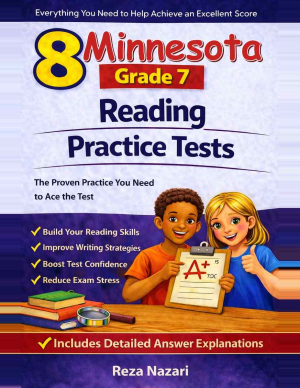
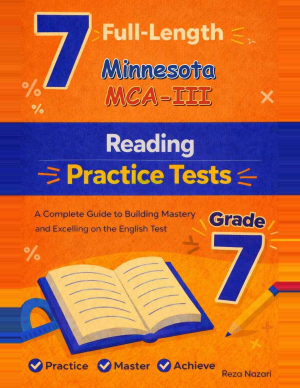
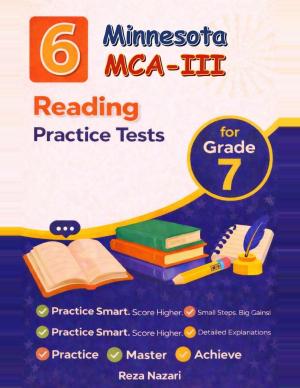
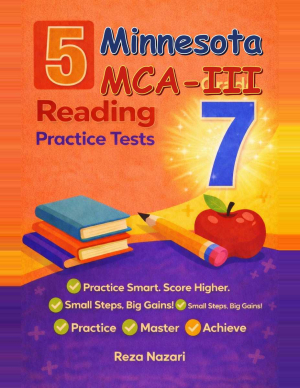
More Grade 7 resources
A USEFUL NEXT STEP
Minnesota Grade 7 English: study questions
Does a favorable adjective prove that a character made the right choice?
No. It can guide the reader’s response without establishing the outcome. Compare the narrator’s wording with the actions and results the text actually supplies.
Where are the complete Minnesota Grade 7 requirements?
Use Minnesota’s 2020 English Language Arts standards, February 2024 corrected edition. The state implementation page identifies full implementation in 2025–26. These selected benchmarks support one activity; use the complete framework and the school’s sequence for curriculum planning.
Official source ↗Resources from Effortless Math · Editorial standards