


LEARN · PRACTICE · EXPLORE
Indiana Grade 7 English
Revise an original sentence about a student and a display, explain a dangling modifier, and practice part of Indiana’s Grade 7 grammar expectation.
Focused lessons · Useful practice · Clear next steps
What do Indiana 7th graders learn in ELA?
In 7th grade, Indiana English language arts centers on how ideas and characters develop, comparing texts, and arguments with claims and counterclaims. Students take the ILEARN grade 7 ELA test in the spring. This page explains each Indiana grade 7 ELA standard and pairs it with short lessons, printable worksheets and a full-length practice test.
Printable Indiana grade 7 ELA books:

Indiana ILEARN Grade 7 ELA: Test Facts and Scores
Indiana 7th graders take ILEARN in English/language arts. It is a through-year test: three Checkpoints during the year and one summative test in spring. On the spring 2026 scale, 474 or higher is At Proficiency for Grade 7.
| Test | ILEARN Grade 7 English/Language Arts (computer adaptive) |
|---|---|
| Structure | Three Checkpoints plus a spring summative |
| Standards | 2023 Indiana Academic Standards |
Grade 7 ELA scale scores (updated spring 2026)
| Achievement level | Scale score |
|---|---|
| Below Proficiency | 316 to 417 |
| Approaching Proficiency | 418 to 473 |
| At Proficiency | 474 to 529 |
| Above Proficiency | 530 to 597 |
Practice on this page: Indiana standards
Indiana Grade 7 ELA testing questions
What ILEARN score is At Proficiency in Grade 7 ELA?
474. Above Proficiency starts at 530, and Approaching Proficiency starts at 418.
What are ILEARN Checkpoints?
Three shorter tests during the school year that each cover part of the standards. They inform teaching; the spring summative covers the full year.
Can Indiana ELA ILEARN scores be compared with earlier years?
Use care. IDOE updated the ELA and math performance standards starting with spring 2026, so the cut scores changed.
Facts from the Indiana Department of Education (IDOE), checked November 23, 2026: IDOE: ILEARN reporting scale, performance levels, and cut scores (published August 11, 2026); IDOE: ILEARN Through Year Assessment.
All 27 Indiana Grade 7 English/Language Arts Standards
Every Grade 7 standard in the 2023 Indiana Academic Standards for English/Language Arts, grouped by domain. ILEARN Grade 7 ELA measures these standards. Open a group to see its standards.
Reading Comprehension (13)
| 7.RC.1 | Analyze what a text says explicitly as well as draw inferences through citing several pieces of textual evidence. |
|---|---|
| 7.RC.2 | Analyze the development of a theme or central idea over the course of a work of literature; provide a detailed summary that supports the analysis. |
| 7.RC.3 | Analyze how a work of literature’s structural elements such as subplots, parallel episodes, climax, and conflicts contribute to its meaning and plot. |
| 7.RC.4 | Compare and contrast a fictional portrayal of a time, place, or character and a historical account of the same period as a means of understanding how authors of fiction use or alter history. |
| 7.RC.5 | Analyze the development of two or more central ideas over the course of a text; provide a detailed, objective summary of the text. |
| 7.RC.6 | Analyze the interactions between individuals, events, and ideas in a text (e.g., how ideas influence individuals or events or how individuals influence ideas or events). |
| 7.RC.7 | Determine an author’s perspective or purpose in a text, and analyze how the author distinguishes their position from the positions of others. |
| 7.RC.8 | Trace and evaluate the argument and specific claims in a text, assessing whether the reasoning is sound and the evidence is relevant and sufficient to support the claims, noting instances of bias and stereotyping. |
| 7.RC.9 | Analyze how two or more authors writing about the same topic shape their presentations of key information by emphasizing different evidence or advancing different interpretations of facts. |
| 7.RC.10 | Use context to determine or clarify the meaning of words and phrases. |
| 7.RC.11 | Use the relationship between particular words (e.g., synonym/antonym, analogy) to better understand each of the words. |
| 7.RC.12 | Distinguish among the connotations of words with similar denotations. |
| 7.RC.13 | Use common, grade-appropriate Greek or Latin affixes and roots as clues to the meaning of words (e.g., belligerent, bellicose, rebel). |
Writing (6)
| 7.W.1 | a. Introduce claim(s), acknowledge alternate or opposing claims, and use appropriate organizational structures. b. Support claim(s) with logical reasoning and relevant evidence, using accurate, credible sources and demonstrating an understanding of the topic or text. c. Establish and maintain a consistent style and tone appropriate for the purpose and audience. d. Use effective transitions to create cohesion and clarify the relationships among claim(s), reasons, and evidence. e. Provide a concluding statement or section that follows and supports the argument presented. Write informative compositions in a variety of forms that:. |
|---|---|
| 7.W.2 | a. Introduce a topic clearly, previewing what is to follow; organize ideas, concepts, and information using strategies such as definition and classification; include formatting (e.g., headings), graphics (e.g., charts, tables), and multimedia when useful to aid comprehension. b. Develop the topic with relevant facts, definitions, concrete details, quotations, or other information and examples from various sources and texts. c. Use appropriate transitions to create cohesion and clarify the relationships among ideas and concepts. d. Choose language and content-specific vocabulary that express ideas precisely and concisely, recognizing and eliminating wordiness and redundancy. e. Establish and maintain a style appropriate for the purpose and audience. f. Provide a concluding statement or section that follows and supports the information or explanation presented. Write narrative compositions in a variety of forms that:. |
| 7.W.3 | a. Engage and orient the reader by establishing a context and point of view and introducing a narrator and/or characters. b. Organize an event sequence (e.g., conflict, climax, resolution) that unfolds naturally and logically, using a variety of transition words, phrases, and clauses to convey sequence and signal shifts from one time frame or setting to another. c. Use narrative techniques, such as dialogue, pacing, and description, to develop experiences, events, and/or characters. d. Use precise words and phrases, relevant descriptive details, and sensory language to capture the action and convey experiences and events. e. Provide an ending that follows and reflects on the narrated experiences or events. Apply the writing process to all formal writing including but not limited to argumentative, informative, and narrative:. |
| 7.W.4 | a. Plan and develop, draft, and revise writing using appropriate reference materials. Rewrite, try a new approach, and edit to produce and strengthen writing that is clear and coherent with some guidance and support from peers and adults. b. Use technology to interact and collaborate with others to generate, produce, and publish writing and link to sources. |
| 7.W.5 | a. Formulate a research question. b. Gather relevant information from multiple sources, using search terms effectively and annotate sources. c. Assess the credibility and accuracy of each source. d. Quote or paraphrase the information and conclusions of others. e. Avoid plagiarism and follow a standard format for citation. f. Present information, choosing from a variety of formats. Demonstrate command of English grammar and usage, focusing on:. |
| 7.W.7 | a. Verbs – Recognizing and correcting problems with subject/verb agreement. b. Phrases and Clauses – Recognizing and correcting misplaced and dangling modifiers. c. Usage – Writing simple, compound, complex, and compound-complex sentences; recognizing and correcting sentence fragments and run-ons; varying sentence patterns for meaning, reader interest, and style. Demonstrate command of the conventions of standard English capitalization, punctuation, and spelling, focusing on: a. Punctuation – Using commas with subordinate clauses. |
Communication and Collaboration (8)
| 7.CC.1 | Engage effectively in a range of collaborative discussions (e.g., one-on-one, in groups, and teacher-led) on grade-appropriate topics, texts, and issues, building on others’ ideas and expressing personal ideas clearly. |
|---|---|
| 7.CC.2 | Pose questions that elicit elaboration and respond to others’ questions and comments with relevant observations and ideas that bring the discussion back on topic as needed. |
| 7.CC.3 | Acknowledge new information expressed by others, and consider it in relation to one's own views. |
| 7.CC.4 | Analyze the main ideas and supporting details presented in diverse media and formats (e.g., visually, quantitatively, orally), and explain how the ideas clarify a topic, text, or issue under study. |
| 7.CC.5 | Delineate a speaker’s argument and specific claims, evaluating the soundness of the reasoning, relevance, and sufficiency of the evidence. |
| 7.CC.6 | Present claims and findings, emphasizing salient points in a focused, coherent manner with pertinent descriptions, facts, details, and examples. Use appropriate eye contact, adequate volume, and clear pronunciation. |
| 7.CC.7 | Develop engaging presentations that include multimedia components and visual displays to clarify claims and findings and emphasize salient points. |
| 7.CC.8 | Analyze the ways that the media use words and images to attract the public's attention. |
Codes and wording from the IDOE standards document (examples and “E” essential markers are in the official document). Checked November 23, 2026: IDOE: 2023 Indiana Academic Standards, Grade 7 English/Language Arts; IDOE: Indiana Academic Standards for English/Language Arts (2023).
Standards source: Indiana English Language Arts, Indiana Department of Education.
Give an opening modifier the subject it describes
An opening phrase can suggest an action without naming its doer. The main clause needs to make the intended connection clear. This original example lets the reader check the sentence’s grammar against the event the writer means to describe.
Curriculum reference: 2023 Indiana Academic Standards: Grade 7 English/Language Arts, from the Indiana Department of Education standards directory.
Indiana Grade 7 references for this activity
Indiana’s 2023 English document includes Grade 7 expectations in the grade’s reading, writing, and communication domains. The expectations selected here support this activity; use the whole document and the school’s sequence for wider coverage.
| Grade-level expectation | Activity focus | Official requirement |
|---|---|---|
| 7.W.6 | Recognize and correct misplaced or dangling modifiers within the grammar expectation | Read the state document (PDF page 6) |
These are selected grade-level expectations from Indiana’s current English standards. Activity labels describe a teaching focus rather than reproduce complete requirements. Read the linked state document’s complete grade-level expectations, including its marked essential standards, alongside the school’s curriculum sequence.
A worked Grade 7 reading and writing activity
This original classroom example is separate from official assessment questions.
Walking into the room, the display caught Sam’s attention.
| Version | Main-clause subject | Connection |
|---|---|---|
| Walking into the room, the display caught Sam’s attention. | The display | Does not name Sam as the walker |
| Walking into the room, Sam noticed the display. | Sam | Clearly connects walking with Sam |
| As Sam walked into the room, the display caught Sam’s attention. | The display | Opening clause explicitly names Sam |
Try the activity
Who is supposed to be walking? Explain the problem with the opening modifier and revise the sentence to keep Sam as the person entering the room.
Follow the reasoning
Walking into the room describes the person doing the walking, but the main clause begins with the display as its subject. That arrangement appears to attach the walking to the display, although the intended walker is Sam. One revision is “Walking into the room, Sam noticed the display.” Another is “As Sam walked into the room, the display caught Sam’s attention.” Both make the walker explicit, while using different sentence structures. The first puts Sam directly after the opening phrase; the second gives the opening action its own subject and verb.
Notice what needs more practice
Simply inserting a comma does not repair the missing grammatical connection; the original already has one. Nor should a revision quietly invent a moving display to make the original literally possible. Establish the intended event, then arrange the sentence to express it. A misplaced modifier is a related problem in which position obscures what an expressed detail modifies. This example concentrates on a dangling opening phrase and does not replace the expectation’s work on agreement, sentence boundaries, and varied sentence patterns.
Grade 7 English worksheets
Choose printable practice that matches the skill being taught. Check the task, reading difficulty, and directions before assigning it; the collection is independently published.
Use the next session to build independence
- Identify the action in the opening phrase.
- Locate the main-clause subject and test the connection.
- Revise the sentence and confirm the intended actor and event.
Compare the two revisions aloud. Decide which best fits a longer paragraph and explain the choice without treating one structure as universally better. Next, write a sentence beginning “After opening the box…” and check that the subject that follows is the intended opener. For a related misplaced-modifier task, move a phrase in an original sentence and discuss how its position changes the apparent meaning. Keep the original intended event available so that revision improves clarity rather than inventing a different story.
For more general reading and writing resources, visit the Grade 7 English Online Center.
Indiana Grade 7 English: useful planning questions
Can adding a comma alone fix this dangling modifier?
No. The original already has a comma. The revision must connect the opening action clearly with the intended person.
Where are the complete state requirements?
Indiana’s 2023 English document includes Grade 7 expectations in the grade’s reading, writing, and communication domains. The expectations selected here support this activity; use the whole document and the school’s sequence for wider coverage. The school’s sequence also includes reading, writing, speaking, listening, and language work beyond this example.
Official sources checked October 6, 2026. Grade 7 is within the ILEARN English language arts testing range. This original lesson is independent practice. Read the Indiana assessment overview and use the school’s guidance for preparation. ILEARN’s through-year system measures English language arts and mathematics in Grades 3–8 with checkpoints and an end-of-year summative assessment. Follow the school’s current assessment assignment, accommodations, and guidance; this classroom activity is independent practice and does not predict a state performance level. This site’s practice and books are independently published. Check their editions and contents against current standards and assessment guidance.
Grade 7 English in other states
When moving between school systems, compare the official curriculum and the school’s learning sequence. Use the national Online Center’s map to find another state’s resources.
Recommended Indiana Grade 7 resources
Build a Strong Indiana Grade 7 ILEARN English Practice Library
These independently published resources have their own coverage and editions. Check the contents alongside Indiana’s current English standards before choosing assessment preparation.
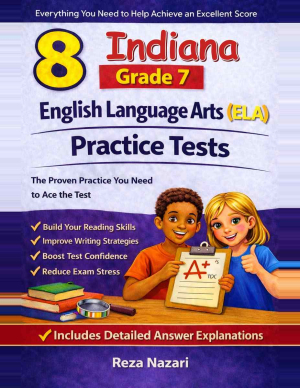
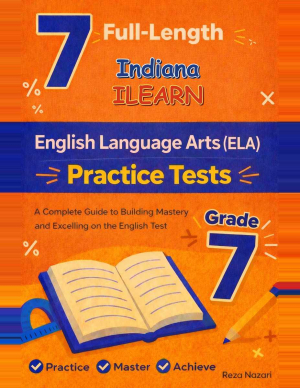
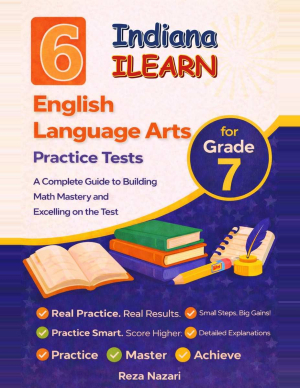
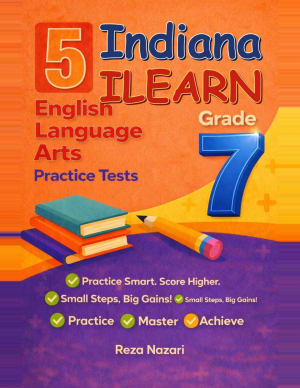
Use these Indiana Grade 7 resources for reading comprehension, language, writing, and full-length practice where available. Click any cover to open the resource page.
More Grade 7 resources
Choose another state
Grade 7 English in Every State
Select a state on the map to open its Grade 7 English page. You are viewing Indiana.
All states A–Z
A USEFUL NEXT STEP
Indiana Grade 7 English: study questions
Can adding a comma alone fix this dangling modifier?
No. The original already has a comma. The revision must connect the opening action clearly with the intended person.
Where are the complete Indiana Grade 7 requirements?
Indiana’s 2023 English document includes Grade 7 expectations in the grade’s reading, writing, and communication domains. The expectations selected here support this activity; use the whole document and the school’s sequence for wider coverage.
Official source ↗Resources from Effortless Math · Editorial standards