LEARN · PRACTICE · EXPLORE
North Dakota Grade 7 English
Analyze the limits of a first-person narrator’s view in an original Grade 7 story, with North Dakota English references and printable practice.
Focused lessons · Useful practice · Clear next steps
What do North Dakota 7th graders learn in ELA?
In 7th grade, North Dakota English language arts centers on how ideas and characters develop, comparing texts, and arguments with claims and counterclaims. Students take the NDSA grade 7 ELA test in the spring. This page explains each North Dakota grade 7 ELA standard and pairs it with short lessons, printable worksheets and a full-length practice test.
Printable North Dakota grade 7 ELA books:
- 5 North Dakota NDSA Grade 7 English Language Arts (ELA) Practice Tests
- 6 North Dakota NDSA Grade 7 English Language Arts (ELA) Practice Tests
- 7 North Dakota NDSA Grade 7 English Language Arts (ELA) Practice Tests
- 8 North Dakota NDSA Grade 7 English Language Arts (ELA) Practice Tests
- North Dakota Grade 7 ELA Preparation Bundle
Standards source: North Dakota adopted content standards.
Analyze a Narrator’s View
Analyze the limits of a first-person narrator’s view in an original Grade 7 story, with North Dakota English references and printable practice. Connect this activity with the school’s wider literacy sequence.
Curriculum reference: North Dakota English Language Arts Content Standards, June 2023, from the NDDPI English Language Arts standards page.
North Dakota Grade 7 references for this activity
NDDPI’s current English Language Arts page links the June 2023 K–12 standards. The document organizes literacy through foundations, communication, reading, writing, and inquiry/research; foundations apply through Grade 6, while later grades extend reading, writing, communication, and inquiry. Selected references here use the state document’s own grade and strand codes. Read the school’s complete course sequence alongside the full standards rather than treat one activity as an entire literacy program.
| Selected North Dakota reading reference | Activity focus | State-linked standards document |
|---|---|---|
| 7.R.8 | Analyze fiction: point of view and its effect (subpart b) | Read the state-linked document (PDF page 31) |
These selected reference labels identify an activity focus, with the correct grade and PDF page linked separately. Read the complete standards selected by the school and its learning sequence, including reading, writing, language, speaking, and listening. This short original example does not fulfill the entire curriculum or establish a student’s grade-level proficiency.
What I could not see from the doorway
This original classroom example is separate from official assessment questions.
I waited at the doorway while Dena worked inside. When she covered the table with a cloth, I thought she had abandoned our model. I nearly left. Then she opened the door and lifted one corner. Beneath it, the new pieces stood ready. “I wanted you to see the whole thing at once,” she said. I put down my bag and stepped closer.
Try the activity
Identify the narrator’s point of view. Explain how its limits create the narrator’s first interpretation and the reader’s later discovery. What can the narrator directly observe, and when do we receive Dena’s explanation?
Follow the reasoning
The first-person narrator reports personal observations and thoughts through “I.” From the doorway, the narrator sees a covered table but cannot see beneath the cloth. That limited view leads to the mistaken thought that Dena has abandoned the model. Readers receive the same incomplete information until Dena reveals the pieces and states her purpose. The point of view therefore helps create uncertainty and a later correction. Dena’s explanation comes through her spoken words; the narrator does not directly enter her thoughts. The final action of stepping closer shows renewed engagement, but the scene does not explain every stage of Dena’s work.
Notice what needs more practice
A first-person narrator can misinterpret an event without intentionally deceiving readers. Distinguish an observation, a thought based on it, and another person’s later explanation. The narrator’s identity and age are not given. Do not invent them or assign Dena an unstated motive beyond the explanation she supplies.
Grade 7 English worksheets
Choose printable practice that matches the skill being taught. Check the task, reading difficulty, and directions before assigning it; the collection is independently published.
Use the next session to build independence
- Identify the first-person wording.
- Separate observation from the narrator’s interpretation.
- Explain how new information changes what readers understand.
Compare this approach with a teacher-selected third-person scene. Explain what information each narrator can supply and how access to another character’s thoughts changes uncertainty. Use the actual narrative rather than assume every third-person narrator knows everything.
For more general reading and writing resources, visit the Grade 7 English Online Center.
North Dakota Grade 7 English: useful planning questions
Does first person make every statement a fact?
No. The narrator may report a perception or an interpretation. Check what is directly observed and what later evidence confirms or corrects.
Which standards does the school use?
NDDPI’s current English Language Arts page links the June 2023 K–12 standards. The document organizes literacy through foundations, communication, reading, writing, and inquiry/research; foundations apply through Grade 6, while later grades extend reading, writing, communication, and inquiry. Selected references here use the state document’s own grade and strand codes. Read the school’s complete course sequence alongside the full standards rather than treat one activity as an entire literacy program. The school’s sequence also includes reading, writing, speaking, listening, and language work beyond this example.
Sources checked October 6, 2026. The official 2026–2027 assessment-window page lists general ND A+ summative English language arts in Grades 3–8 and 10, including Grade 7, within March 15–May 7, 2027. Confirm the school’s actual day, the learner’s assigned assessment pathway, and accommodations. Read the NDDPI 2026–2027 assessment windows and current ELA standards resources. Independently published practice has its own directions and scoring. Its result does not predict a state performance level, and this original activity is not an official assessment item.
Grade 7 English in other states
When moving between school systems, compare the official curriculum and the school’s learning sequence. Use the national Online Center’s map to find another state’s resources.
Recommended North Dakota Grade 7 resources
Build a Strong North Dakota Grade 7 NDSA English Practice Library
These independently published resources have their own coverage and editions. Check the contents alongside North Dakota’s current English standards before choosing assessment preparation.
Use these North Dakota Grade 7 resources for reading comprehension, language, writing, and full-length practice where available. Click any cover to open the resource page.
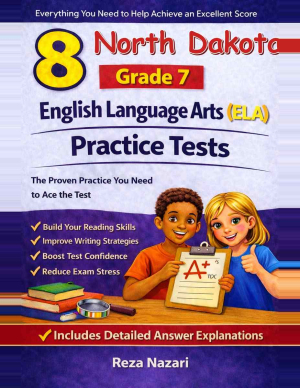
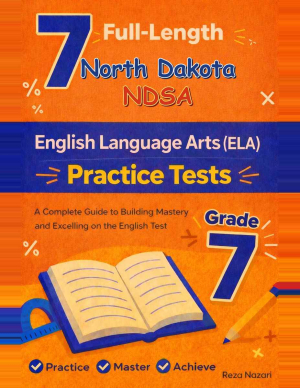
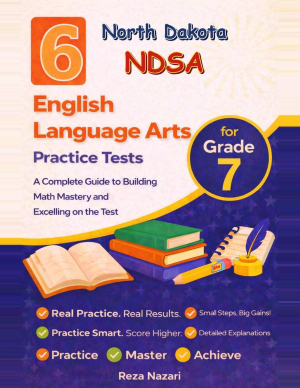
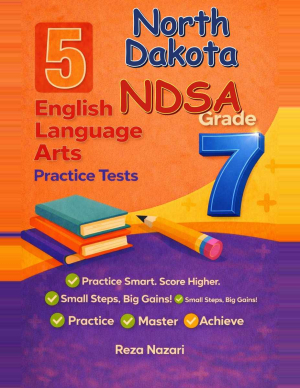
More Grade 7 resources
A USEFUL NEXT STEP
North Dakota Grade 7 English: study questions
Does first person make every statement a fact?
No. The narrator may report a perception or an interpretation. Check what is directly observed and what later evidence confirms or corrects.
Where are the complete North Dakota Grade 7 requirements?
NDDPI’s current English Language Arts page links the June 2023 K–12 standards. The document organizes literacy through foundations, communication, reading, writing, and inquiry/research; foundations apply through Grade 6, while later grades extend reading, writing, communication, and inquiry. Selected references here use the state document’s own grade and strand codes. Read the school’s complete course sequence alongside the full standards rather than treat one activity as an entire literacy program.
Official source ↗Resources from Effortless Math · Editorial standards