LEARN · PRACTICE · EXPLORE
North Carolina Grade 7 English
Analyze an author’s position and its distinction from another view in an original Grade 7 argument, with North Carolina English references and practice.
Focused lessons · Useful practice · Clear next steps
What do North Carolina 7th graders learn in ELA?
In 7th grade, North Carolina English language arts centers on how ideas and characters develop, comparing texts, and arguments with claims and counterclaims. Students take the EOG grade 7 ELA test in the spring. This page explains each North Carolina grade 7 ELA standard and pairs it with short lessons, printable worksheets and a full-length practice test.
Standards source: North Carolina adopted content standards.
Distinguish an Author’s Position
Analyze an author’s position and its distinction from another view in an original Grade 7 argument, with North Carolina English references and practice. Use this focused activity alongside the school’s wider reading, writing, speaking, listening, and language sequence.
Curriculum reference: 2017 North Carolina English Language Arts Standard Course of Study, from the North Carolina English Language Arts standards page.
North Carolina Grade 7 references for this activity
NCDPI identifies the 2017 English Language Arts Standard Course of Study as the current instructional reference for 2026–2027. Its newly adopted 2026 standards begin implementation in 2027–2028. The selected references here use the current 2017 document; consult the school’s wider reading, writing, speaking, listening, and language sequence and check the state resources page when planning for the transition.
| Selected North Carolina reading reference | Activity focus | State-linked standards document |
|---|---|---|
| RI.7.6 | Determine an author’s position and how it differs from others | Read the state-linked document (PDF page 24) |
These selected reference labels identify an activity focus, with the correct grade and PDF page linked separately. Read the complete standards selected by the school and its learning sequence, including reading, writing, language, speaking, and listening. This short original example does not fulfill the entire curriculum or establish a student’s grade-level proficiency.
A proposed quiet study period
This original classroom example is separate from official assessment questions.
Some students say that every lunchtime should remain completely open because it is the only time friends from different classes can meet. That concern deserves attention. Still, I propose a quiet study room on two lunchtimes each week, with attendance optional. Students who want conversation could keep using the usual lunch spaces. Students who need a calm place to finish work would have another choice. The school should try the plan for one month and ask both groups whether it meets their needs.
Try the activity
Identify the author’s position and the other view presented. Explain how the author distinguishes the proposal from that view. Does the author dismiss social time, require every student to study, or establish that the trial has already succeeded?
Follow the reasoning
The author supports an optional quiet room on two lunchtimes each week and a one-month trial. The other view favors keeping lunchtime entirely open for friends to meet. The author acknowledges that concern, then distinguishes the proposal through optional attendance and continued access to the usual lunch spaces. This reframes the choice as adding a space rather than requiring everyone to give up conversation. The final request for feedback makes success an open question. The passage therefore supplies a position and a response to another position, but no survey findings or completed trial results.
Notice what needs more practice
Do not replace the author’s limited proposal with “all students should study every lunchtime.” Identifying the competing view is part of analyzing how the author presents the position. A respectful tone does not by itself prove that the proposed room can be staffed or that both groups will be satisfied. This argument is invented for reading practice.
Grade 7 English worksheets
Choose printable practice that matches the skill being taught. Check the task, reading difficulty, and directions before assigning it; the collection is independently published.
Use the next session to build independence
- State the author’s precise proposal.
- Identify the competing concern in the text.
- Explain the response and distinguish a proposal from results.
Compare a teacher-selected argument that quotes or summarizes another position. Explain whether the author answers the actual concern, changes its terms, or leaves a question unresolved. Use evidence from the wording.
For more general reading and writing resources, visit the Grade 7 English Online Center.
North Carolina Grade 7 English: useful planning questions
Does acknowledging another view mean the author agrees with all of it?
No. Explain which concern the author accepts and how the proposed response still differs from the other position.
Which standards does the school use?
NCDPI identifies the 2017 English Language Arts Standard Course of Study as the current instructional reference for 2026–2027. Its newly adopted 2026 standards begin implementation in 2027–2028. The selected references here use the current 2017 document; consult the school’s wider reading, writing, speaking, listening, and language sequence and check the state resources page when planning for the transition. The school’s sequence also includes reading, writing, speaking, listening, and language work beyond this example.
Sources checked October 6, 2026. NCDPI’s March 2026 assessment brief describes reading EOG tests in Grades 3–8, including Grade 7. This is a scope reference, not a claim about every 2026–2027 administration detail. Confirm current school directions, the learner’s assigned assessment pathway, and accommodations. Read the March 2026 EOG assessment brief (PDF), NCDPI assessment briefs page, and current and upcoming ELA standards resources. Independently published practice has its own directions and scoring. Its result does not predict a state performance level, and this original activity is not an official assessment item.
Grade 7 English in other states
When moving between school systems, compare the official curriculum and the school’s learning sequence. Use the national Online Center’s map to find another state’s resources.
Recommended North Carolina Grade 7 resources
Build a Strong North Carolina Grade 7 EOG English Practice Library
These independently published resources have their own coverage and editions. Check the contents alongside North Carolina’s current English standards before choosing assessment preparation.
Use these North Carolina Grade 7 resources for reading comprehension, language, writing, and full-length practice where available. Click any cover to open the resource page.
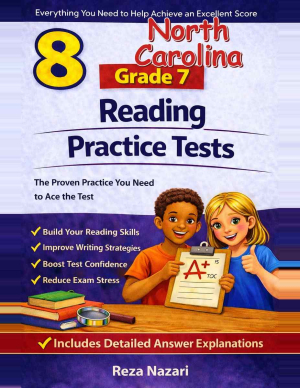
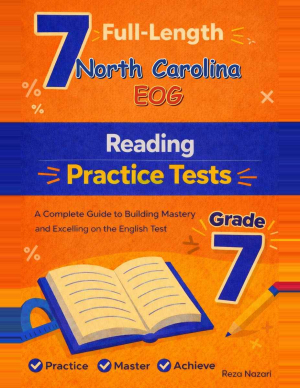
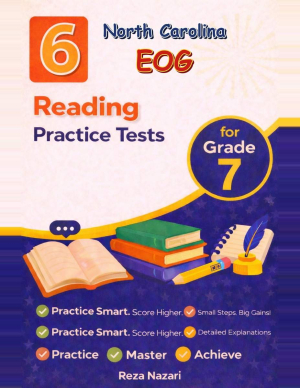
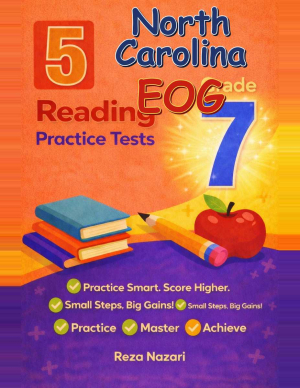
More Grade 7 resources
A USEFUL NEXT STEP
North Carolina Grade 7 English: study questions
Does acknowledging another view mean the author agrees with all of it?
No. Explain which concern the author accepts and how the proposed response still differs from the other position.
Where are the complete North Carolina Grade 7 requirements?
NCDPI identifies the 2017 English Language Arts Standard Course of Study as the current instructional reference for 2026–2027. Its newly adopted 2026 standards begin implementation in 2027–2028. The selected references here use the current 2017 document; consult the school’s wider reading, writing, speaking, listening, and language sequence and check the state resources page when planning for the transition.
Official source ↗Resources from Effortless Math · Editorial standards