LEARN · PRACTICE · EXPLORE
Michigan Grade 7 English
Evaluate an original library-hours argument, separate a small trial from a broad claim, and find Michigan Grade 7 English standards and practice resources.
Focused lessons · Useful practice · Clear next steps
What do Michigan 7th graders learn in ELA?
In 7th grade, Michigan English language arts centers on how ideas and characters develop, comparing texts, and arguments with claims and counterclaims. Students take the M-STEP grade 7 ELA test in the spring. This page explains each Michigan grade 7 ELA standard and pairs it with short lessons, printable worksheets and a full-length practice test.
Printable Michigan grade 7 ELA books:
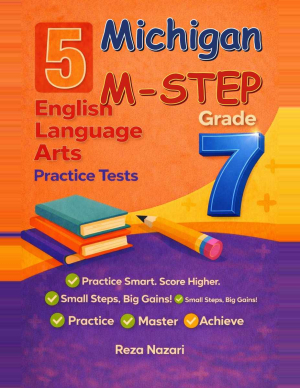
- 5 Michigan M-STEP Grade 7 English Language Arts (ELA) Practice Tests
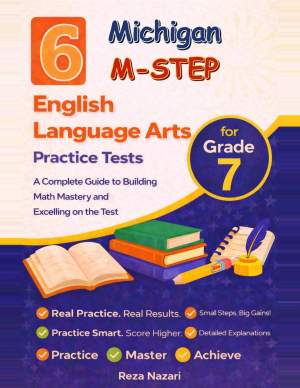
- 6 Michigan M-STEP Grade 7 English Language Arts (ELA) Practice Tests
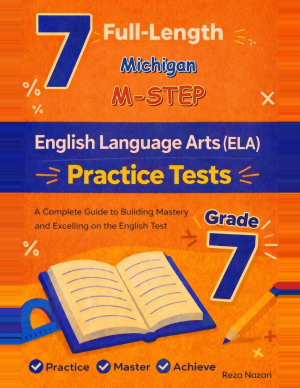
- 7 Michigan M-STEP Grade 7 English Language Arts (ELA) Practice Tests
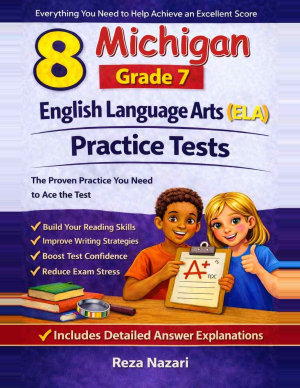
- 8 Michigan M-STEP Grade 7 English Language Arts (ELA) Practice Tests
- Michigan Grade 7 ELA Preparation Bundle
Standards source: Michigan English Language Arts, Michigan Department of Education.
Evaluate whether evidence is sufficient for a claim
Evidence may relate to a claim and still be too limited to support its full reach. Look at who was observed, when, and what was actually measured.
Curriculum reference: Michigan K–12 English Language Arts Standards, from the Michigan Department of Education academic standards directory.
Michigan Grade 7 references for this activity
The state’s academic standards directory links the Michigan K–12 English Language Arts Standards, adopted by the State Board of Education in 2010. Read the individual Grade 7 requirements and the school’s sequence. These selected references support this activity; they do not cover the whole English curriculum.
| Grade-level expectation | Activity focus | Official requirement |
|---|---|---|
| RI.7.8 | Assess reasoning and relevant, sufficient evidence | Read the state framework (PDF page 39) |
| RI.7.1 | Several pieces of evidence supporting analysis | Read the state framework (PDF page 39) |
These are selected grade-level expectations from the currently linked Michigan English standards adopted in 2010. Activity labels describe a teaching focus rather than reproduce complete requirements. Read the linked state document’s complete grade-level expectations, including its grade-specific details, alongside the school’s curriculum sequence.
A worked Grade 7 reading and writing activity
This original classroom example is separate from official assessment questions.
The club should keep its reading room open every afternoon, the newsletter argues. Four volunteers used the room during a single Tuesday trial, and all four said the quiet space helped them finish their assignments. Therefore, every club member will benefit every afternoon. The room already has tables and lights, so there would be no further work involved. The club has not yet checked who would supervise the room or whether members can attend on other days. These invented statements are supplied for evaluating the argument.
Try the activity
Separate the proposal, the reported trial, and the broad conclusion. Explain whether the trial evidence is relevant and sufficient for the claim about every member every afternoon. Evaluate the claim that no further work is involved using the passage’s final information.
Follow the reasoning
The proposal is to open the room each afternoon. Four volunteers reporting a helpful quiet space is relevant to whether the room might help some members, but one Tuesday and four self-selected participants do not establish benefit for every member on every day. The argument expands from a small observed group to an unrestricted conclusion. Having tables and lights relates to existing equipment, yet it does not settle supervision or attendance; the passage explicitly says those questions are unchecked. A careful evaluation can acknowledge the trial’s usefulness while identifying the gap between what it supports and what the author asserts.
Notice what needs more practice
Calling the proposal definitely useless would make another unsupported leap. Insufficient evidence for a universal claim is not proof of the opposite. Ask students to distinguish relevance from sufficiency: a Tuesday trial concerns the room’s use, but its scope is limited. Reported completion is also not an independently verified measure of long-term learning. Several relevant details should support the evaluation, including the volunteer group, single day, and unanswered supervision question. This is an invented reading task rather than a decision about a real club’s staffing or spending.
Grade 7 English worksheets
Choose printable practice that matches the skill being taught. Check the task, reading difficulty, and directions before assigning it; the collection is independently published.
Use the next session to build independence
- Underline the exact reach of the claim.
- Identify the people, time, and outcome in the evidence.
- Explain a supported conclusion and what remains untested.
Revise the newsletter conclusion to fit the available record, such as proposing a broader trial while noting the initial volunteers’ reports. Identify additional information that would address attendance on other days and supervision needs. Explain how each would answer a specific gap rather than gather unrelated facts. Next, evaluate a teacher-selected argument, tracing its claims and evidence before deciding whether the reasoning is sound. A confident tone should not replace a sufficient record. Keep this focused task alongside the school’s sustained nonfiction reading and argument-writing work.
For more general reading and writing resources, visit the Grade 7 English Online Center.
Michigan Grade 7 English: useful planning questions
Does limited evidence prove the proposal is wrong?
No. It may support a narrower conclusion or justify further investigation. Explain what the evidence shows and which broader claims remain unsupported.
Where are the complete state requirements?
The state’s academic standards directory links the Michigan K–12 English Language Arts Standards, adopted by the State Board of Education in 2010. Read the individual Grade 7 requirements and the school’s sequence. These selected references support this activity; they do not cover the whole English curriculum. The school’s sequence also includes reading, writing, speaking, listening, and language work beyond this example.
Sources checked October 6, 2026. The currently linked 2025–26 state guide identifies M-STEP English language arts and mathematics in Grades 3–7, including Grade 7. Follow the school’s current assigned assessment pathway and directions. Read the state assessment guide, PDF page 24, and MDE assessment updates for later guidance. Independently published practice may use its own timer, question count, and scoring; those features are not official administration specifications or a prediction of a state performance level. Use the complete standards and the school’s learning sequence to choose further reading, writing, speaking, listening, and language work. This original classroom activity is not an official assessment item.
Grade 7 English in other states
When moving between school systems, compare the official curriculum and the school’s learning sequence. Use the national Online Center’s map to find another state’s resources.
Recommended Michigan Grade 7 resources
Build a Strong Michigan Grade 7 M-STEP English Practice Library
These independently published resources have their own coverage and editions. Check the contents alongside Michigan’s current English standards before choosing assessment preparation.
Use these Michigan Grade 7 resources for reading comprehension, language, writing, and full-length practice where available. Click any cover to open the resource page.
More Grade 7 resources
A USEFUL NEXT STEP
Michigan Grade 7 English: study questions
Does limited evidence prove the proposal is wrong?
No. It may support a narrower conclusion or justify further investigation. Explain what the evidence shows and which broader claims remain unsupported.
Where are the complete Michigan Grade 7 requirements?
The state’s academic standards directory links the Michigan K–12 English Language Arts Standards, adopted by the State Board of Education in 2010. Read the individual Grade 7 requirements and the school’s sequence. These selected references support this activity; they do not cover the whole English curriculum.
Official source ↗Resources from Effortless Math · Editorial standards