LEARN · PRACTICE · EXPLORE
New Hampshire Grade 7 English
Practice New Hampshire Grade 7 English by testing a fictional school proposal, judging relevant evidence, and using selected references with printable resources.
Focused lessons · Useful practice · Clear next steps
What do New Hampshire 7th graders learn in ELA?
In 7th grade, New Hampshire English language arts centers on how ideas and characters develop, comparing texts, and arguments with claims and counterclaims. Students take the NH SAS grade 7 ELA test in the spring. This page explains each New Hampshire grade 7 ELA standard and pairs it with short lessons, printable worksheets and a full-length practice test.
Printable New Hampshire grade 7 ELA books:
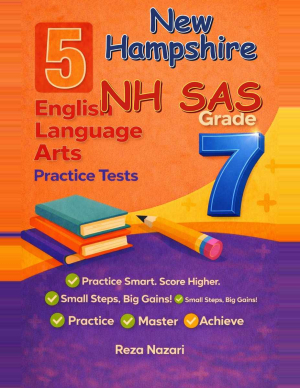
- 5 New Hampshire NH SAS Grade 7 English Language Arts (ELA) Practice Tests
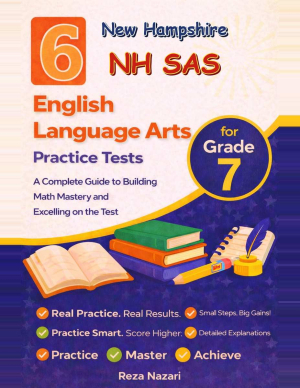
- 6 New Hampshire NH SAS Grade 7 English Language Arts (ELA) Practice Tests
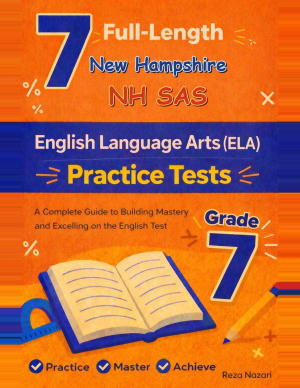
- 7 New Hampshire NH SAS Grade 7 English Language Arts (ELA) Practice Tests
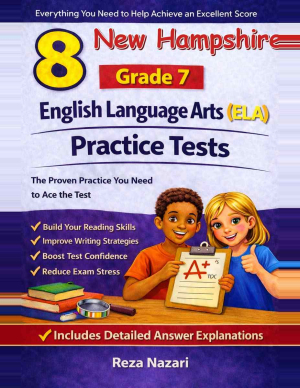
- 8 New Hampshire NH SAS Grade 7 English Language Arts (ELA) Practice Tests
- New Hampshire Grade 7 ELA Preparation Bundle
Standards source: New Hampshire school-approval rules, Ed 306.29.
Grade 7: ask whether evidence supports the actual claim
Evidence can be relevant to a proposal without being sufficient to justify its full claim. This original argument-reading activity makes that distinction concrete. Students trace a recommendation, inspect the scope of a small survey, and identify what remains unknown. The numbers are invented for reading practice and describe no real New Hampshire school.
Curriculum reference: 2010 Common Core ELA/literacy standards, original publisher’s document, from the New Hampshire school-approval rules (Ed 306.29).
New Hampshire Grade 7 references for this activity
New Hampshire’s current school-approval rules, Ed 306.29, allow local boards to use the adopted 2010 Common Core English standards or approved alternative academic standards. Confirm the school’s choice and competencies first. The selected Common Core references here were checked in the original publisher’s 2010 document, using the correct grade column. These references identify this activity’s focus and are not a complete local curriculum checklist.
| Selected Common Core reference | Activity focus | Publisher’s document |
|---|---|---|
| RI.7.8 | Evaluate reasoning and the relevance and sufficiency of evidence | Read the publisher’s document (PDF page 39) |
These selected reference labels identify an activity focus, with the grade column and PDF page linked separately. Read the complete standards selected by the school and its learning sequence, including reading, writing, language, speaking, and listening. This short original example does not fulfill the entire curriculum or establish a student’s grade-level proficiency.
Does a small preference survey justify an all-school change?
This original classroom example is separate from official assessment questions.
Our school should replace every lunchtime club meeting with an art workshop. In a survey of twelve members of our art club, ten said they would attend the workshop. This proves the workshop would be the best choice for everyone. Art workshops can give students another place to share their work, so the school should make the change next month.
Try the activity
Identify the proposal and separate its reasons from its evidence. Explain what the survey supports and what it does not establish. Suggest evidence that would help evaluate the broader recommendation.
Follow the reasoning
The proposal is to replace every lunchtime club meeting with an art workshop. The survey supports a narrower conclusion: ten of the twelve surveyed art-club members expressed interest in attending. That is relevant to likely interest within this group, but it does not establish the preferences of all students or compare the benefits of every existing club. The opportunity to share work is a reason to consider a workshop. It does not by itself justify removing other options. A wider inquiry could include students from several clubs, students who attend no club, available space and staffing, and the possible effects of keeping both kinds of activity.
Notice what needs more practice
Do not confuse finding a weakness with proving the opposite proposal. The survey does not show that nobody else would attend, or that an art workshop is a bad idea. The problem is the jump from a small interested group to “best for everyone.” More data are useful only when they answer the decision’s actual questions. A large count of unrelated facts would not repair the reasoning.
Grade 7 English worksheets
Choose printable practice that matches the skill being taught. Check the task, reading difficulty, and directions before assigning it; the collection is independently published.
Use the next session to build independence
- Write the proposed change in one sentence. Mark the survey result separately from the writer’s broader conclusion.
- Explain why the surveyed group limits the conclusion, and identify a reason that is relevant but incomplete.
- Revise the proposal so it matches the current evidence, or design a broader evidence-gathering plan. Explain what new information could change the recommendation.
Read a longer classroom argument and trace how each reason connects to the claim. For every source, ask who or what it represents and whether it addresses the proposal. Practice respectful disagreement by describing the reasoning problem precisely, rather than judging the writer’s character.
For more general reading and writing resources, visit the Grade 7 English Online Center.
New Hampshire Grade 7 English: useful planning questions
Does incomplete evidence prove a proposal is wrong?
No. The small survey supports interest among the surveyed art-club members. It does not settle whether replacing all clubs is justified. A sound evaluation distinguishes an unsupported broad conclusion from proof of its opposite.
Which standards does the school use?
New Hampshire’s current school-approval rules, Ed 306.29, allow local boards to use the adopted 2010 Common Core English standards or approved alternative academic standards. Confirm the school’s choice and competencies first. The selected Common Core references here were checked in the original publisher’s 2010 document, using the correct grade column. These references identify this activity’s focus and are not a complete local curriculum checklist. The school’s sequence also includes reading, writing, speaking, listening, and language work beyond this example.
Sources checked October 6, 2026. The 2025–2026 public NH SAS manual describes general ELA testing in Grades 3–8, including Grade 7, with reading and writing sessions. Confirm the learner’s assigned pathway and the school’s current directions. Read the public NH SAS manual resource page, students and families portal and school-approval rules. The manual reviewed here is the 2025–2026 edition; confirm later-year directions with the school. Independently published practice has its own timing and scoring and does not predict a state performance level. Use local competencies and the teacher’s sequence for further reading, writing, speaking, listening, and language work. This original activity is not an official assessment item.
Grade 7 English in other states
When moving between school systems, compare the official curriculum and the school’s learning sequence. Use the national Online Center’s map to find another state’s resources.
Recommended New Hampshire Grade 7 resources
Build a Strong New Hampshire Grade 7 NH SAS English Practice Library
These independently published resources have their own coverage and editions. Check the contents alongside New Hampshire’s current English standards before choosing assessment preparation.
Use these New Hampshire Grade 7 resources for reading comprehension, language, writing, and full-length practice where available. Click any cover to open the resource page.
More Grade 7 resources
A USEFUL NEXT STEP
New Hampshire Grade 7 English: study questions
Does incomplete evidence prove a proposal is wrong?
No. The small survey supports interest among the surveyed art-club members. It does not settle whether replacing all clubs is justified. A sound evaluation distinguishes an unsupported broad conclusion from proof of its opposite.
Where are the complete New Hampshire Grade 7 requirements?
New Hampshire’s current school-approval rules, Ed 306.29, allow local boards to use the adopted 2010 Common Core English standards or approved alternative academic standards. Confirm the school’s choice and competencies first. The selected Common Core references here were checked in the original publisher’s 2010 document, using the correct grade column. These references identify this activity’s focus and are not a complete local curriculum checklist.
Official source ↗Resources from Effortless Math · Editorial standards