LEARN · PRACTICE · EXPLORE
New York Grade 7 English
Evaluate an original Grade 7 argument about a study-room proposal, distinguish relevant evidence from distractions, and find New York English practice.
Focused lessons · Useful practice · Clear next steps
What do New York 7th graders learn in ELA?
In 7th grade, New York English language arts centers on how ideas and characters develop, comparing texts, and arguments with claims and counterclaims. Students take the New York State grade 7 ELA test in the spring. This page explains each New York grade 7 ELA standard and pairs it with short lessons, printable worksheets and a full-length practice test.
Printable New York grade 7 ELA books:
- 5 New York NYSTP Grade 7 English Language Arts (ELA) Practice Tests
- 6 New York NYSTP Grade 7 English Language Arts (ELA) Practice Tests
- 7 New York NYSTP Grade 7 English Language Arts (ELA) Practice Tests
- 8 New York NYSTP Grade 7 English Language Arts (ELA) Practice Tests
- New York Grade 7 ELA Preparation Bundle
Standards source: New York adopted content standards.
Relevant & Sufficient Evidence
Evaluate an original Grade 7 argument about a study-room proposal, distinguish relevant evidence from distractions, and find New York English practice. Use this focused activity alongside the school’s wider reading, writing, speaking, listening, and language sequence.
Curriculum reference: 2017 New York State Next Generation English Language Arts Learning Standards, from the New York English Language Arts standards page.
New York Grade 7 references for this activity
New York’s English Language Arts page links the 2017 Next Generation ELA Learning Standards. The state’s implementation timeline places Pre-K–8 instruction under those standards from September 2022, with Grades 3–8 assessment first aligned in Spring 2023. The selected reading references below identify this activity’s focus; use the complete grade requirements and the school’s broader literacy program.
| Selected New York reading reference | Activity focus | State-hosted standards document |
|---|---|---|
| 7R1 | Cite evidence for analysis | Read the state-hosted document (PDF page 82) |
| 7R8 | Assess reasoning and the relevance and sufficiency of evidence | Read the state-hosted document (PDF page 82) |
These selected reference labels identify an activity focus, with the correct grade and PDF page linked separately. Read the complete standards selected by the school and its learning sequence, including reading, writing, language, speaking, and listening. This short original example does not fulfill the entire curriculum or establish a student’s grade-level proficiency.
Does one trial justify every afternoon?
This original classroom example is separate from official assessment questions.
Invented proposal
The library should keep the quiet study room open every afternoon. On a trial Tuesday, twelve students used it after school, and nine said they found it helpful. That proves the room would be full every day. The school team won its Saturday match, so our community clearly values achievement. A daily study room would require no additional staff because the room already exists. We should approve the plan immediately.
Invented trial note
Twelve students visited during the single Tuesday trial. Nine returned a comment card saying the room helped them study. A staff member supervised that session; staffing for other afternoons has not been decided.
Try the activity
Trace the proposal from claim to supporting reasons. Which evidence is relevant to possible demand, and which is irrelevant? Explain two ways the conclusion exceeds the evidence. Does the trial prove the proposal should be rejected?
Follow the reasoning
The main claim asks for opening every afternoon. Twelve users and nine favorable comment cards are relevant evidence of interest and reported usefulness during one session. They do not show room capacity or demand on other days, so they cannot prove daily full use. The match result concerns a different activity and does not establish study-room demand or staffing. The existing room shows physical space is present, but does not show supervision will cost nothing; the trial note explicitly records a staff member and an undecided future arrangement. The evidence supports considering the proposal, not the certainty or urgency attached to it. Additional attendance observations on different days, capacity information, and a staffing plan would address the gaps. Missing evidence does not establish the opposite claim either.
Notice what needs more practice
Nine favorable cards out of twelve visitors leave three visitors’ views unreported; they are not necessarily unfavorable. A trial is neither a guarantee of daily success nor proof of failure. Recognize the invalid step from an existing room to zero staffing need. These texts and quantities are invented, not a report about a New York library.
Grade 7 English worksheets
Choose printable practice that matches the skill being taught. Check the task, reading difficulty, and directions before assigning it; the collection is independently published.
Use the next session to build independence
- State the main claim without persuasive wording.
- Match each reason with relevant supporting evidence.
- Identify a gap and specify what evidence would address it.
Write a revised proposal that retains the useful trial information and identifies conditions still to resolve. Compare how the original and revised versions distinguish evidence, prediction, and decision. For wider reading, apply the same method to a teacher-selected argument with a clear author and publication context.
For more general reading and writing resources, visit the Grade 7 English Online Center.
New York Grade 7 English: useful planning questions
Does insufficient evidence prove a claim is false?
No. It means the supplied evidence does not establish the claim. Explain the gap and what further evidence could support or challenge it.
Which standards does the school use?
New York’s English Language Arts page links the 2017 Next Generation ELA Learning Standards. The state’s implementation timeline places Pre-K–8 instruction under those standards from September 2022, with Grades 3–8 assessment first aligned in Spring 2023. The selected reading references below identify this activity’s focus; use the complete grade requirements and the school’s broader literacy program. The school’s sequence also includes reading, writing, speaking, listening, and language work beyond this example.
Sources checked October 6, 2026. The 2026–2027 NYSED schedule places Grades 3–8 ELA, including Grade 7, in an April 5–May 14, 2027 window. Each school sets its grade/subject administration dates within that window; ELA uses two consecutive school days. Confirm the learner’s assigned pathway, accommodations, and current school directions. Read the official 2026–2027 testing schedule (PDF), NYSED schedules page, ELA standards page, and instruction and assessment implementation timeline (PDF). Independently published practice has its own directions and scoring. Its result does not predict a state performance level, and this original activity is not an official assessment item.
Grade 7 English in other states
When moving between school systems, compare the official curriculum and the school’s learning sequence. Use the national Online Center’s map to find another state’s resources.
Recommended New York Grade 7 resources
Build a Strong New York Grade 7 NYSTP English Practice Library
These independently published resources have their own coverage and editions. Check the contents alongside New York’s current English standards before choosing assessment preparation.
Use these New York Grade 7 resources for reading comprehension, language, writing, and full-length practice where available. Click any cover to open the resource page.
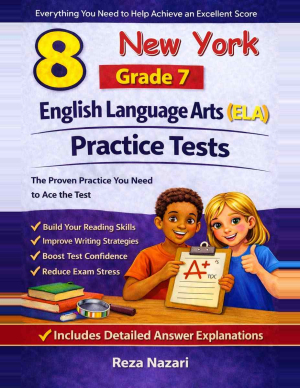
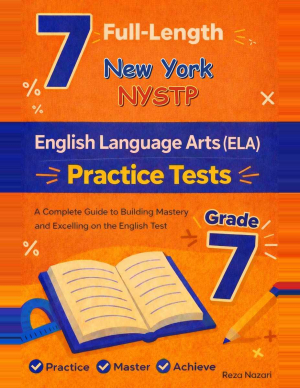
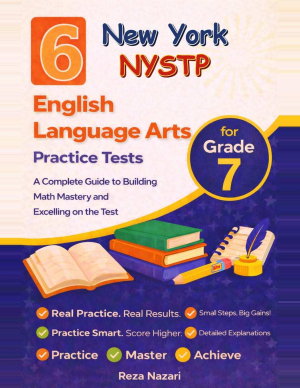
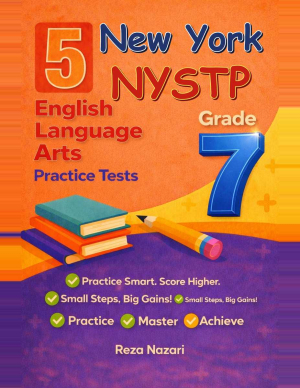
More Grade 7 resources
A USEFUL NEXT STEP
New York Grade 7 English: study questions
Does insufficient evidence prove a claim is false?
No. It means the supplied evidence does not establish the claim. Explain the gap and what further evidence could support or challenge it.
Where are the complete New York Grade 7 requirements?
New York’s English Language Arts page links the 2017 Next Generation ELA Learning Standards. The state’s implementation timeline places Pre-K–8 instruction under those standards from September 2022, with Grades 3–8 assessment first aligned in Spring 2023. The selected reading references below identify this activity’s focus; use the complete grade requirements and the school’s broader literacy program.
Official source ↗Resources from Effortless Math · Editorial standards