LEARN · PRACTICE · EXPLORE
Massachusetts Grade 7 English
Compare two original reports that emphasize different evidence, explain their interpretations, and find Massachusetts Grade 7 English references.
Focused lessons · Useful practice · Clear next steps
What do Massachusetts 7th graders learn in ELA?
In 7th grade, Massachusetts English language arts centers on how ideas and characters develop, comparing texts, and arguments with claims and counterclaims. Students take the MCAS grade 7 ELA test in the spring. This page explains each Massachusetts grade 7 ELA standard and pairs it with short lessons, printable worksheets and a full-length practice test.
Printable Massachusetts grade 7 ELA books:
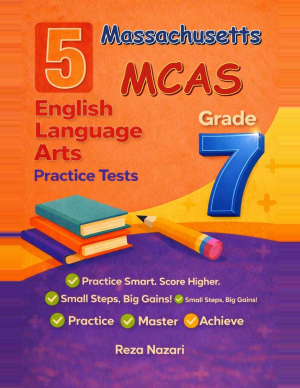
- 5 Massachusetts MCAS Grade 7 English Language Arts (ELA) Practice Tests
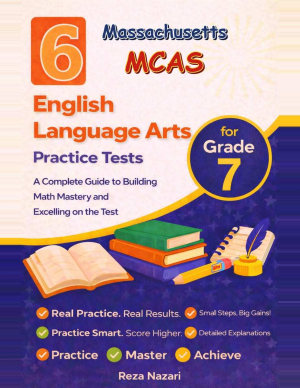
- 6 Massachusetts MCAS Grade 7 English Language Arts (ELA) Practice Tests
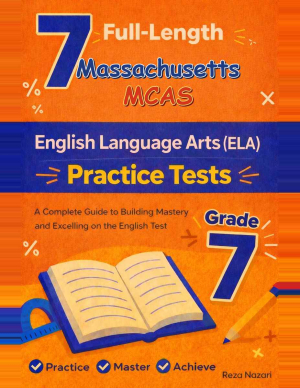
- 7 Massachusetts MCAS Grade 7 English Language Arts (ELA) Practice Tests
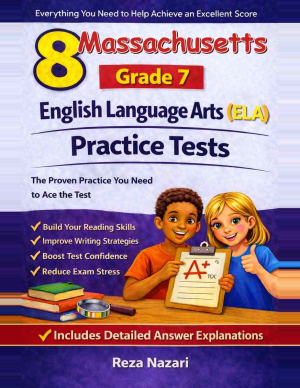
- 8 Massachusetts MCAS Grade 7 English Language Arts (ELA) Practice Tests
- Massachusetts Grade 7 ELA Preparation Bundle
Standards source: Massachusetts English Language Arts, Massachusetts Department of Elementary and Secondary Education.
Compare how two authors present the same results
Reports can agree on the recorded facts and still lead readers toward different interpretations. Compare selection and emphasis before deciding that the facts conflict.
Curriculum reference: 2017 Massachusetts English Language Arts and Literacy Framework, from the Massachusetts Department of Elementary and Secondary Education current frameworks directory.
Massachusetts Grade 7 references for this activity
The state’s current frameworks directory links the 2017 Massachusetts English Language Arts and Literacy Framework, adopted in March 2017. Read the individual Grade 7 requirements and the school’s sequence. These selected references support this activity; they do not cover the whole English curriculum.
| Grade-level expectation | Activity focus | Official requirement |
|---|---|---|
| RI.7.9 | Compare authors’ emphasis and interpretations of one topic | Read the state framework (PDF page 100) |
| RI.7.1 | Several pieces of text evidence supporting analysis | Read the state framework (PDF page 100) |
These are selected grade-level expectations from the current 2017 Massachusetts English framework. Activity labels describe a teaching focus rather than reproduce complete requirements. Read the linked state document’s complete grade-level expectations, including its grade-specific details, alongside the school’s curriculum sequence.
A worked Grade 7 reading and writing activity
This original classroom example is separate from official assessment questions.
REPORT A: The club’s new afternoon workshop attracted 18 students, compared with 10 at the previous morning workshop. The larger attendance suggests the later time may be worth keeping. Attendance alone does not tell us whether every student preferred it.
REPORT B: Six of the 18 students at the afternoon workshop left before the final activity. The earlier workshop had 10 attendees and all stayed to the end. Before choosing a regular time, the club should ask why students left and consider participation through the full session.
Both reports refer to the same invented club records. They do not describe a real Massachusetts school.
Try the activity
Compare the presentations. What evidence does each author emphasize, and what decision does each suggest? Explain whether the two reports disagree about the attendance count or instead offer different interpretations of the workshop’s success. Cite several relevant details.
Follow the reasoning
Report A emphasizes the increase from 10 to 18 attendees and suggests the later time may be worth keeping. It also limits its inference by noting that attendance is not a survey of preferences. Report B emphasizes the six early departures and contrasts them with the earlier group staying through the session. It suggests gathering reasons before selecting a regular time. Both accept the count of 18 for the afternoon session. Their different focus is on what matters when judging success: initial attendance versus participation through the full activity. The comparison should connect each author’s selected evidence with the recommendation rather than claim that one reports 18 and the other reports only six attendees.
Notice what needs more practice
The six are departures, not the total afternoon attendance. Do not confuse the categories or infer why students left without evidence. The records also do not establish that time alone caused the attendance difference; other conditions might have changed. A response that simply says both reports discuss a club does not analyze presentation. Several pieces of evidence should serve the comparison, not become a copied list. These brief reports begin the skill; longer nonfiction can use organization, wording, and omitted context to shape interpretation.
Grade 7 English worksheets
Choose printable practice that matches the skill being taught. Check the task, reading difficulty, and directions before assigning it; the collection is independently published.
Use the next session to build independence
- Mark each report’s selected facts and recommendation.
- Separate agreement on facts from differences in interpretation.
- Write a comparison linking several details with the authors’ emphasis.
Draft a third report that acknowledges both higher initial attendance and early departures. State which additional information would help evaluate the scheduling choice, then explain why it matters. Keep invented values labeled as examples. Next, compare two teacher-selected nonfiction texts on one topic and identify the evidence each highlights. Check whether an apparent contradiction comes from incompatible facts, different categories, or different judgments. Use the school’s Grade 7 sequence for further source evaluation and writing; this comparison does not certify an entire reading course or predict an MCAS score.
For more general reading and writing resources, visit the Grade 7 English Online Center.
Massachusetts Grade 7 English: useful planning questions
Do different conclusions always mean the factual records disagree?
No. Authors may accept the same facts but emphasize different evidence or criteria. Identify the exact point of agreement or disagreement before judging the conclusions.
Where are the complete state requirements?
The state’s current frameworks directory links the 2017 Massachusetts English Language Arts and Literacy Framework, adopted in March 2017. Read the individual Grade 7 requirements and the school’s sequence. These selected references support this activity; they do not cover the whole English curriculum. The school’s sequence also includes reading, writing, speaking, listening, and language work beyond this example.
Sources checked October 6, 2026. Grade 7 is within the MCAS English language arts testing range. The state overview identifies English language arts and mathematics testing in Grades 3–8 and 10. Follow the school’s assigned pathway and current administration directions. The official MCAS overview states that MCAS is untimed within a regular school day. Independently published practice may use its own timer, question count, and scoring; those features are not official MCAS specifications or a prediction of a state performance level. Use the complete framework and the school’s learning sequence to choose further reading, writing, speaking, listening, and language work. This original classroom activity is not an official assessment item.
Grade 7 English in other states
When moving between school systems, compare the official curriculum and the school’s learning sequence. Use the national Online Center’s map to find another state’s resources.
Recommended Massachusetts Grade 7 resources
Build a Strong Massachusetts Grade 7 MCAS English Practice Library
These independently published resources have their own coverage and editions. Check the contents alongside Massachusetts’s current English standards before choosing assessment preparation.
Use these Massachusetts Grade 7 resources for reading comprehension, language, writing, and full-length practice where available. Click any cover to open the resource page.
More Grade 7 resources
A USEFUL NEXT STEP
Massachusetts Grade 7 English: study questions
Do different conclusions always mean the factual records disagree?
No. Authors may accept the same facts but emphasize different evidence or criteria. Identify the exact point of agreement or disagreement before judging the conclusions.
Where are the complete Massachusetts Grade 7 requirements?
The state’s current frameworks directory links the 2017 Massachusetts English Language Arts and Literacy Framework, adopted in March 2017. Read the individual Grade 7 requirements and the school’s sequence. These selected references support this activity; they do not cover the whole English curriculum.
Official source ↗Resources from Effortless Math · Editorial standards