LEARN · PRACTICE · EXPLORE
Massachusetts Grade 7 Math
Compare circles whose radii differ by a factor of two, explain perimeter and area changes, and find Massachusetts Grade 7 math references and practice.
Focused lessons · Useful practice · Clear next steps
Standards source: Massachusetts Mathematics Standards, Massachusetts Department of Elementary and Secondary Education.
Start With a MCAS Practice Test
Six independently published, timed Massachusetts MCAS-named Grade 7 math practice tests, 40 questions each, instant scoring, a topic-by-topic breakdown, and full step-by-step solutions. Each one opens right here in a popup. Calculator: Scientific calculator (on part). These are the practice sets’ own specifications; official MCAS is untimed within a regular school day.
MCAS Practice Test 1
An independently published practice set across a range of math topics.
Start Test 1 →
MCAS Practice Test 2
Fresh questions and problem types to build accuracy.
Start Test 2 →
MCAS Practice Test 3
Additional independent practice across a range of skills.
Start Test 3 →
MCAS Practice Test 4
Another complete, timed exam to build pacing and stamina.
Start Test 4 →
MCAS Practice Test 5
A brand-new mixed set to test your readiness.
Start Test 5 →
MCAS Practice Test 6
Another independent practice set; compare its feedback with classroom work.
Start Test 6 →
Massachusetts Grade 7 Math Study Tools
A few minutes of quick review, flip through flashcards or scan every key formula. Both open right here.
Massachusetts Grade 7 Math Skill Quizzes
Short, focused quizzes, pick one skill, answer 10 questions, get instant scoring and full solutions, then jump to the matching lesson. Each opens right here.
Ratios & Proportional Relationships
A quick 10-question check on Ratios & Proportional Relationships with instant scoring and step-by-step solutions.
Start Quiz →
Percents & Financial Literacy
A quick 10-question check on Percents & Financial Literacy with instant scoring and step-by-step solutions.
Start Quiz →
Integers & Rational Numbers
A quick 10-question check on Integers & Rational Numbers with instant scoring and step-by-step solutions.
Start Quiz →
Expressions, Equations & Inequalities
A quick 10-question check on Expressions, Equations & Inequalities with instant scoring and step-by-step solutions.
Start Quiz →
Geometry, Area & Volume
A quick 10-question check on Geometry, Area & Volume with instant scoring and step-by-step solutions.
Start Quiz →
Statistics & Data
A quick 10-question check on Statistics & Data with instant scoring and step-by-step solutions.
Start Quiz →
Probability
A quick 10-question check on Probability with instant scoring and step-by-step solutions.
Start Quiz →
Mixed Grade 7 Review
A quick 10-question check on Mixed Grade 7 Review with instant scoring and step-by-step solutions.
Start Quiz →
Classroom practice and state assessment information
Grade 7 is within the statewide MCAS mathematics assessment range. MCAS is untimed within a regular school day. Independently published practice may use its own timer, tools, question count, and scoring; these are not official administration rules or a prediction of a state performance level. Read the state assessment overview for official guidance.
Use the worked activity and lesson directory to choose a skill. Confirm the directions of an independent practice resource before assigning it.
Compare how circumference and area change with radius
Does doubling the radius double everything?
A classroom drawing compares two circular garden beds with radii of 3 meters and 6 meters. The beds are mathematical models with exact circular boundaries. Compare their diameters, circumferences, and areas using pi in the answers. A student predicts that doubling the radius doubles both the boundary length and the area. Decide which parts of the prediction are correct.
Explain the solution
Diameter is twice the radius, so the diameters are 6 and 12 meters. Circumference is 2 times pi times the radius, giving 6 pi and 12 pi meters. The larger circumference is twice the smaller. Area is pi times radius squared, giving 9 pi and 36 pi square meters. The larger area is four times the smaller because doubling the radius multiplies the squared radius by four. The student’s boundary-length prediction is correct, while the area prediction is not. Keep pi in the exact expressions rather than introduce a rounding difference that distracts from the comparison.
| Radius | Circumference | Area |
|---|---|---|
| 3 meters | 6 pi meters | 9 pi square meters |
| 6 meters | 12 pi meters | 36 pi square meters |
Notice the reasoning
Meters measure boundary length; square meters measure covered surface. A formula written without units can hide the distinction. An informal explanation can compare a drawing enlarged by a scale factor of two: lengths grow by two while two-dimensional coverage grows by two in each direction. For a fuller connection, rearrange narrow sectors of a circle toward a parallelogram-like shape whose height approaches the radius and base approaches half the circumference; this motivates area as half the circumference times the radius. A finite cut-out is an approximation, not an exact rectangle. Massachusetts asks for informal relationships as well as using formulas.
Try a related task
Compare a third circle of radius 9 meters with the radius-3 circle. Its radius and circumference are three times as large, while its area is nine times as large. Explain the factors before calculating. Then reverse the question: if a circular model’s area is four times another’s, what radius factor would account for that? Use diagrams and the squared-radius relationship to justify two, with positive radii. This selected comparison supports parts of the state’s circle expectation. It does not replace work defining a circle, measuring circular objects, or developing an informal derivation through classroom models.
Selected references from Massachusetts mathematics standards
The Massachusetts mathematics standards directory links the current mathematics document, adopted in March 2017 and currently listed in the state’s frameworks directory. These selected references identify the worked activity’s focus. The expectations include numbered requirements, examples, and mathematical practices. Read the full document and confirm the school’s current instructional sequence.
| Adopted-document reference | Activity focus | Official document |
|---|---|---|
| 7.G.4.b–e | Radius, diameter, circumference, area, and informal relationships | Read the state PDF, page 68 |
Sources checked October 6, 2026. Read complete requirements, clarifications, limitations, and mathematical practices alongside the school’s sequence. This selected activity is an entry point for instruction.
Connect the explanation with practice
Use the lesson, worksheet, and quiz directory to choose a related skill. The existing resource links remain available; open each activity’s directions to understand its timer, tools, question count, and scoring.
Grade 7 is within the statewide MCAS mathematics assessment range. MCAS is untimed within a regular school day. Independently published practice may use its own timer, tools, question count, and scoring; these are not official administration rules or a prediction of a state performance level. Read Massachusetts’s assessment overview.
Keep one example of the student’s reasoning with the practice result. Choose a smaller model, a related question, or a new context according to the difficulty revealed in the worked activity.
Massachusetts Grade 7 Math Topics
Choose a lesson, printable worksheet collection, or topic quiz. This broader library includes review and enrichment. Use the school’s current sequence and the adopted Massachusetts document when choosing skills; these rows are not a certified full-course crosswalk.
Ratios & Proportional Relationships
- Unit Rates with FractionsWorksheetsQuiz
- Recognizing Proportional RelationshipsWorksheetsQuiz
- Finding the Constant of ProportionalityWorksheetsQuiz
- Writing Equations for Proportional RelationshipsWorksheetsQuiz
- Graphing Proportional RelationshipsWorksheetsQuiz
- Applying Proportional Reasoning to Real-World ProblemsWorksheetsQuiz
- Proportional Reasoning with Scale ModelsWorksheetsQuiz
Percents & Their Applications
- Solving Percent ProblemsWorksheetsQuiz
- Connecting Percents and ProportionsWorksheetsQuiz
- Percent Increase and DecreaseWorksheetsQuiz
- Markups, Discounts, and Sales TaxWorksheetsQuiz
- Tips, Commissions, and FeesWorksheetsQuiz
- Simple Interest: Earning and Paying InterestWorksheetsQuiz
- Percent Error: How Close Are Your Estimates?WorksheetsQuiz
- Personal Financial LiteracyWorksheetsQuiz
- Financial Literacy, Budgeting, Saving, and InvestingWorksheetsQuiz
- Compound Interest IntroductionWorksheetsQuiz
Integers & Rational Numbers
- Integers and Their OppositesWorksheetsQuiz
- Adding IntegersWorksheetsQuiz
- Subtracting IntegersWorksheetsQuiz
- Adding and Subtracting Rational NumbersWorksheetsQuiz
- Multiplying Integers and Rational NumbersWorksheetsQuiz
- Dividing Integers and Rational NumbersWorksheetsQuiz
- Converting Rational Numbers to DecimalsWorksheetsQuiz
- Solving Real-World Problems with Rational Numbers (resource currently unavailable)WorksheetsQuiz
- Introduction to Square RootsWorksheetsQuiz
- Rational Number Operations in Extended ContextsWorksheetsQuiz
- Introduction to Scientific NotationWorksheetsQuiz
Algebraic Expressions
- Writing and Evaluating ExpressionsWorksheetsQuiz
- Simplifying Expressions by Combining Like TermsWorksheetsQuiz
- Expanding Expressions with the Distributive PropertyWorksheetsQuiz
- Factoring ExpressionsWorksheetsQuiz
- Adding and Subtracting Linear ExpressionsWorksheetsQuiz
- Rewriting Expressions to Solve ProblemsWorksheetsQuiz
- Laws of ExponentsWorksheetsQuiz
Equations & Inequalities
- Writing Two-Step Equations from Word ProblemsWorksheetsQuiz
- Solving Two-Step EquationsWorksheetsQuiz
- Solving Equations with the Distributive PropertyWorksheetsQuiz
- Solving Multi-Step Problems with Rational Numbers (resource currently unavailable)WorksheetsQuiz
- Writing and Solving InequalitiesWorksheetsQuiz
- Graphing Solutions to Inequalities on a Number LineWorksheetsQuiz
Scale Drawings & Geometric Constructions
- Understanding and Using Scale DrawingsWorksheetsQuiz
- Reproducing Scale Drawings at a Different ScaleWorksheetsQuiz
- Drawing Geometric Figures with Given ConditionsWorksheetsQuiz
- Constructing Triangles from Three MeasurementsWorksheetsQuiz
- Cross-Sections of Three-Dimensional FiguresWorksheetsQuiz
- Angle Relationships: Supplementary, Complementary, and Vertical AnglesWorksheetsQuiz
- Transformations on the Coordinate PlaneWorksheetsQuiz
- Similar Figures and ProportionsWorksheetsQuiz
Geometry: Circles, Area & Volume
Statistics & Sampling
- Populations and SamplesWorksheetsQuiz
- Making Inferences from Random SamplesWorksheetsQuiz
- Comparing Two Populations VisuallyWorksheetsQuiz
- Comparing Populations with Measures of Center and VariabilityWorksheetsQuiz
- Stem-and-Leaf PlotsWorksheetsQuiz
- Circle GraphsWorksheetsQuiz
- Data Displays ExtendedWorksheetsQuiz
Best Massachusetts MCAS Grade 7 Math Books
Each book has a job: start from scratch, drill weak skills, or build pacing with full tests. All of them pair with the free tools on this page.
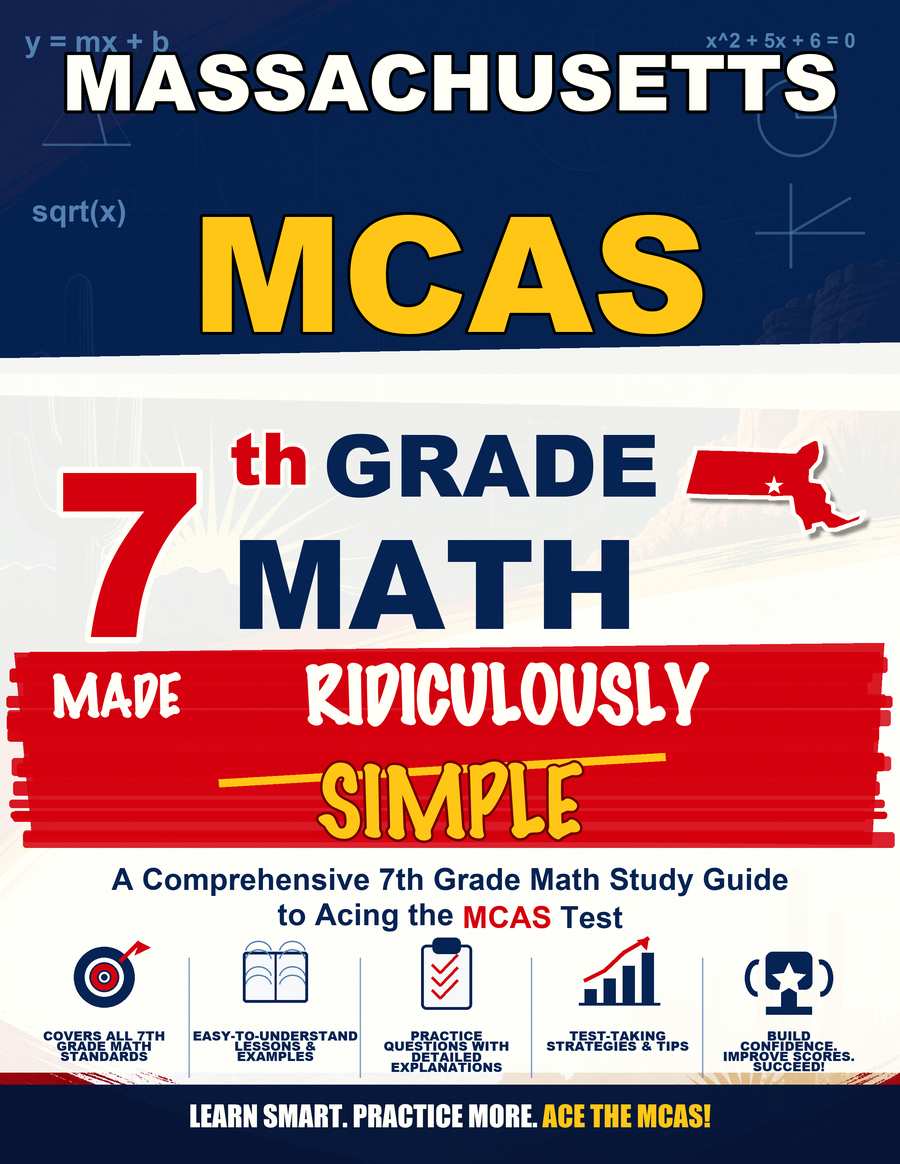
Massachusetts MCAS Grade 7 Math Made Ridiculously Simple
An independently published Grade 7 mathematics resource. Check its edition and contents against Massachusetts’s adopted document and the school’s course before choosing preparation.
- Best starting point for the MCAS math test
- Pairs with Massachusetts flashcards and worksheets
- Use it before full timed practice tests
- Organized for students who need examples before drills
Step-by-step lessons
Short explanations show the move before the student practices it.
✍Worked examples
Examples translate MCAS-style wording into clear math steps.
Targeted practice
Rebuild one skill at a time instead of jumping around.
Test-day bridge
After each topic, connect to formulas, flashcards, and practice questions.
How to use it
- Read one lesson and copy the worked example.
- Do a short worksheet set on the same topic.
- Review the matching flashcards or formulas.
- Try a mixed quiz and mark every miss.
Pair it with free tools
Choose the right Massachusetts Grade 7 math book
Massachusetts MCAS Grade 7 Math Made Ridiculously Simple
Start here to rebuild MCAS math from the ground up.
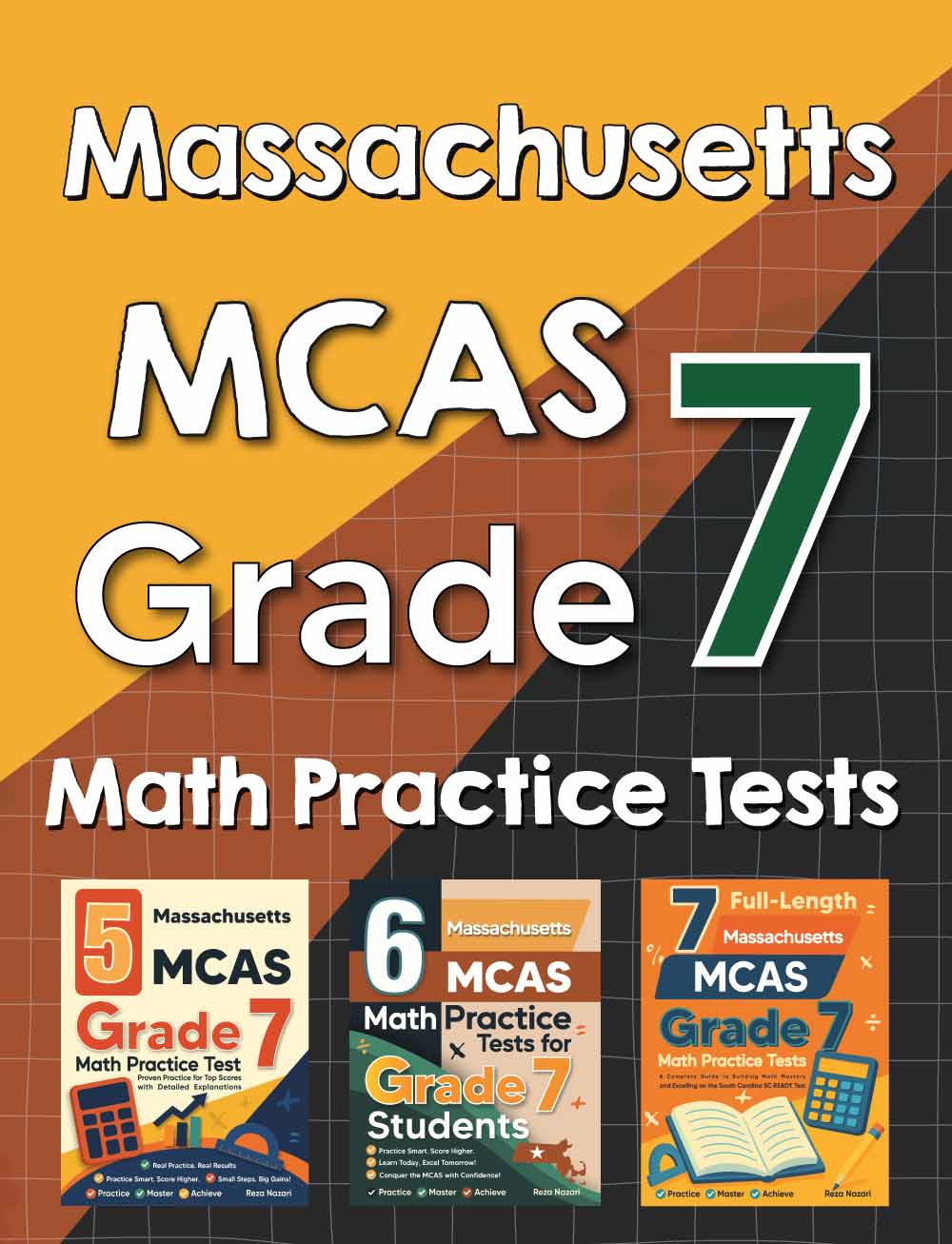
Massachusetts MCAS Grade 7 Math Preparation Bundle
The full prep library, study guide, workbook, and practice tests together.
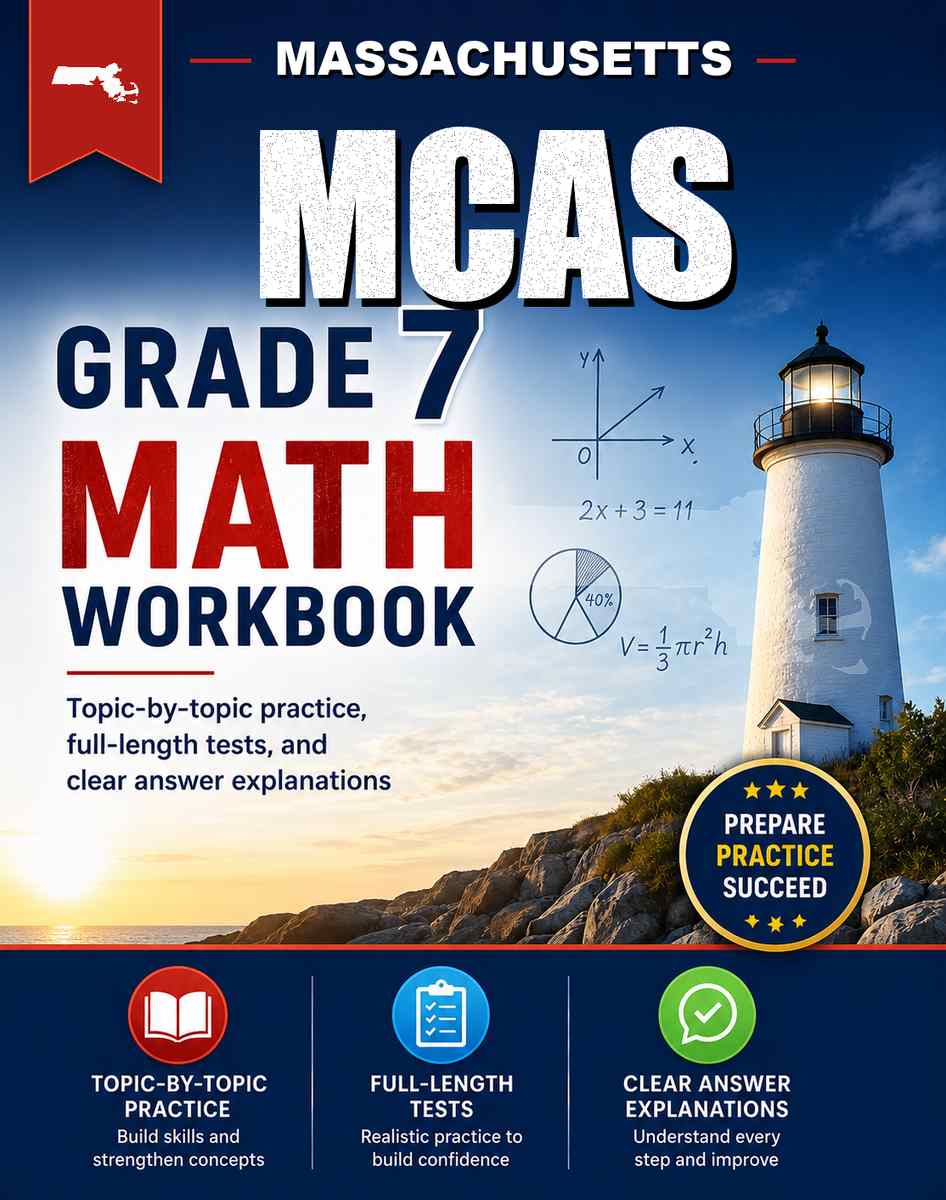
Massachusetts MCAS 7th Grade Math Workbook
Repeated practice by topic when a student needs more reps.
7 Massachusetts MCAS Grade 7 Math Practice Tests
Use after topic review to build pacing and test stamina.
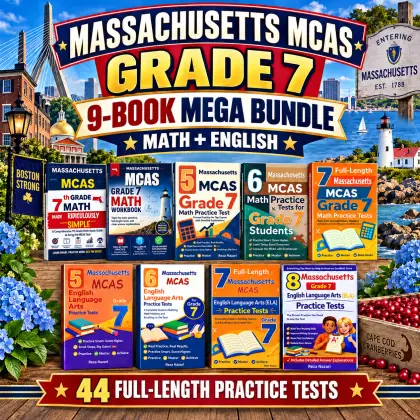
Massachusetts MCAS Grade 7 Math & ELA Mega Bundle
9 books and 44 full-length practice tests in one TPT bundle.
Read the complete Massachusetts mathematics requirements
The Massachusetts standards directory links the current Massachusetts mathematics standards document, including numbered requirements, examples, clarifications, and mathematical practices. Use it with the school’s curriculum rather than treat this independent topic library as the complete state course.
The complete document includes grade-level progression and mathematical practices. Check the expectation’s full wording and the task’s scope when choosing classroom practice.
Massachusetts Grade 7 math: useful study questions
Why does doubling a circle’s radius quadruple its area?
Area depends on the square of the radius: pi times (2r) squared equals four times pi times r squared. Circumference depends directly on radius and therefore only doubles.
Is Grade 7 included in Massachusetts MCAS math testing?
Yes. Grade 7 is within Massachusetts’s general summative MCAS range of Grades 3–8 and 10. MCAS is untimed within a regular school day. The linked activities are independently published practice with separate directions and scoring; any practice timer is not an official MCAS time limit.
Grade 7 Math in Other States
Explore Grade 7 math standards, practice tests, and worksheets for every state.
Make This Your Massachusetts MCAS Starting Point
Choose a related practice resource, compare its feedback with classroom explanations, and follow the school’s current learning and assessment guidance.
Start a practice testA USEFUL NEXT STEP
Massachusetts Grade 7 Math: study questions
Why does doubling a circle’s radius quadruple its area?
Area depends on the square of the radius: pi times (2r) squared equals four times pi times r squared. Circumference depends directly on radius and therefore only doubles.
Is Grade 7 included in Massachusetts MCAS math testing?
Yes. Grade 7 is within Massachusetts’s general summative MCAS range of Grades 3–8 and 10. MCAS is untimed within a regular school day. The linked activities are independently published practice with separate directions and scoring; any practice timer is not an official MCAS time limit.
Official source ↗Resources from Effortless Math · Editorial standards