LEARN · PRACTICE · EXPLORE
Georgia Grade 7 English
Revise an original courtyard proposal with relevant evidence, a counterclaim, and a logical conclusion using current Georgia Grade 7 argument expectations.
Focused lessons · Useful practice · Clear next steps
What do Georgia 7th graders learn in ELA?
In 7th grade, Georgia English language arts centers on how ideas and characters develop, comparing texts, and arguments with claims and counterclaims. Students take the Georgia Milestones grade 7 ELA test in the spring. This page explains each Georgia grade 7 ELA standard and pairs it with short lessons, printable worksheets and a full-length practice test.
Printable Georgia grade 7 ELA books:
- 5 Georgia Georgia Milestones Grade 7 English Language Arts (ELA) Practice Tests
- 6 Georgia Georgia Milestones Grade 7 English Language Arts (ELA) Practice Tests
- 7 Georgia Georgia Milestones Grade 7 English Language Arts (ELA) Practice Tests
- 8 Georgia Georgia Milestones Grade 7 English Language Arts (ELA) Practice Tests
- Georgia Grade 7 ELA Preparation Bundle
Standards source: Georgia English Language Arts, Georgia Department of Education.
Answer a reasonable counterclaim without abandoning the evidence
An argument becomes stronger when it addresses a reasonable concern instead of pretending no other purpose matters. Use the same evidence to check the claim, counterclaim, and conclusion. An objection should influence the response where appropriate, rather than appear as an unrelated sentence added at the end.
Curriculum source: Georgia’s K-12 English Language Arts Standards, approved May 2023 and fully implemented in 2025–26, from the GaDOE English standards directory.
Georgia Grade 7 references for this activity
Georgia’s current Grade 7 English document contains grade-level expectations alongside broader standards and practices. The expectations selected here support this activity; use the whole document and the school’s sequence for wider coverage.
| Grade-level expectation | Activity focus | Official requirement |
|---|---|---|
| 7.T.T.3.a | Analyze a claim, evidence, counterclaim, and conclusion | Read the primary standards document, page 21 |
| 7.T.T.3.c | Use argumentative techniques in writing | Read the primary standards document, page 21 |
These are selected grade-level expectations from Georgia’s current English standards. Activity labels describe a teaching focus rather than reproduce complete requirements. Read the linked grade-level document, including its broader standards and practices, alongside the school’s curriculum sequence.
A worked Grade 7 reading and writing activity
This original classroom example is separate from official assessment questions.
Draft proposal: Remove the courtyard garden and put benches there. More seats would be better.
Invented planning notes: The courtyard has one bench with room for three readers. Four readers were seen standing beside it on two observed afternoons. Science classes used the garden for observations on four days last month. A sketch shows space for one additional bench on the paved area without removing the garden.
Counterclaim: Removing the garden would take away a place used for science observations.
Try the activity
Revise the proposal with a clear claim supported by relevant notes. Identify the counterclaim and respond to it. End with a conclusion that follows the revised reasoning without promising a result the notes cannot establish.
Follow the reasoning
A defensible revision proposes adding a bench on the paved area while retaining the garden. The standing readers support the need for additional seating; the sketch identifies an option that does not require removing the garden. The counterclaim points to the garden’s documented instructional use. Responding with the paved-area option acknowledges that concern rather than dismissing science observations as unimportant. A conclusion can recommend trying the additional seating and reviewing how the space is used. This differs from the original demand to remove the garden.
Notice what needs more practice
“Everyone wants benches” is not supported by two observed afternoons. The notes also do not show that one more bench will solve every space conflict. A counterclaim about the garden should receive a relevant response, not “some people disagree” followed by the same unsupported conclusion. The observations occurred over different time periods, so do not treat four garden days and two seating observations as directly comparable rates. Keep the distinction between reported evidence and the writer’s proposal.
Grade 7 English worksheets
Choose printable practice that matches the skill being taught. Check the task, reading difficulty, and directions before assigning it; the collection is independently published.
Use the next session to build independence
- Identify the original claim and the evidence that actually bears on it.
- State the garden-use counterclaim fairly and examine the alternative shown in the sketch.
- Write a revised claim and conclusion that acknowledge the concern and fit the available evidence.
Have a partner mark the claim, evidence, counterclaim, response, and conclusion in the revision. Ask which additional information would help, such as observations over more afternoons or the garden users’ needs. Try another conclusion that supports keeping the existing layout while collecting evidence, and compare the reasoning rather than choosing a position by preference alone. The activity practices argumentative techniques with fictional planning material, not a real construction recommendation.
For more general reading and writing resources, visit the Grade 7 English Online Center.
Georgia Grade 7 English: useful planning questions
Must answering a counterclaim mean accepting the original proposal unchanged?
No. The concern can lead to a revised proposal. Here, preserving the garden while using paved space for another bench responds to both the seating evidence and the garden-use counterclaim.
Where are the complete state requirements?
Georgia’s current Grade 7 English document contains grade-level expectations alongside broader standards and practices. The expectations selected here support this activity; use the whole document and the school’s sequence for wider coverage. The school’s sequence also includes reading, writing, speaking, listening, and language work beyond this example.
Official sources checked October 5, 2026. Grade 7 is within the Georgia Milestones English language arts testing range. This original lesson is independent practice. Read the Georgia Milestones overview and use the school’s guidance for preparation. Georgia’s new English standards were fully implemented in 2025–26, alongside revised assessments. This site’s practice and books are independently published. Check their editions and contents against current standards and assessment guidance.
Grade 7 English in other states
When moving between school systems, compare the official curriculum and the school’s learning sequence. Use the national Online Center’s map to find another state’s resources.
Recommended Georgia Grade 7 resources
Build a Strong Georgia Grade 7 Milestones English Practice Library
These independently published resources may use earlier Georgia English standards. Check the edition and contents alongside GaDOE’s current English standards before choosing assessment preparation.
Use these Georgia Grade 7 resources for reading comprehension, language, writing, and full-length practice where available. Click any cover to open the resource page.
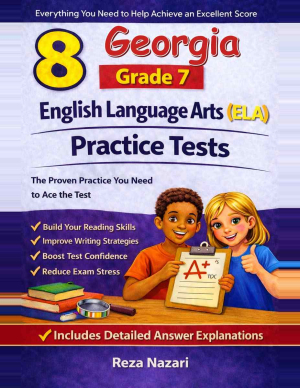 8 Georgia Georgia Milestones Grade 7 English Language Arts (ELA) Practice Tests
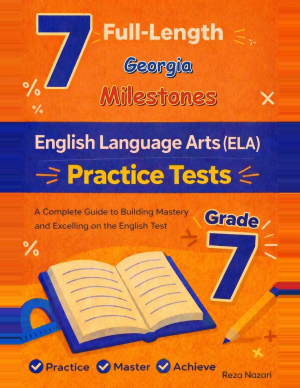 7 Georgia Georgia Milestones Grade 7 English Language Arts (ELA) Practice Tests
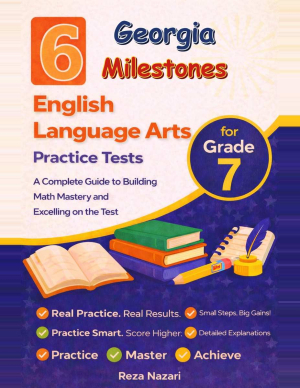 6 Georgia Georgia Milestones Grade 7 English Language Arts (ELA) Practice Tests
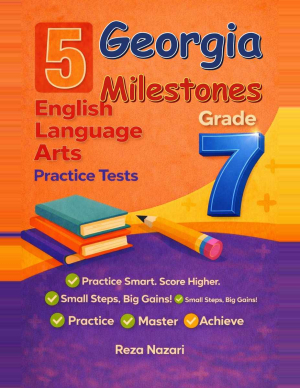 5 Georgia Georgia Milestones Grade 7 English Language Arts (ELA) Practice Tests
More Grade 7 resources
A USEFUL NEXT STEP
Georgia Grade 7 English: study questions
Must answering a counterclaim mean accepting the original proposal unchanged?
No. The concern can lead to a revised proposal. Here, preserving the garden while using paved space for another bench responds to both the seating evidence and the garden-use counterclaim.
Where are the complete Georgia Grade 7 requirements?
Georgia’s current Grade 7 English document contains grade-level expectations alongside broader standards and practices. The expectations selected here support this activity; use the whole document and the school’s sequence for wider coverage.
Official source ↗Resources from Effortless Math · Editorial standards