LEARN · PRACTICE · EXPLORE
Georgia Grade 7 Math
Georgia Grade 7 Math: explore grade-level lessons, worksheets, and learning references. Check the curriculum source and choose practice for your next skill.
Focused lessons · Useful practice · Clear next steps
Standards source: Learning and Standards, Georgia Department of Education.
Start With a Milestones Practice Test
Six full, timed Georgia Milestones Grade 7 math practice tests, 40 questions each, instant scoring, a topic-by-topic breakdown, and full step-by-step solutions. Each one opens right here in a popup. Calculator: Scientific calculator (on part).
Milestones Practice Test 1
A full diagnostic across every Georgia Grade 7 math topic.
Start Test 1 →
Milestones Practice Test 2
Fresh questions and problem types to build accuracy.
Start Test 2 →
Milestones Practice Test 3
New problems to add speed and confidence on every skill.
Start Test 3 →
Milestones Practice Test 4
Another complete, timed exam to build pacing and stamina.
Start Test 4 →
Milestones Practice Test 5
A brand-new mixed set to test your readiness.
Start Test 5 →
Milestones Practice Test 6
A final full-length simulation to confirm you are ready.
Start Test 6 →
Georgia Grade 7 Math Study Tools
A few minutes of quick review, flip through flashcards or scan every key formula. Both open right here.
Georgia Grade 7 Math Skill Quizzes
Short, focused quizzes, pick one skill, answer 10 questions, get instant scoring and full solutions, then jump to the matching lesson. Each opens right here.
Ratios & Proportional Relationships
A quick 10-question check on Ratios & Proportional Relationships with instant scoring and step-by-step solutions.
Start Quiz →
Percents & Financial Literacy
A quick 10-question check on Percents & Financial Literacy with instant scoring and step-by-step solutions.
Start Quiz →
Integers & Rational Numbers
A quick 10-question check on Integers & Rational Numbers with instant scoring and step-by-step solutions.
Start Quiz →
Expressions, Equations & Inequalities
A quick 10-question check on Expressions, Equations & Inequalities with instant scoring and step-by-step solutions.
Start Quiz →
Geometry, Area & Volume
A quick 10-question check on Geometry, Area & Volume with instant scoring and step-by-step solutions.
Start Quiz →
Statistics & Data
A quick 10-question check on Statistics & Data with instant scoring and step-by-step solutions.
Start Quiz →
Probability
A quick 10-question check on Probability with instant scoring and step-by-step solutions.
Start Quiz →
Mixed Grade 7 Review
A quick 10-question check on Mixed Grade 7 Review with instant scoring and step-by-step solutions.
Start Quiz →
Georgia Milestones Grade 7 Math Snapshot
Georgia Grade 7: connect practice to a classroom target
Use Georgia curriculum source to check the expectation your class is studying. The topic directory provides general lessons; it is not a complete state alignment. These selected learning references give you more precise ideas to compare with an assignment. Common Core-style codes are Common Core references, and other codes come from the existing planning reference. Confirm current state wording and placement before treating either as an official local requirement.
- 7.NR.1.1
- Show that a number and its opposite have a sum of 0 (are additive inverses). Describe situations in which opposite quantities combine to make 0
- 7.PAR.2.1
- Apply properties of operations as strategies to add, subtract, factor, and expand linear expressions with rational coefficients
- 7.GSR.5.1
- Measure angles in whole nonstandard units
- 7.PR.6.1
- Represent the probability of a chance event as a number between 0 and 1 that expresses the likelihood of the event occurring. Describe that a probability near 0 indicates an unlikely event, a probability around 1/2 indicates an event that is neither unlikely nor likely, and a probability near 1 indicates a likely event
Choose practice from the explanation
Ask the student to explain one of the ideas above with a drawing, model, table, or short calculation. If the explanation is unclear, open the related lesson before assigning a mixed test. If the idea is understood but the calculation is unreliable, choose a focused worksheet and review the strategy afterward.
Keep the classroom target, the resource used, and the next step together in a study note. A topic quiz can guide review; its score is not an official state performance level. Revisit the skill in a new context after a few days.
Georgia Grade 7 Math Topics
70 student-friendly Grade 7 math skills connected to the Georgia standards, each tagged with its Milestones standard code and a focused lesson.
Ratios & Proportional Relationships
- 7.PAR.4.1Unit Rates with FractionsWorksheetsQuiz
- 7.PAR.4.3Recognizing Proportional RelationshipsWorksheetsQuiz
- 7.PAR.4.2Finding the Constant of ProportionalityWorksheetsQuiz
- 7.PAR.4.2Writing Equations for Proportional RelationshipsWorksheetsQuiz
- 7.PAR.4.5Graphing Proportional RelationshipsWorksheetsQuiz
- 7.PAR.4.9Applying Proportional Reasoning to Real-World ProblemsWorksheetsQuiz
- 7.PAR.4.6Proportional Reasoning with Scale ModelsWorksheetsQuiz
Percents & Their Applications
- 7.NR.1.5Solving Percent ProblemsWorksheetsQuiz
- 7.PAR.4.9Connecting Percents and ProportionsWorksheetsQuiz
- 7.PAR.4.7Percent Increase and DecreaseWorksheetsQuiz
- 7.PAR.4.6Markups, Discounts, and Sales TaxWorksheetsQuiz
- 7.NR.1.5Tips, Commissions, and FeesWorksheetsQuiz
- 7.PAR.4.8Simple Interest: Earning and Paying InterestWorksheetsQuiz
- 7.PAR.4.1Percent Error: How Close Are Your Estimates?WorksheetsQuiz
- 7.PAR.4.1Personal Financial LiteracyWorksheetsQuiz
- 7.PAR.4.11Financial Literacy, Budgeting, Saving, and InvestingWorksheetsQuiz
- 7.PAR.2.2Compound Interest IntroductionWorksheetsQuiz
Integers & Rational Numbers
- 7.NR.1.1Integers and Their OppositesWorksheetsQuiz
- 7.NR.1.1Adding IntegersWorksheetsQuiz
- 7.NR.1.4Subtracting IntegersWorksheetsQuiz
- 7.NR.1.9Adding and Subtracting Rational NumbersWorksheetsQuiz
- 7.NR.1.8Multiplying Integers and Rational NumbersWorksheetsQuiz
- 7.NR.1.7Dividing Integers and Rational NumbersWorksheetsQuiz
- 7.NR.1.10Converting Rational Numbers to DecimalsWorksheetsQuiz
- 7.NR.1.11Solving Real-World Problems with Rational Numbers (resource currently unavailable)WorksheetsQuiz
- 7.NR.1.3Introduction to Square RootsWorksheetsQuiz
- 7.NR.1.9Rational Number Operations in Extended ContextsWorksheetsQuiz
- 7.NR.1.9Introduction to Scientific NotationWorksheetsQuiz
Algebraic Expressions
- 7.PAR.2.1Writing and Evaluating ExpressionsWorksheetsQuiz
- 7.PAR.2.1Simplifying Expressions by Combining Like TermsWorksheetsQuiz
- 7.PAR.2.1Expanding Expressions with the Distributive PropertyWorksheetsQuiz
- 7.PAR.2.1Factoring ExpressionsWorksheetsQuiz
- 7.PAR.2.1Adding and Subtracting Linear ExpressionsWorksheetsQuiz
- 7.PAR.2.2Rewriting Expressions to Solve ProblemsWorksheetsQuiz
- 7.NR.1.7Laws of ExponentsWorksheetsQuiz
Equations & Inequalities
- 7.PAR.3.1Writing Two-Step Equations from Word ProblemsWorksheetsQuiz
- 7.PAR.3.1Solving Two-Step EquationsWorksheetsQuiz
- 7.PAR.2.1Solving Equations with the Distributive PropertyWorksheetsQuiz
- 7.NR.1.11Solving Multi-Step Problems with Rational Numbers (resource currently unavailable)WorksheetsQuiz
- 7.PAR.3.1Writing and Solving InequalitiesWorksheetsQuiz
- 7.NR.1.3Graphing Solutions to Inequalities on a Number LineWorksheetsQuiz
Scale Drawings & Geometric Constructions
- 7.PAR.4.6Understanding and Using Scale DrawingsWorksheetsQuiz
- 7.PAR.4.6Reproducing Scale Drawings at a Different ScaleWorksheetsQuiz
- 7.PAR.4.6Drawing Geometric Figures with Given ConditionsWorksheetsQuiz
- 7.GSR.5.3Constructing Triangles from Three MeasurementsWorksheetsQuiz
- 7.GSR.5.7Cross-Sections of Three-Dimensional FiguresWorksheetsQuiz
- 7.GSR.5.3Angle Relationships: Supplementary, Complementary, and Vertical AnglesWorksheetsQuiz
- 7.PAR.4.7Transformations on the Coordinate PlaneWorksheetsQuiz
- 7.PAR.4.6Similar Figures and ProportionsWorksheetsQuiz
Geometry: Circles, Area & Volume
- 7.GSR.5.4Parts of a CircleWorksheetsQuiz
- 7.GSR.5.4Circumference of a CircleWorksheetsQuiz
- 7.GSR.5.5Area of a CircleWorksheetsQuiz
- 7.PAR.2.1Area of Composite ShapesWorksheetsQuiz
- 7.GSR.5.6Surface Area of Three-Dimensional ObjectsWorksheetsQuiz
- 7.GSR.5.6Volume of PrismsWorksheetsQuiz
- 7.GSR.5.6Cylinder Surface Area and VolumeWorksheetsQuiz
Statistics & Sampling
- 7.PAR.4.10Populations and SamplesWorksheetsQuiz
- 7.PAR.4.12Making Inferences from Random SamplesWorksheetsQuiz
- 7.PAR.4.12Comparing Two Populations VisuallyWorksheetsQuiz
- 7.PR.6.6Comparing Populations with Measures of Center and VariabilityWorksheetsQuiz
- 7.NR.1.8Stem-and-Leaf PlotsWorksheetsQuiz
- 7.GSR.5.5Circle GraphsWorksheetsQuiz
- 7.PAR.4.9Data Displays ExtendedWorksheetsQuiz
Probability
- 7.PR.6.1What Is Probability?WorksheetsQuiz
- 7.PR.6.4Theoretical ProbabilityWorksheetsQuiz
- 7.PR.6.2Experimental ProbabilityWorksheetsQuiz
- 7.PR.6.4Probability ModelsWorksheetsQuiz
- 7.PR.6.4Sample Spaces for Compound EventsWorksheetsQuiz
- 7.PR.6.4Finding Probabilities of Compound EventsWorksheetsQuiz
- 7.PR.6.4Simulating Compound EventsWorksheetsQuiz
Best Georgia Milestones Grade 7 Math Books
Each book has a job: start from scratch, drill weak skills, or build pacing with full tests. All of them pair with the free tools on this page.
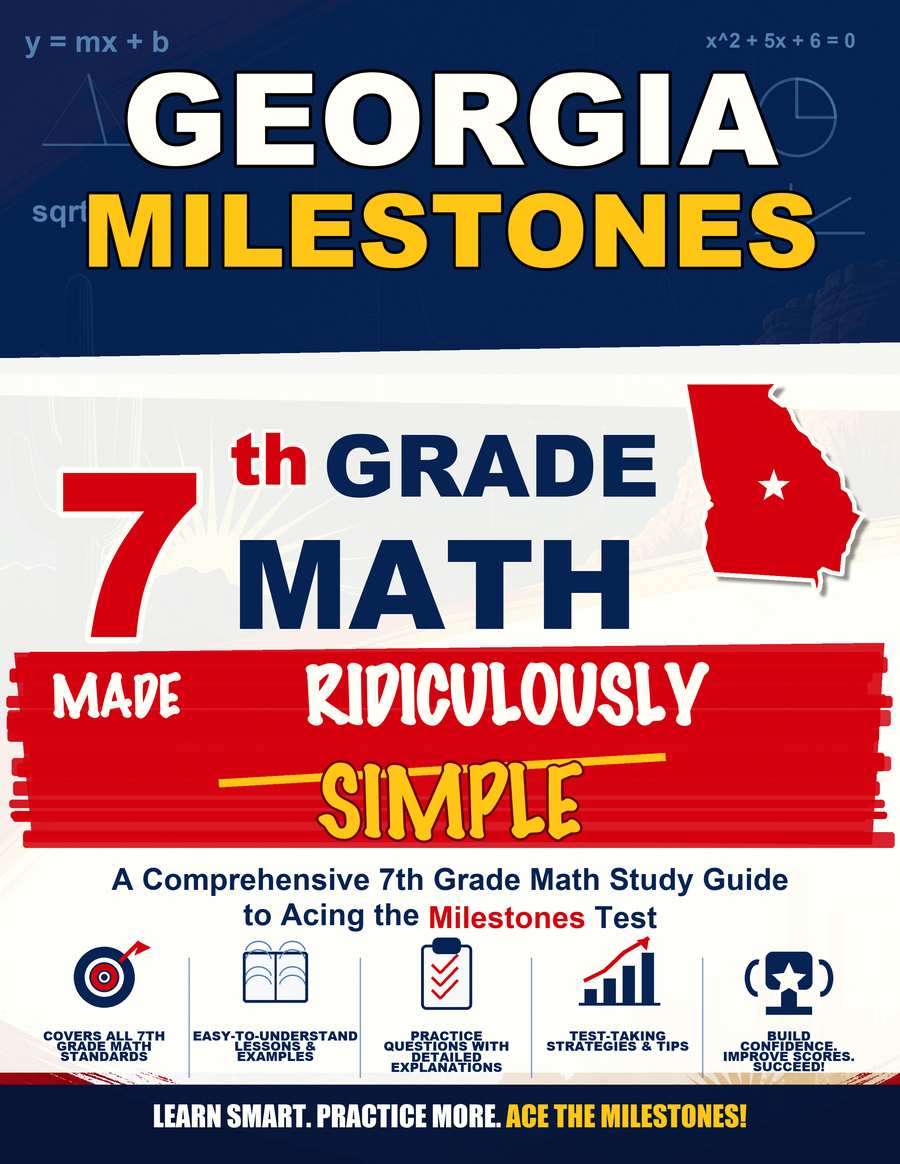
Georgia Milestones Grade 7 Math Made Ridiculously Simple
A step-by-step Milestones Grade 7 math book that rebuilds every tested skill clearly and in order, built to match the Georgia standards.
- Best starting point for the Milestones math test
- Pairs with Georgia flashcards and worksheets
- Use it before full timed practice tests
- Organized for students who need examples before drills
Step-by-step lessons
Short explanations show the move before the student practices it.
✍Worked examples
Examples translate Milestones-style wording into clear math steps.
Targeted practice
Rebuild one skill at a time instead of jumping around.
Test-day bridge
After each topic, connect to formulas, flashcards, and practice questions.
How to use it
- Read one lesson and copy the worked example.
- Do a short worksheet set on the same topic.
- Review the matching flashcards or formulas.
- Try a mixed quiz and mark every miss.
Pair it with free tools
Choose the right Georgia Grade 7 math book
Georgia Milestones Grade 7 Math Made Ridiculously Simple
Start here to rebuild Milestones math from the ground up.
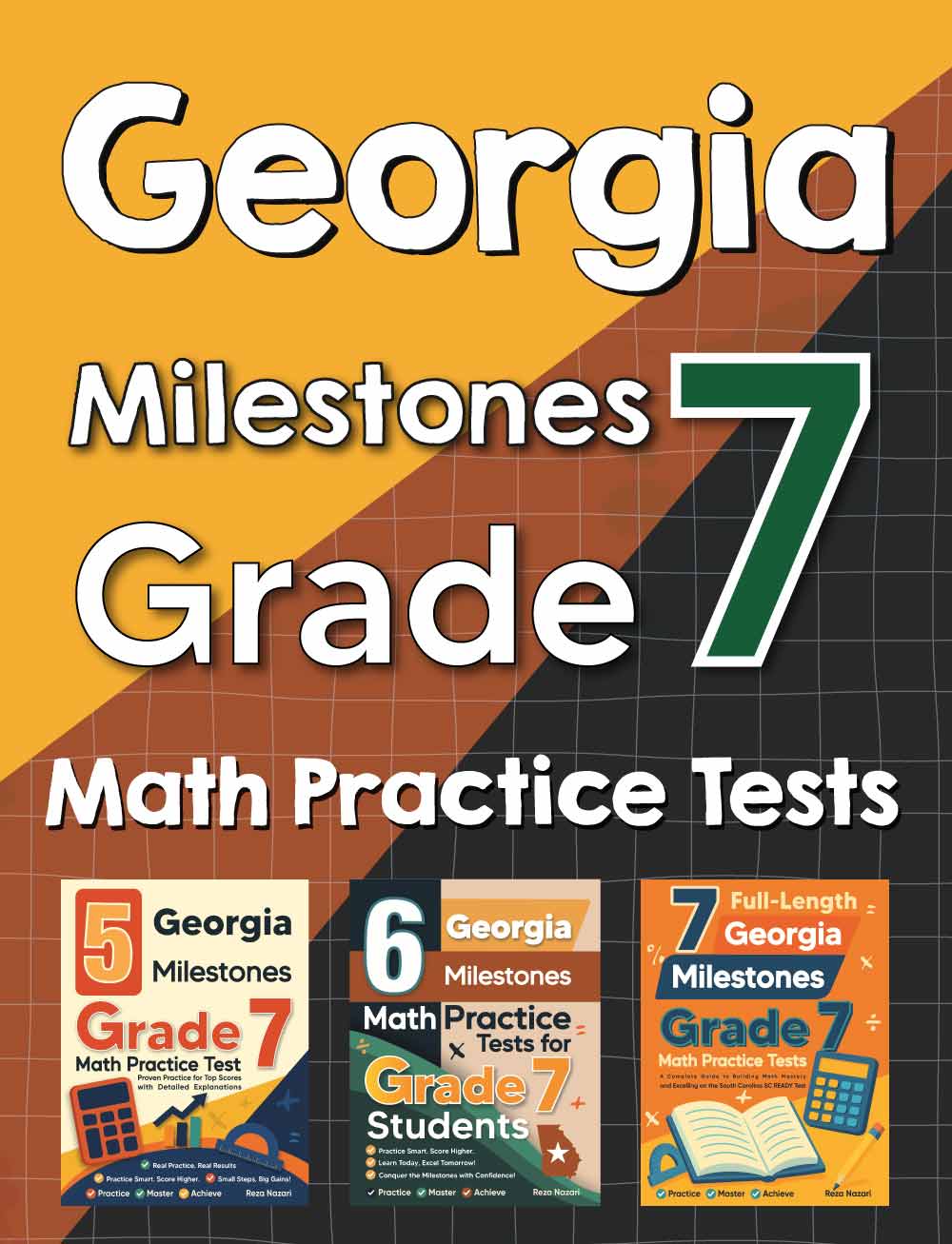
Georgia Milestones Grade 7 Math Preparation Bundle
The full prep library, study guide, workbook, and practice tests together.
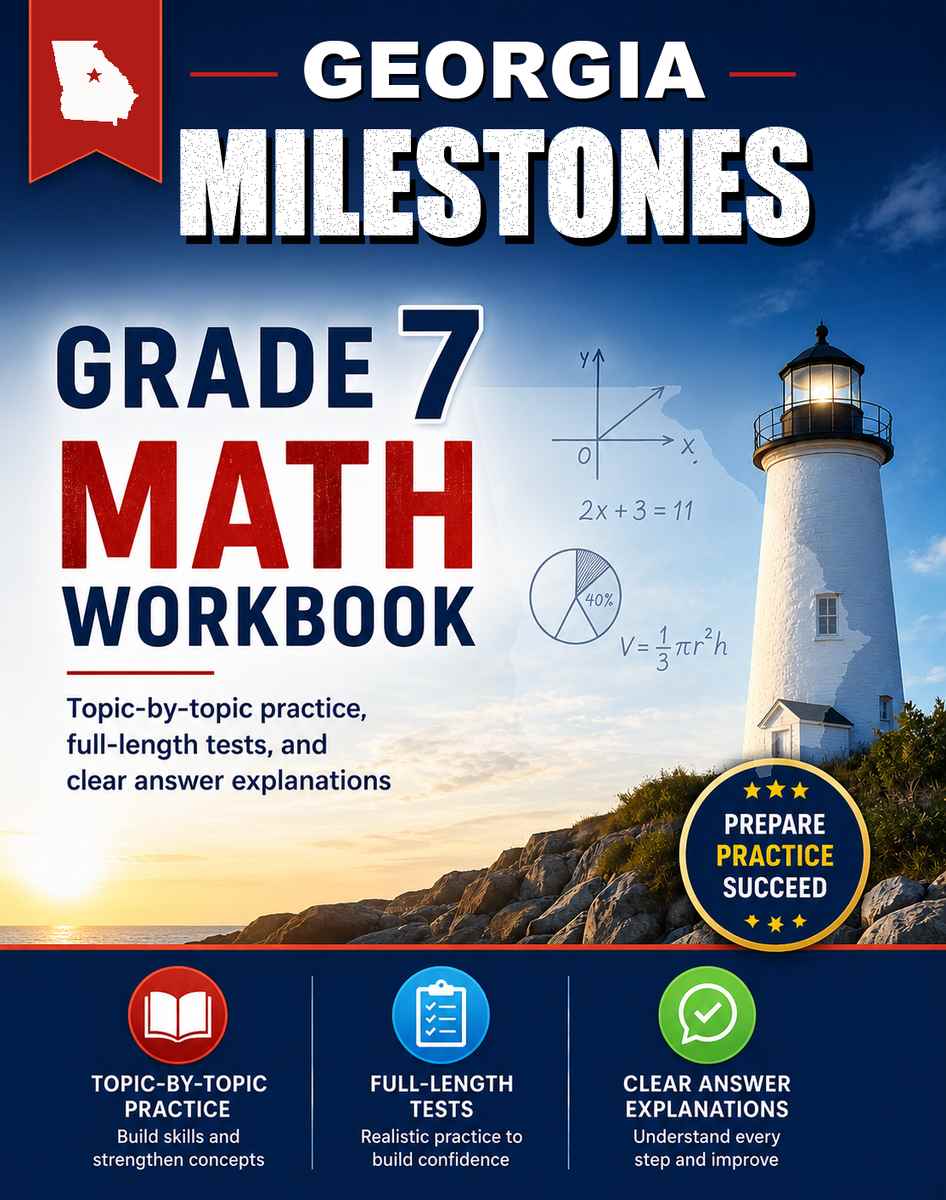
Georgia Milestones 7th Grade Math Workbook
Repeated practice by topic when a student needs more reps.
7 Georgia Milestones Grade 7 Math Practice Tests
Use after topic review to build pacing and test stamina.
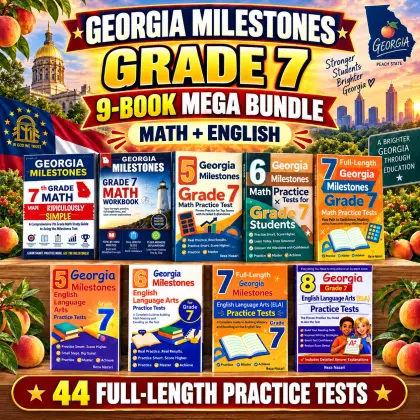
Georgia Milestones Grade 7 Math & ELA Mega Bundle
9 books and 44 full-length practice tests in one TPT bundle.
Georgia Grade 7 Math Standards
The official Georgia Grade 7 math standards, grouped by domain with the exact code and description for each expectation.
7.GSR
- 7.GSR.5Solve practical problems involving angle measurement, circles, area of circles, surface area of prisms and cylinders, and volume of cylinders and prisms composed of cubes and right prisms
- 7.GSR.5.1Measure angles in whole nonstandard units
- 7.GSR.5.2Measure angles in whole number degrees using a protractor
- 7.GSR.5.3Use facts about supplementary, complementary, vertical, and adjacent angles in a multi-step problem to write and solve equations for an unknown angle in a figure
- 7.GSR.5.4Explore and describe the relationship between pi, radius, diameter, circumference, and area of a circle to derive the formulas for the circumference and area of a circle
- 7.GSR.5.5Given the formula for the area and circumference of a circle, solve problems that exist in everyday life
- 7.GSR.5.6Solve realistic problems involving surface area of right prisms and cylinders
- 7.GSR.5.7Describe the two-dimensional figures (cross sections) that result from slicing three-dimensional figures, as in the plane sections of right rectangular prisms, right rectangular pyramids, cones, cylinders, and spheres
- 7.GSR.5.8Explore volume as a measurable attribute of cylinders and right prisms. Find the volume of these geometric figures using concrete problems
7.NR
- 7.NR.1Solve relevant, mathematical problems, including multi-step problems, involving the four operations with rational numbers and quantities in any form (integers, percentages, fractions, and decimal numbers)
- 7.NR.1.1Show that a number and its opposite have a sum of 0 (are additive inverses). Describe situations in which opposite quantities combine to make 0
- 7.NR.1.2Show and explainp+qas the number located a distance |q| fromp, in the positive or negative direction, depending on whetherqis positive or negative. Interpret sums of rational numbers by describing applicable situations
- 7.NR.1.3Represent addition and subtraction with rational numbers on a horizontal or a vertical number line diagram to solve authentic problems
- 7.NR.1.4Show and explain subtraction of rational numbers as adding the additive inverse,p-q=p+ (-q). Show that the distance between two rational numbers on the number line is the absolute value of their difference and apply this principle in contextual situations
- 7.NR.1.5Apply properties of operations, including part-whole reasoning, as strategies to add and subtract rational numbers
- 7.NR.1.6Make sense of multiplication of rational numbers using realistic applications
- 7.NR.1.7Show and explain that integers can be divided, assuming the divisor is not zero, and every quotient of integers is a rational number
- 7.NR.1.8Represent the multiplication and division of integers using a variety of strategies and interpret products and quotients of rational numbers by describing them based on the relevant situation
- 7.NR.1.9Apply properties of operations as strategies to solve multiplication and division problems involving rational numbers represented in an applicable scenario
- 7.NR.1.10Convert rational numbers between forms to include fractions, decimal numbers and percentages, using understanding of the part divided by the whole. Know that the decimal form of a rational number terminates in 0s or eventually repeats
- 7.NR.1.11Solve multi-step, contextual problems involving rational numbers, converting between forms as appropriate, and assessing the reasonableness of answers using mental computation and estimation strategies
7.PAR
- 7.PAR.2Use properties of operations, generate equivalent expressions and interpret the expressions to explain relevant situations
- 7.PAR.2.1Apply properties of operations as strategies to add, subtract, factor, and expand linear expressions with rational coefficients
- 7.PAR.2.2Rewrite an expression in different forms from a contextual problem to clarify the problem and show how the quantities in it are related
- 7.PAR.3Represent authentic situations using equations and inequalities with variables; solve equations and inequalities symbolically, using the properties of equality
- 7.PAR.3.1Construct algebraic equations to solve practical problems leading to equations of the formpx+q=randp(x+q)=r, wherep,q, andrare specific rational numbers. Interpret the solution based on the situation
- 7.PAR.3.2Construct algebraic inequalities to solve problems, leading to inequalities of the formpx±q>r,px±q<r,px±q≤r, orpx±q≥r, wherep,q, andrare specific rational numbers. Graph and interpret the solution based on the realistic situation that the inequalities represent
- 7.PAR.4Recognize proportional relationships in relevant, mathematical problems; represent, solve, and explain these relationships with tables, graphs, and equations
- 7.PAR.4.1Compute unit rates associated with ratios of fractions, including ratios of lengths, areas and other quantities measured in like or different units presented in realistic problems
- 7.PAR.4.2Determine the unit rate (constant of proportionality) in tables, graphs (1,r), equations, diagrams, and verbal descriptions of proportional relationships to solve realistic problems
- 7.PAR.4.3Determine whether two quantities presented in authentic problems are in a proportional relationship
- 7.PAR.4.4Identify, represent, and use proportional relationships
- 7.PAR.4.5Use context to explain what a point (x,y) on the graph of a proportional relationship means in terms of the situation, with special attention to the points (0, 0) and (1,r) whereris the unit rate
- 7.PAR.4.6Solve everyday problems involving scale drawings of geometric figures, including computing actual lengths and areas from a scale drawing and reproducing a scale drawing at a different scale
- 7.PAR.4.7Use similar triangles to explain why the slope,m, is the same between any two distinct points on a nonvertical line in the coordinate plane
- 7.PAR.4.8Graph proportional relationships, interpreting the unit rate as the slope of the graph. Compare two different proportional relationships represented in different ways
- 7.PAR.4.9Use proportional relationships to solve multi-step ratio and percent problems presented in applicable situations
- 7.PAR.4.10Predict characteristics of a population by examining the characteristics of a representative sample. Recognize the potential limitations and scope of the sample to the population
- 7.PAR.4.11Analyze sampling methods and conclude that random sampling produces and supports valid inferences
- 7.PAR.4.12Use data from repeated random samples to evaluate how much a sample mean is expected to vary from a population mean. Simulate multiple samples of the same size
7.PR
- 7.PR.6Using mathematical reasoning, investigate chance processes and develop, evaluate, and use probability models to find probabilities of simple events presented in authentic situations
- 7.PR.6.1Represent the probability of a chance event as a number between 0 and 1 that expresses the likelihood of the event occurring. Describe that a probability near 0 indicates an unlikely event, a probability around 1/2 indicates an event that is neither unlikely nor likely, and a probability near 1 indicates a likely event
- 7.PR.6.2Approximate the probability of a chance event by collecting data on an event and observing its long-run relative frequency will approach the theoretical probability
- 7.PR.6.3Develop a probability model and use it to find probabilities of simple events. Compare experimental and theoretical probabilities of events. If the probabilities are not close, explain possible sources of the discrepancy
- 7.PR.6.4Develop a uniform probability model by assigning equal probability to all outcomes and use the model to determine probabilities of events
- 7.PR.6.5Develop a probability model (which may not be uniform) by observing frequencies in data generated from a chance process
- 7.PR.6.6Use appropriate graphical displays and numerical summaries from data distributions with categorical or quantitative (numerical) variables as probability models to draw informal inferences about two samples or populations
Standards: Georgia Standards of Excellence. Official source ↗
Georgia Milestones Grade 7 Math FAQ
What is the Milestones Grade 7 math test?
The Milestones (Georgia Milestones Assessment System) is Georgia's Grade 7 mathematics assessment. The linked activities are independent Grade 7 practice. Their question count, timer, scoring, and item types may differ from the official assessment. Use the directions inside each activity.
Can I use a calculator?
Calculator rules depend on the grade, assessment, test segment, and approved accommodations. Follow the current assessment guidance and ask your school which rules apply. A tool available in independent practice does not establish permission on the official test.
How long is each practice test?
Read the timer and question count shown in the practice activity you open. These are practice settings, not a statement of the official assessment’s duration or scoring.
Is it free?
The linked general practice and topic resources are available separately from optional books. Check each activity’s directions and access requirements. The study guide and bundle are optional next steps.
Grade 7 Math in Other States
Explore Grade 7 math standards, practice tests, and worksheets for every state.
Make This Your Georgia Milestones Starting Point
Take a timed practice test, find your weakest topic, and study it with the linked lessons, worksheets, and the Milestones study guide.
Start a practice testA USEFUL NEXT STEP
Georgia Grade 7 Math: study questions
How should I choose a Grade 7 math study target?
Choose a current classroom target, find the matching learning reference, and use a lesson or available practice resource to check understanding. State documents control local wording and placement; shared reference codes are not a certified crosswalk.
Are these activities official state assessments?
These are independently published learning resources. A practice score does not predict or replace an official state score. Use the directions in each activity and consult your school for official testing and accommodation rules.
Resources from Effortless Math · Editorial standards