LEARN · PRACTICE · EXPLORE
Vermont Grade 7 Math
Use distribution and like terms to justify an equivalent expression, then check rational substitutions, with a selected Vermont Grade 7 reference.
Focused lessons · Useful practice · Clear next steps
Standards source: Vermont mathematics standards.
Independent Grade 7 Mathematics Practice
Six independently published Grade 7 mathematics practice sets open in popups. Follow each resource’s own directions and review its feedback alongside classroom work. These are not official state assessments; the resource’s timer and calculator settings do not establish state test policy.
VTCAP Practice Test 1
Use this independent practice set to identify topics to review alongside classroom work. Check its directions and coverage before starting.
Start Test 1 →
VTCAP Practice Test 2
Fresh questions and problem types to build accuracy.
Start Test 2 →
VTCAP Practice Test 3
Use this independent practice set to identify topics to review alongside classroom work. Check its directions and coverage before starting.
Start Test 3 →
VTCAP Practice Test 4
Use this independent practice set to identify topics to review alongside classroom work. Check its directions and coverage before starting.
Start Test 4 →
VTCAP Practice Test 5
Use this independent practice set to identify topics to review alongside classroom work. Check its directions and coverage before starting.
Start Test 5 →
VTCAP Practice Test 6
Use this independent practice set to identify topics to review alongside classroom work. Check its directions and coverage before starting.
Start Test 6 →
Vermont Grade 7 Math Study Tools
Choose a short review of selected concepts or formulas. Check the resource’s directions and compare its scope with the current classroom unit.
Grade 7 Math Flashcards
Key formulas, vocabulary, and concepts. Flip, shuffle, and track what you know.
Start Flashcards →
Grade 7 Math Formula Review
A compact independent review of selected mathematics formulas. Check its scope and the class’s permitted methods before using it.
Review Formulas →
Vermont Grade 7 Math Skill Quizzes
Choose a related independent quiz and follow its own instructions. Review the feedback with classroom work before deciding which lesson to study next.
Ratios & Proportional Relationships
Independent practice on Ratios & Proportional Relationships. Follow the quiz’s directions and discuss its feedback alongside classroom work.
Start Quiz →
Percents & Financial Literacy
Independent practice on Percents & Financial Literacy. Follow the quiz’s directions and discuss its feedback alongside classroom work.
Start Quiz →
Integers & Rational Numbers
Independent practice on Integers & Rational Numbers. Follow the quiz’s directions and discuss its feedback alongside classroom work.
Start Quiz →
Expressions, Equations & Inequalities
Independent practice on Expressions, Equations & Inequalities. Follow the quiz’s directions and discuss its feedback alongside classroom work.
Start Quiz →
Geometry, Area & Volume
Independent practice on Geometry, Area & Volume. Follow the quiz’s directions and discuss its feedback alongside classroom work.
Start Quiz →
Statistics & Data
Independent practice on Statistics & Data. Follow the quiz’s directions and discuss its feedback alongside classroom work.
Start Quiz →
Probability
Independent practice on Probability. Follow the quiz’s directions and discuss its feedback alongside classroom work.
Start Quiz →
Mixed Grade 7 Review
Independent practice on Mixed Grade 7 Review. Follow the quiz’s directions and discuss its feedback alongside classroom work.
Start Quiz →
Classroom practice and state assessment
The Vermont Agency of Education Academic Proficiency overview lists general VTCAP English and mathematics assessment in Grades 3–9. Grade 7 is included in that mathematics range. Follow the school’s current directions and accommodations. Independently published practice follows its own timing, tools, question count, and scoring; its result does not establish a state performance level. This original activity is not an official state assessment question. Read official assessment guidance.
Explain Why Two Linear Expressions Are Equivalent
Use distribution and like terms to justify an equivalent expression, then check rational substitutions, with a selected Vermont Grade 7 reference.
Every term inside the parentheses matters
Rewrite 3(2x + 4) − x without parentheses and combine like terms. A student writes 6x + 4 − x. Explain the error and justify the correct expression for any rational value of x. Test x = 1/2 as a check.
Follow the reasoning
The factor 3 multiplies both terms inside the parentheses: 3(2x + 4) = 6x + 12. Subtracting x leaves 5x + 12. The student multiplies 2x by 3 but leaves the 4 unchanged, so the written expression is not equivalent. Distribution and combining like terms establish equality for every rational x; a few substitutions can illustrate that reasoning but cannot replace it. At x = 1/2, the original gives 3(1 + 4) − 1/2 = 14.5, and 5(1/2) + 12 also gives 14.5. The student’s version gives 6.5, exposing the error in that case.
Check the explanation
An equivalent expression has the same value for all permitted substitutions. Combining 6x and −x is valid because both terms have the same variable part. The constant 12 cannot be combined with 5x as though both were multiples of x.
Try the next step
Rewrite 3(2x − 4) − x as 5x − 12. Explain how the negative constant changes the distribution. At x = −1/2, both expressions give −14.5. Use the properties to justify the identity rather than treating that one check as a proof.
Vermont reference for this worked activity
The Vermont mathematics standards directory identifies Common Core State Standards adoption in 2010. The linked publisher PDF is the June 2010 CCSS mathematics edition; the upload directory date does not establish a new adoption. Read the complete requirements and the school’s current curriculum sequence. The reference below selects one worked focus.
| Selected reference | Activity focus | Complete requirement |
|---|---|---|
| 7.EE.1 | Use operation properties to expand and combine linear expressions | Read the state-linked PDF page 49 |
This selected reference identifies the activity focus. The complete standard and grade curriculum include additional work. These labels do not certify alignment of every independent lesson, worksheet, or quiz in the broader directory.
Choose a next task from the student’s explanation
Use a different set of numbers to check whether the student can explain the same relationship. If the explanation is unclear, return to the model; if the reasoning is sound but a calculation is wrong, work through a shorter calculation and check it against the model. Use the related learning resources alongside the teacher’s assigned goals.
The Vermont Agency of Education Academic Proficiency overview lists general VTCAP English and mathematics assessment in Grades 3–9. Grade 7 is included in that mathematics range. Follow the school’s current directions and accommodations. Independently published practice follows its own timing, tools, question count, and scoring; its result does not establish a state performance level. This original activity is not an official state assessment question. Read Vermont assessment guidance.
State sources and the selected complete PDF page checked October 6, 2026. Confirm later guidance and local assignments before planning assessment preparation.
Vermont Grade 7 Math Topics
Choose a related lesson, printable resource, or quiz. This broader directory may include review and enrichment. Compare the task with the school’s learning goals; use the separately linked state reference for the worked activity above.
Ratios & Proportional Relationships
- Unit Rates with FractionsWorksheetsQuiz
- Recognizing Proportional RelationshipsWorksheetsQuiz
- Finding the Constant of ProportionalityWorksheetsQuiz
- Writing Equations for Proportional RelationshipsWorksheetsQuiz
- Graphing Proportional RelationshipsWorksheetsQuiz
- Applying Proportional Reasoning to Real-World ProblemsWorksheetsQuiz
- Proportional Reasoning with Scale ModelsWorksheetsQuiz
Percents & Their Applications
- Solving Percent ProblemsWorksheetsQuiz
- Connecting Percents and ProportionsWorksheetsQuiz
- Percent Increase and DecreaseWorksheetsQuiz
- Markups, Discounts, and Sales TaxWorksheetsQuiz
- Tips, Commissions, and FeesWorksheetsQuiz
- Simple Interest: Earning and Paying InterestWorksheetsQuiz
- Percent Error: How Close Are Your Estimates?WorksheetsQuiz
- Personal Financial LiteracyWorksheetsQuiz
- Financial Literacy, Budgeting, Saving, and InvestingWorksheetsQuiz
- Compound Interest IntroductionWorksheetsQuiz
Integers & Rational Numbers
- Integers and Their OppositesWorksheetsQuiz
- Adding IntegersWorksheetsQuiz
- Subtracting IntegersWorksheetsQuiz
- Adding and Subtracting Rational NumbersWorksheetsQuiz
- Multiplying Integers and Rational NumbersWorksheetsQuiz
- Dividing Integers and Rational NumbersWorksheetsQuiz
- Converting Rational Numbers to DecimalsWorksheetsQuiz
- Solving Real-World Problems with Rational Numbers (resource currently unavailable)WorksheetsQuiz
- Introduction to Square RootsWorksheetsQuiz
- Rational Number Operations in Extended ContextsWorksheetsQuiz
- Introduction to Scientific NotationWorksheetsQuiz
Algebraic Expressions
- Writing and Evaluating ExpressionsWorksheetsQuiz
- Simplifying Expressions by Combining Like TermsWorksheetsQuiz
- Expanding Expressions with the Distributive PropertyWorksheetsQuiz
- Factoring ExpressionsWorksheetsQuiz
- Adding and Subtracting Linear ExpressionsWorksheetsQuiz
- Rewriting Expressions to Solve ProblemsWorksheetsQuiz
- Laws of ExponentsWorksheetsQuiz
Equations & Inequalities
- Writing Two-Step Equations from Word ProblemsWorksheetsQuiz
- Solving Two-Step EquationsWorksheetsQuiz
- Solving Equations with the Distributive PropertyWorksheetsQuiz
- Solving Multi-Step Problems with Rational Numbers (resource currently unavailable)WorksheetsQuiz
- Writing and Solving InequalitiesWorksheetsQuiz
- Graphing Solutions to Inequalities on a Number LineWorksheetsQuiz
Scale Drawings & Geometric Constructions
- Understanding and Using Scale DrawingsWorksheetsQuiz
- Reproducing Scale Drawings at a Different ScaleWorksheetsQuiz
- Drawing Geometric Figures with Given ConditionsWorksheetsQuiz
- Constructing Triangles from Three MeasurementsWorksheetsQuiz
- Cross-Sections of Three-Dimensional FiguresWorksheetsQuiz
- Angle Relationships: Supplementary, Complementary, and Vertical AnglesWorksheetsQuiz
- Transformations on the Coordinate PlaneWorksheetsQuiz
- Similar Figures and ProportionsWorksheetsQuiz
Geometry: Circles, Area & Volume
Statistics & Sampling
- Populations and SamplesWorksheetsQuiz
- Making Inferences from Random SamplesWorksheetsQuiz
- Comparing Two Populations VisuallyWorksheetsQuiz
- Comparing Populations with Measures of Center and VariabilityWorksheetsQuiz
- Stem-and-Leaf PlotsWorksheetsQuiz
- Circle GraphsWorksheetsQuiz
- Data Displays ExtendedWorksheetsQuiz
Vermont Grade 7 Math Books and Resources
Compare each resource’s contents, edition, and worked explanations with the student’s current assignment before choosing a book.
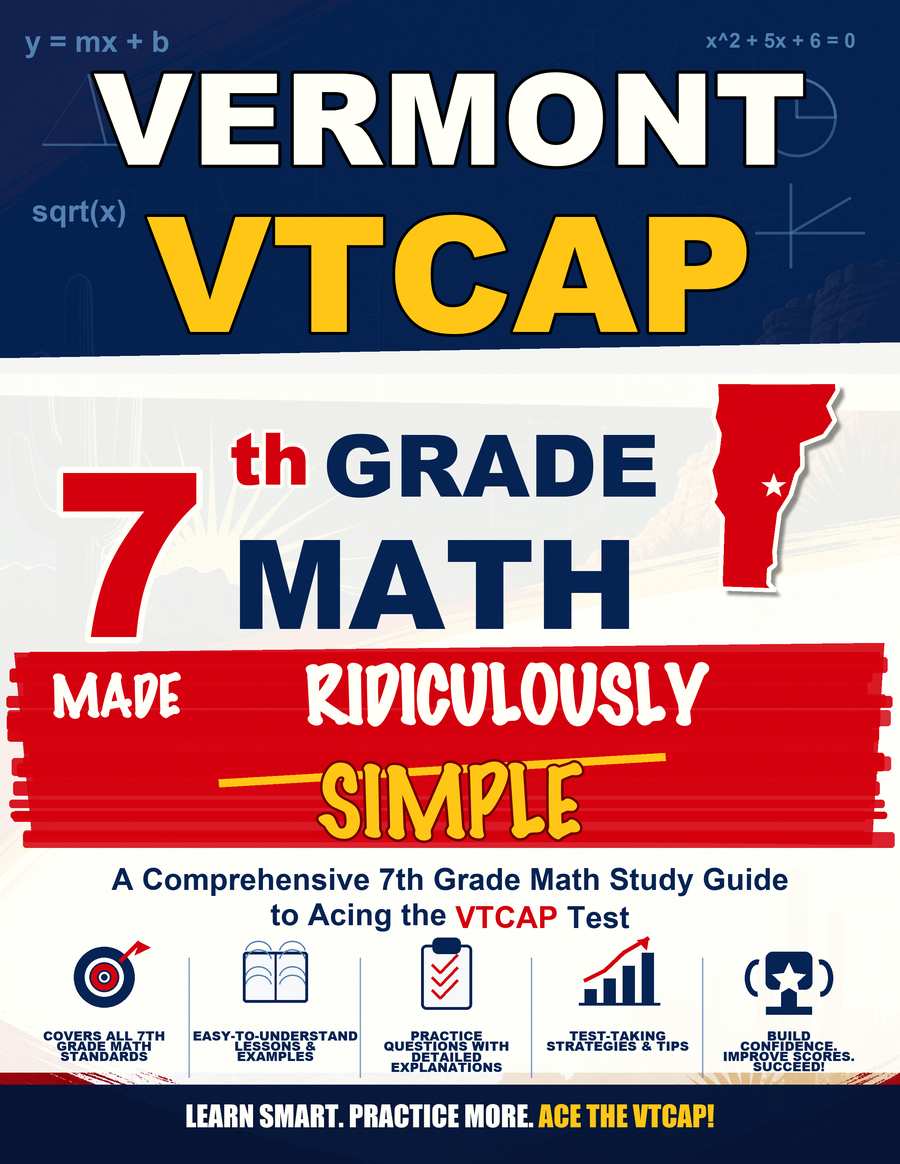
Vermont VTCAP Grade 7 Math Made Ridiculously Simple
An independently published Grade 7 mathematics resource. Compare its contents and worked explanations with the current classroom unit and complete state requirements.
- Best starting point for the VTCAP math test
- Pairs with Vermont flashcards and worksheets
- Use it before full timed practice tests
- Organized for students who need examples before drills
Step-by-step lessons
Short explanations show the move before the student practices it.
✍Worked examples
Read an explanation, try a related problem, and compare the reasoning with the classroom method.
Targeted practice
Rebuild one skill at a time instead of jumping around.
Test-day bridge
After each topic, connect to formulas, flashcards, and practice questions.
How to use it
- Read one lesson and copy the worked example.
- Do a short worksheet set on the same topic.
- Review the matching flashcards or formulas.
- Try a mixed quiz and mark every miss.
Pair it with free tools
Choose the right Vermont Grade 7 math book
Vermont VTCAP Grade 7 Math Made Ridiculously Simple
Compare the independent book’s contents and worked explanations with the topics assigned at school.
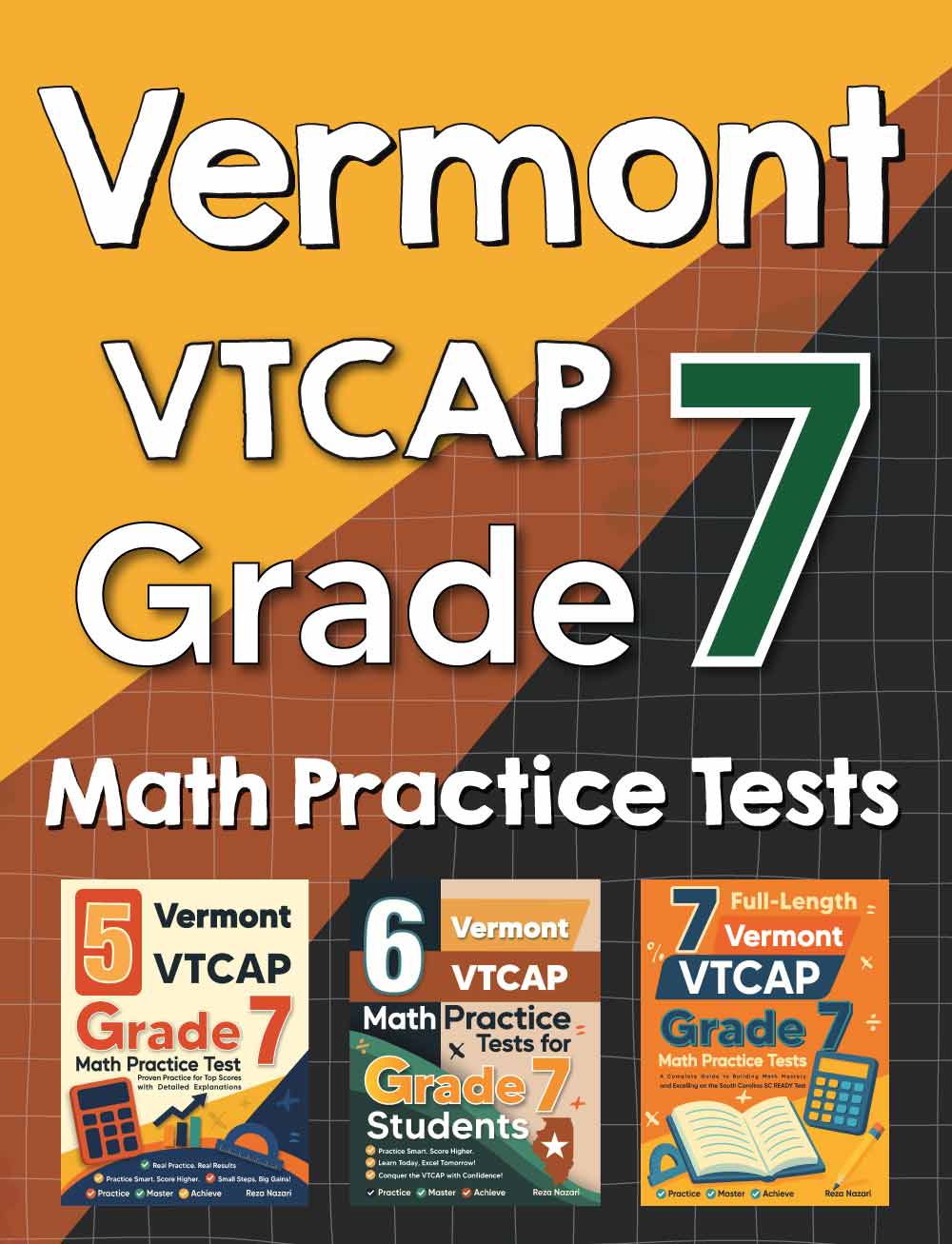
Vermont VTCAP Grade 7 Math Preparation Bundle
The full prep library, study guide, workbook, and practice tests together.
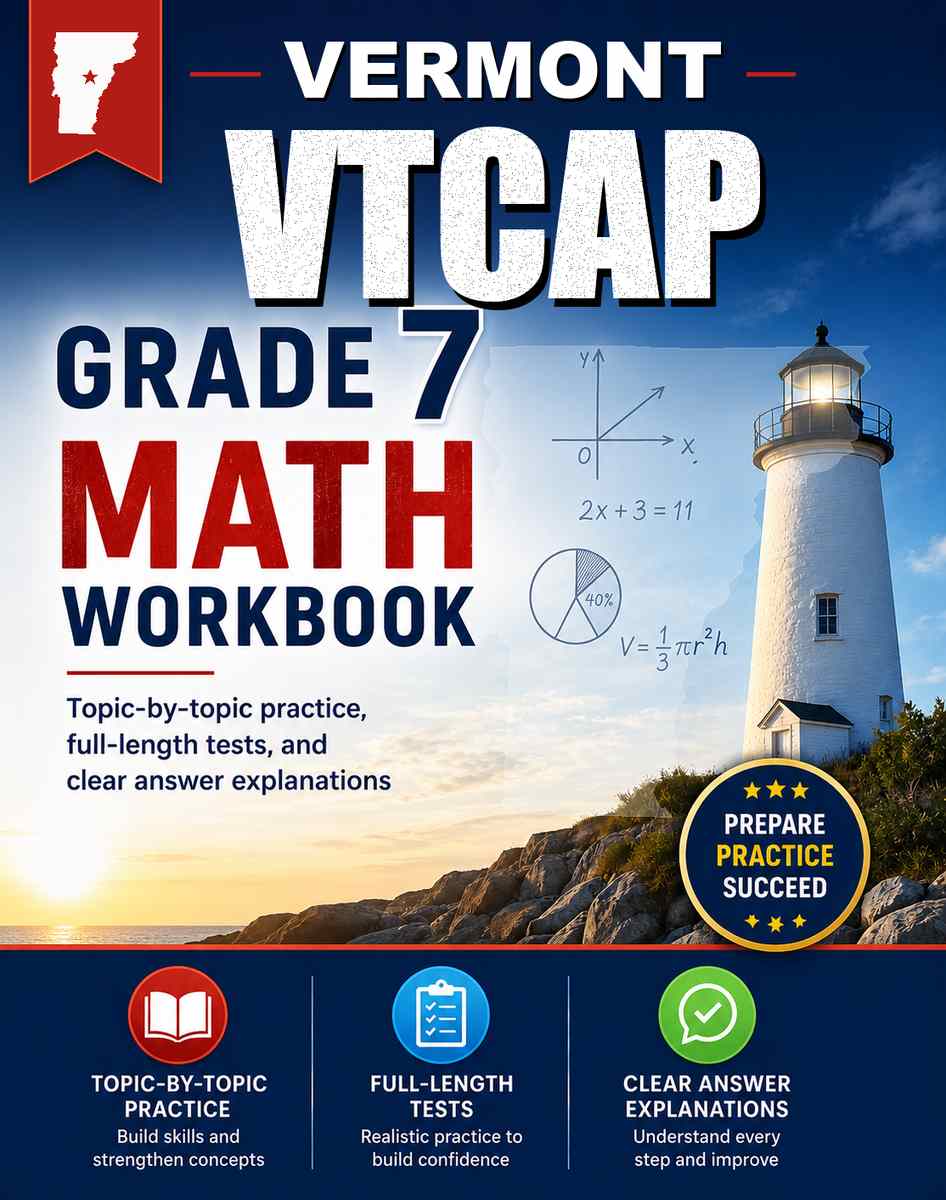
Vermont VTCAP 7th Grade Math Workbook
Repeated practice by topic when a student needs more reps.
7 Vermont VTCAP Grade 7 Math Practice Tests
Use after topic review to build pacing and test stamina.
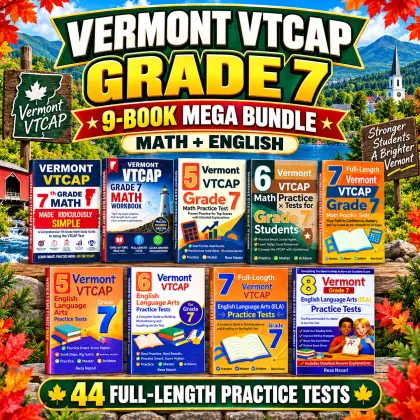
Vermont VTCAP Grade 7 Math & ELA Mega Bundle
Check the collection’s current contents and editions before choosing resources for classroom review or independent practice.
Complete Vermont Grade 7 Mathematics Requirements
Read the complete CCSS mathematics document linked through the Vermont department, including the Grade 7 overview and all grade requirements. The separately cited reference above selects the focus of one worked activity; it does not replace the full curriculum.
Open the complete state-linked mathematics PDF at the Grade 7 overview
Grade 7 math: useful planning questions
Do matching values at one substitution prove expressions equivalent?
No. A single match can occur by coincidence. Operation properties can justify equality across the whole permitted set of values.
How does Grade 7 mathematics connect with state assessment?
The Vermont Agency of Education Academic Proficiency overview lists general VTCAP English and mathematics assessment in Grades 3–9. Grade 7 is included in that mathematics range. Follow the school’s current directions and accommodations. Independently published practice follows its own timing, tools, question count, and scoring; its result does not establish a state performance level. This original activity is not an official state assessment question.
Grade 7 Math in Other States
Explore Grade 7 math standards, practice tests, and worksheets for every state.
Choose the Next Topic to Review
Review a practice response alongside classroom work. Choose a related lesson or printable task, explain the method, and check a new example with the teacher.
Start a practice testA USEFUL NEXT STEP
Vermont Grade 7 Math: study questions
Do matching values at one substitution prove expressions equivalent?
No. A single match can occur by coincidence. Operation properties can justify equality across the whole permitted set of values.
How does Grade 7 mathematics connect with state assessment?
The Vermont Agency of Education Academic Proficiency overview lists general VTCAP English and mathematics assessment in Grades 3–9. Grade 7 is included in that mathematics range. Follow the school’s current directions and accommodations. Independently published practice follows its own timing, tools, question count, and scoring; its result does not establish a state performance level. This original activity is not an official state assessment question.
Official source ↗Resources from Effortless Math · Editorial standards