LEARN · PRACTICE · EXPLORE
New Mexico Grade 7 Math
Describe plane sections of a rectangular prism in New Mexico Grade 7 math, explain how cut direction matters, and find lessons, worksheets, quizzes, and state references.
Focused lessons · Useful practice · Clear next steps
Standards source: New Mexico adopted content standards.
Explore Independent Grade 7 Math Practice
Six independently published, timed New Mexico NM-MSSA-named Grade 7 math practice tests, 40 questions each, instant scoring, a topic-by-topic breakdown, and full step-by-step solutions. Each one opens right here in a popup. Calculator: Scientific calculator (on part). These are the practice sets’ own specifications; follow the school’s current assigned assessment pathway and official directions.
NM-MSSA Practice Test 1
An independently published practice set across a range of math topics.
Start Test 1 →
NM-MSSA Practice Test 2
Fresh questions and problem types to build accuracy.
Start Test 2 →
NM-MSSA Practice Test 3
Additional independent practice across a range of skills.
Start Test 3 →
NM-MSSA Practice Test 4
Another independently published, timed practice set.
Start Test 4 →
NM-MSSA Practice Test 5
A brand-new mixed set to test your readiness.
Start Test 5 →
NM-MSSA Practice Test 6
Another independent practice set; compare its feedback with classroom work.
Start Test 6 →
New Mexico Grade 7 Math Study Tools
A few minutes of quick review, flip through flashcards or read a selected formula reference. Both open right here.
New Mexico Grade 7 Math Skill Quizzes
Short, focused quizzes, pick one skill, answer 10 questions, get instant scoring and full solutions, then jump to the matching lesson. Each opens right here.
Ratios & Proportional Relationships
A quick 10-question check on Ratios & Proportional Relationships with instant scoring and step-by-step solutions.
Start Quiz →
Percents & Financial Literacy
A quick 10-question check on Percents & Financial Literacy with instant scoring and step-by-step solutions.
Start Quiz →
Integers & Rational Numbers
A quick 10-question check on Integers & Rational Numbers with instant scoring and step-by-step solutions.
Start Quiz →
Expressions, Equations & Inequalities
A quick 10-question check on Expressions, Equations & Inequalities with instant scoring and step-by-step solutions.
Start Quiz →
Geometry, Area & Volume
A quick 10-question check on Geometry, Area & Volume with instant scoring and step-by-step solutions.
Start Quiz →
Statistics & Data
A quick 10-question check on Statistics & Data with instant scoring and step-by-step solutions.
Start Quiz →
Probability
A quick 10-question check on Probability with instant scoring and step-by-step solutions.
Start Quiz →
Mixed Grade 7 Review
A quick 10-question check on Mixed Grade 7 Review with instant scoring and step-by-step solutions.
Start Quiz →
Classroom practice and state assessment information
The current state NM-MSSA resource page describes statewide mathematics and ELA assessment at the end of Grades 3–8, including Grade 7. Scores are one measure and should be considered alongside classroom and other assessment evidence. Confirm the learner’s assigned pathway and school directions. The assessment directory is updating resources for 2026–2027; this guide does not claim Spring2027 administration specifications from a Spring2026 manual. Independently published practice may use its own timer, tools, question count, and scoring; these are not official administration specifications or a prediction of a state performance level. Read the official NM-MSSA resource page for official guidance.
Use the worked activity and lesson directory to choose a skill. Confirm the directions of an independent practice resource before assigning it.
Describe the flat shape made by a specified cut
A plane section is the two-dimensional shape where a plane passes through a solid. Its shape depends on the solid and the direction of the cut. This original rectangular-prism model specifies that direction rather than treating every section as identical.
Try this original activity
A right rectangular prism has a six-unit by four-unit base and height three units. Describe the section from a horizontal plane halfway up, parallel to the base. Then describe a vertical section through the interior, parallel to a six-unit by three-unit face. Sketch and label each section.
| Dimension or cut | Description |
|---|---|
| Base | 6 units by 4 units |
| Height | 3 units |
| Horizontal cut | Parallel to the base, halfway up |
| Vertical cut | Parallel to a 6-by-3 face, through the interior |
Work through the reasoning
The horizontal section is a rectangle measuring six units by four units. Because the sides are vertical and the plane is parallel to the base, the width and depth do not change at half the height. The vertical section parallel to the six-by-three face is a six-unit by three-unit rectangle: it spans the full six-unit direction and the full three-unit height. The first section has area 24 square units and the second 18, if those areas are calculated as a check. Neither is a box or another three-dimensional prism; the section has no thickness in the mathematical model. A drawing of the solid in perspective may make a rectangular face look slanted on the screen. Describe its mathematical shape from the specified perpendicular edges and dimensions.
Check the common mistake
Halfway up does not halve the section’s width or depth. It locates the cutting plane along the height. Similarly, cutting through the interior is different from counting an outside face, even when the shapes and dimensions match. Do not conclude that every possible tilted cut of every prism must produce the same rectangle. The direction specified in each case is essential.
Try a related case
Change the prism’s height to four units while keeping its six-by-four base. The horizontal section remains six by four, while the parallel vertical section becomes six by four too. Explain why equal section shapes in this new case do not mean the two cutting planes have the same orientation. For a different solid, use a teacher-guided paper model to examine a cut before predicting its section.
Selected New Mexico mathematics references for this activity
The current New Mexico adopted content standards directory links the Common Core mathematics standards. The selected references below were checked in the state-hosted 2010 standards document. They identify this activity’s focus, rather than a complete course. Read the full requirements, mathematical practices, examples, and progression alongside the school’s curriculum.
| Selected reference | Activity focus | State-hosted document |
|---|---|---|
| 7.G.3 | Describe two-dimensional sections of three-dimensional figures | Read the state-hosted PDF, page 50 |
Sources checked October 6, 2026. Read complete requirements, clarifications, limitations, and mathematical practices alongside the school’s sequence. This selected activity is an entry point for instruction.
Connect the explanation with practice
Use the lesson, worksheet, and quiz directory to choose a related skill. The existing resource links remain available; open each activity’s directions to understand its timer, tools, question count, and scoring.
The current state NM-MSSA resource page describes statewide mathematics and ELA assessment at the end of Grades 3–8, including Grade 7. Scores are one measure and should be considered alongside classroom and other assessment evidence. Confirm the learner’s assigned pathway and school directions. The assessment directory is updating resources for 2026–2027; this guide does not claim Spring2027 administration specifications from a Spring2026 manual. Independently published practice may use its own timer, tools, question count, and scoring; these are not official administration specifications or a prediction of a state performance level. Read the official NM-MSSA resource page.
Read New Mexico adopted content standards for later guidance. Keep one example of the student’s reasoning with the practice result. Choose a smaller model, a related question, or a new context according to the difficulty revealed in the worked activity.
New Mexico Grade 7 Math Topics
Choose a lesson, printable worksheet collection, or topic quiz. This broader library includes review and enrichment. Use the school’s current sequence and the complete state standards when choosing skills; these rows are not a certified full-course crosswalk.
Ratios & Proportional Relationships
- Unit Rates with FractionsWorksheetsQuiz
- Recognizing Proportional RelationshipsWorksheetsQuiz
- Finding the Constant of ProportionalityWorksheetsQuiz
- Writing Equations for Proportional RelationshipsWorksheetsQuiz
- Graphing Proportional RelationshipsWorksheetsQuiz
- Applying Proportional Reasoning to Real-World ProblemsWorksheetsQuiz
- Proportional Reasoning with Scale ModelsWorksheetsQuiz
Percents & Their Applications
- Solving Percent ProblemsWorksheetsQuiz
- Connecting Percents and ProportionsWorksheetsQuiz
- Percent Increase and DecreaseWorksheetsQuiz
- Markups, Discounts, and Sales TaxWorksheetsQuiz
- Tips, Commissions, and FeesWorksheetsQuiz
- Simple Interest: Earning and Paying InterestWorksheetsQuiz
- Percent Error: How Close Are Your Estimates?WorksheetsQuiz
- Personal Financial LiteracyWorksheetsQuiz
- Financial Literacy, Budgeting, Saving, and InvestingWorksheetsQuiz
- Compound Interest IntroductionWorksheetsQuiz
Integers & Rational Numbers
- Integers and Their OppositesWorksheetsQuiz
- Adding IntegersWorksheetsQuiz
- Subtracting IntegersWorksheetsQuiz
- Adding and Subtracting Rational NumbersWorksheetsQuiz
- Multiplying Integers and Rational NumbersWorksheetsQuiz
- Dividing Integers and Rational NumbersWorksheetsQuiz
- Converting Rational Numbers to DecimalsWorksheetsQuiz
- Solving Real-World Problems with Rational Numbers (resource currently unavailable)WorksheetsQuiz
- Introduction to Square RootsWorksheetsQuiz
- Rational Number Operations in Extended ContextsWorksheetsQuiz
- Introduction to Scientific NotationWorksheetsQuiz
Algebraic Expressions
- Writing and Evaluating ExpressionsWorksheetsQuiz
- Simplifying Expressions by Combining Like TermsWorksheetsQuiz
- Expanding Expressions with the Distributive PropertyWorksheetsQuiz
- Factoring ExpressionsWorksheetsQuiz
- Adding and Subtracting Linear ExpressionsWorksheetsQuiz
- Rewriting Expressions to Solve ProblemsWorksheetsQuiz
- Laws of ExponentsWorksheetsQuiz
Equations & Inequalities
- Writing Two-Step Equations from Word ProblemsWorksheetsQuiz
- Solving Two-Step EquationsWorksheetsQuiz
- Solving Equations with the Distributive PropertyWorksheetsQuiz
- Solving Multi-Step Problems with Rational Numbers (resource currently unavailable)WorksheetsQuiz
- Writing and Solving InequalitiesWorksheetsQuiz
- Graphing Solutions to Inequalities on a Number LineWorksheetsQuiz
Scale Drawings & Geometric Constructions
- Understanding and Using Scale DrawingsWorksheetsQuiz
- Reproducing Scale Drawings at a Different ScaleWorksheetsQuiz
- Drawing Geometric Figures with Given ConditionsWorksheetsQuiz
- Constructing Triangles from Three MeasurementsWorksheetsQuiz
- Cross-Sections of Three-Dimensional FiguresWorksheetsQuiz
- Angle Relationships: Supplementary, Complementary, and Vertical AnglesWorksheetsQuiz
- Transformations on the Coordinate PlaneWorksheetsQuiz
- Similar Figures and ProportionsWorksheetsQuiz
Geometry: Circles, Area & Volume
Statistics & Sampling
- Populations and SamplesWorksheetsQuiz
- Making Inferences from Random SamplesWorksheetsQuiz
- Comparing Two Populations VisuallyWorksheetsQuiz
- Comparing Populations with Measures of Center and VariabilityWorksheetsQuiz
- Stem-and-Leaf PlotsWorksheetsQuiz
- Circle GraphsWorksheetsQuiz
- Data Displays ExtendedWorksheetsQuiz
New Mexico Grade 7 Math Books and Resources
Each book has a job: start from scratch, drill weak skills, or build pacing with full tests. All of them pair with the free tools on this page.
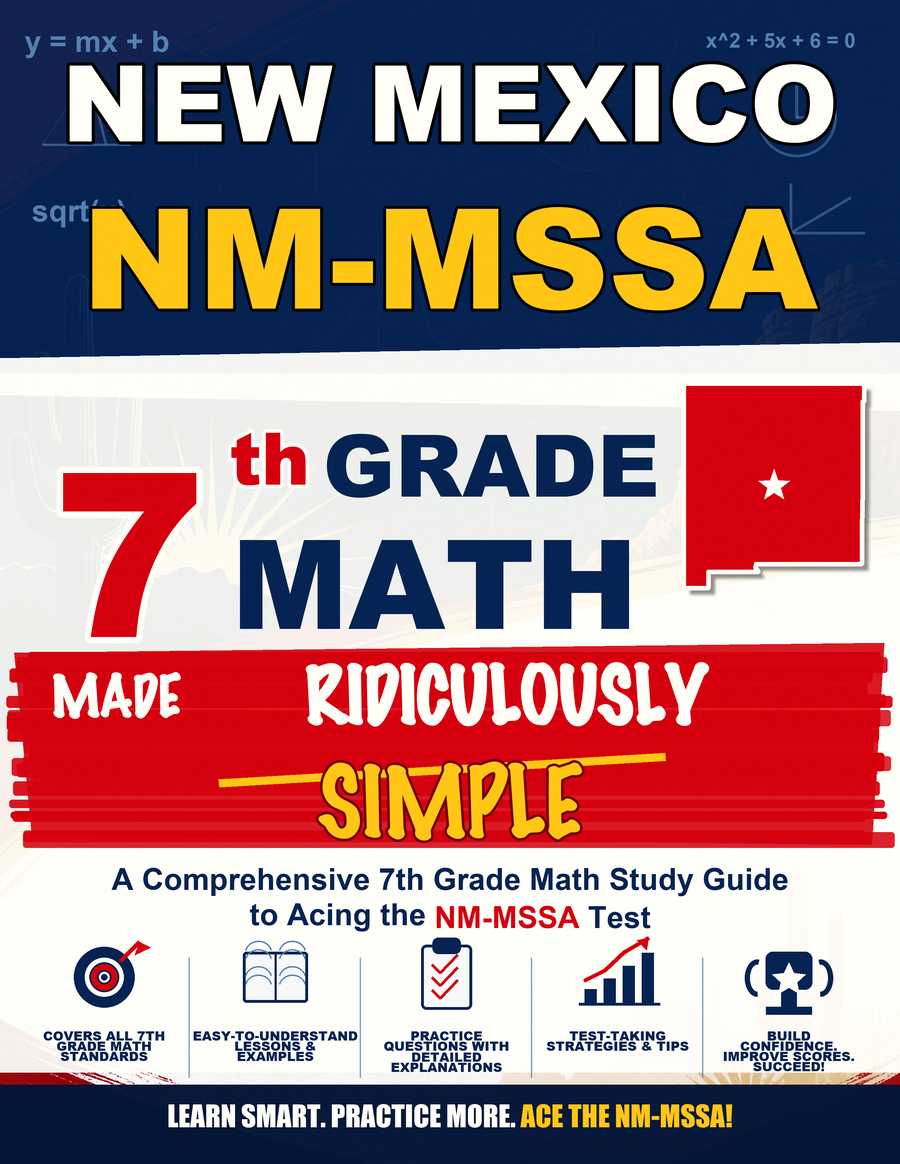
New Mexico NM-MSSA Grade 7 Math Made Ridiculously Simple
An independently published Grade 7 mathematics resource. Check its edition and contents against New Mexico’s adopted document and the school’s course before choosing preparation.
- Best starting point for the NM-MSSA math test
- Pairs with New Mexico flashcards and worksheets
- Use it before full timed practice tests
- Organized for students who need examples before drills
Step-by-step lessons
Short explanations show the move before the student practices it.
✍Worked examples
Check the listed book’s contents and edition against the learner’s course before choosing it.
Targeted practice
Rebuild one skill at a time instead of jumping around.
Test-day bridge
After each topic, connect to formulas, flashcards, and practice questions.
How to use it
- Read one lesson and copy the worked example.
- Do a short worksheet set on the same topic.
- Review the matching flashcards or formulas.
- Try a mixed quiz and mark every miss.
Pair it with free tools
Choose the right New Mexico Grade 7 math book
New Mexico NM-MSSA Grade 7 Math Made Ridiculously Simple
Choose a resource that fits the learner’s current Grade 7 mathematics work.
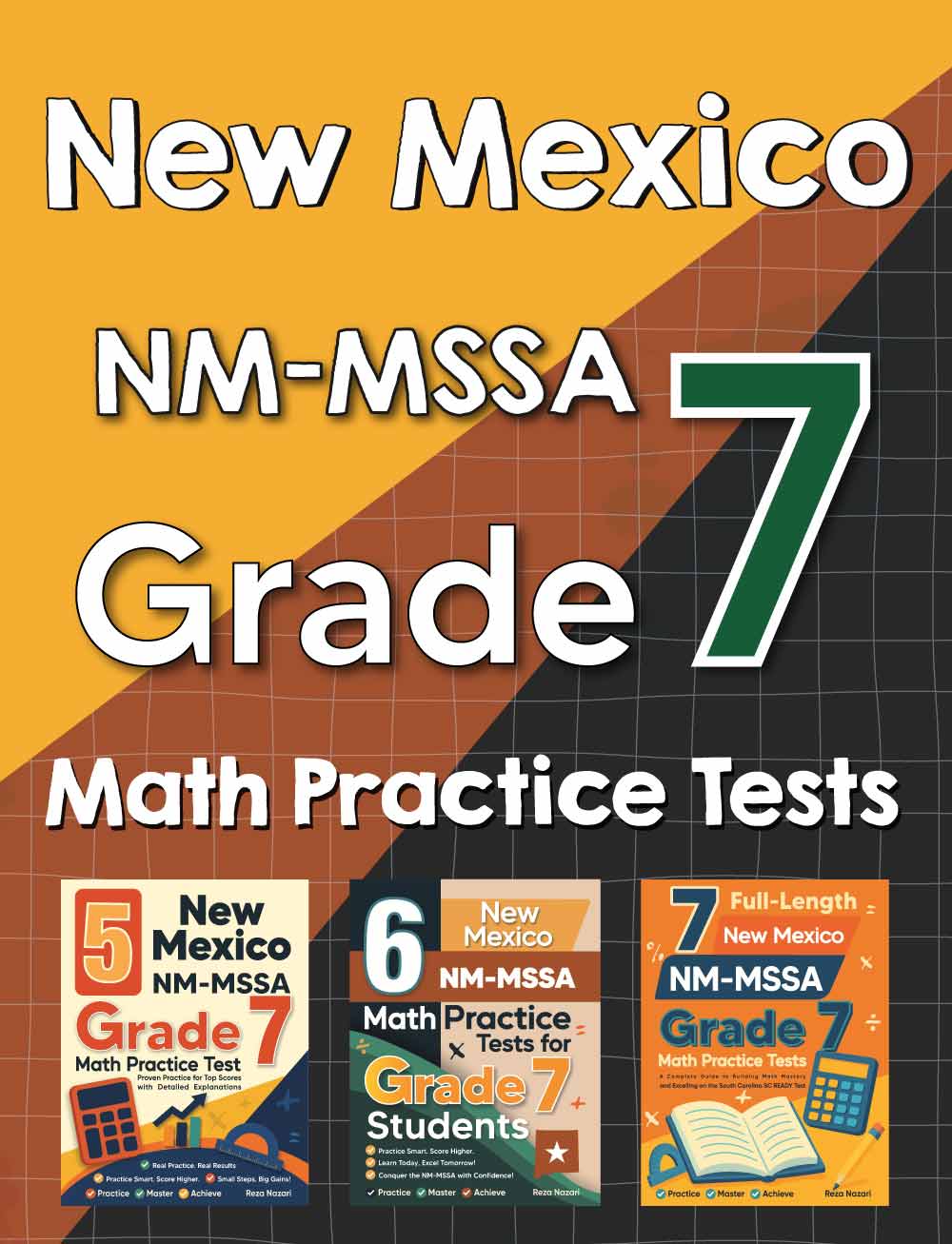
New Mexico NM-MSSA Grade 7 Math Preparation Bundle
The full prep library, study guide, workbook, and practice tests together.
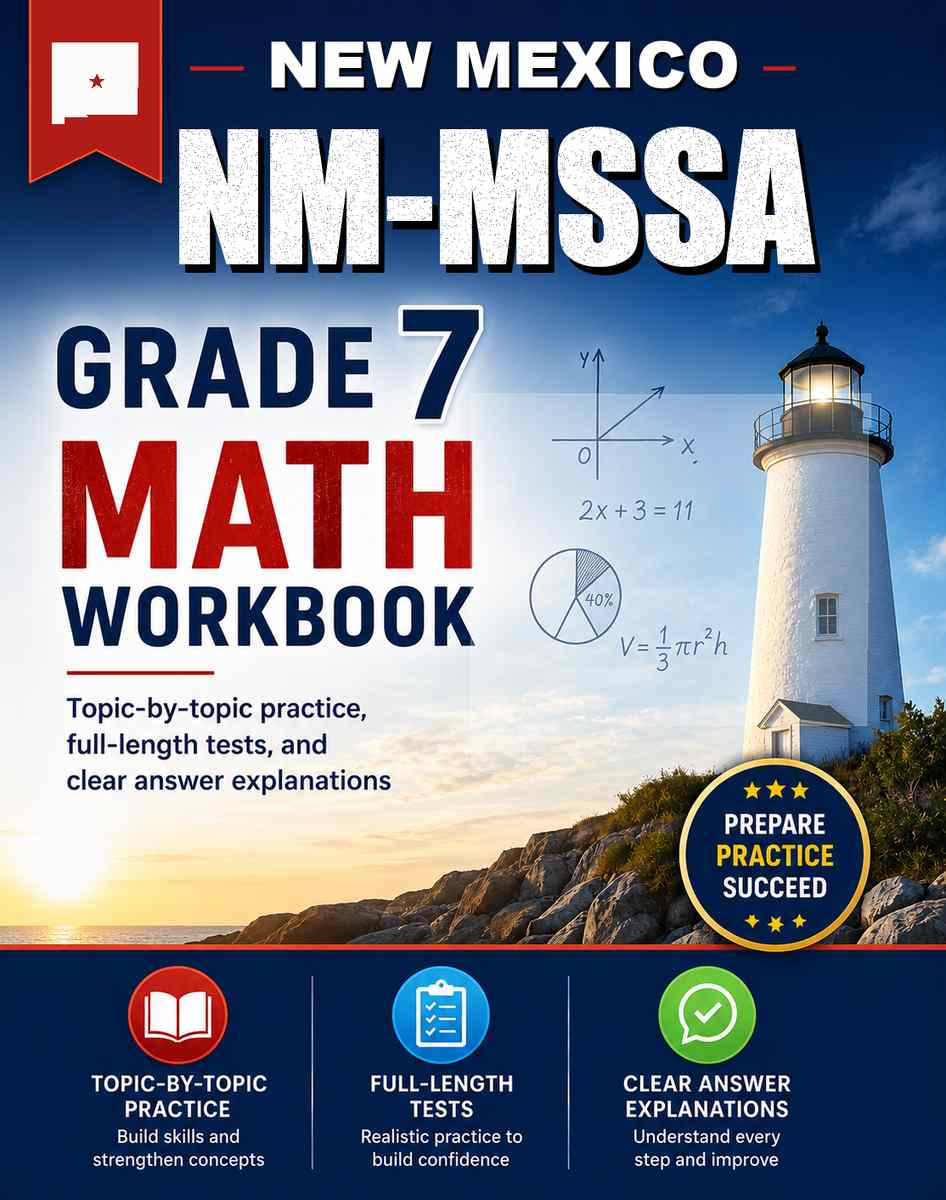
New Mexico NM-MSSA 7th Grade Math Workbook
Repeated practice by topic when a student needs more reps.
7 New Mexico NM-MSSA Grade 7 Math Practice Tests
Use after topic review to build pacing and test stamina.
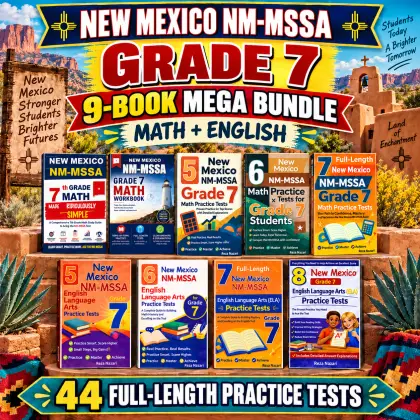
New Mexico NM-MSSA Grade 7 Math & ELA Mega Bundle
9 books and 44 full-length practice tests in one TPT bundle.
Read the complete mathematics requirements
The New Mexico standards directory links the Common Core mathematics document with grade-level requirements, examples, clarifications, and mathematical practices. Read these alongside the school’s learning sequence. This activity and the broader independent lesson library are not a certified full curriculum crosswalk.
New Mexico Grade 7 math: useful study questions
Does a plane section keep the solid’s thickness?
No. It is the two-dimensional intersection with a plane. A physical slice may have thickness, but the mathematical section describes the flat shape at the cut.
Which statewide mathematics assessment pathway applies to New Mexico Grade 7?
The current state NM-MSSA resource page describes statewide mathematics and ELA assessment at the end of Grades 3–8, including Grade 7. Scores are one measure and should be considered alongside classroom and other assessment evidence. Confirm the learner’s assigned pathway and school directions. The assessment directory is updating resources for 2026–2027; this guide does not claim Spring2027 administration specifications from a Spring2026 manual. Independently published practice may use its own timer, tools, question count, and scoring; these are not official administration specifications or a prediction of a state performance level.
Grade 7 Math in Other States
Explore Grade 7 math standards, practice tests, and worksheets for every state.
Plan Your Next Grade 7 Math Task
Choose a related practice resource, compare its feedback with classroom explanations, and follow the school’s current learning and assessment guidance.
Start a practice testA USEFUL NEXT STEP
New Mexico Grade 7 Math: study questions
Does a plane section keep the solid’s thickness?
No. It is the two-dimensional intersection with a plane. A physical slice may have thickness, but the mathematical section describes the flat shape at the cut.
Which statewide mathematics assessment pathway applies to New Mexico Grade 7?
The current state NM-MSSA resource page describes statewide mathematics and ELA assessment at the end of Grades 3–8, including Grade 7. Scores are one measure and should be considered alongside classroom and other assessment evidence. Confirm the learner’s assigned pathway and school directions. The assessment directory is updating resources for 2026–2027; this guide does not claim Spring2027 administration specifications from a Spring2026 manual. Independently published practice may use its own timer, tools, question count, and scoring; these are not official administration specifications or a prediction of a state performance level.
Official source ↗Resources from Effortless Math · Editorial standards