LEARN · PRACTICE · EXPLORE
California Grade 7 Math
Apply a 25% discount and then an invented 8% tax, explain the changing base, and find California Grade 7 proportional-reasoning references and practice.
Focused lessons · Useful practice · Clear next steps
What do California 7th graders learn in math?
In 7th grade, California math centers on proportional relationships, operations with negative numbers, multi-step equations and inequalities, circles and angles, and probability. Students take the CAASPP grade 7 math test in the spring. This page explains each California grade 7 math standard and pairs it with short lessons, skill quizzes, printable worksheets and a full-length practice test.
Printable California grade 7 math books:
Standards source: Content Standards, California Department of Education.
Start With a CAASPP Practice Test
Six full, timed California CAASPP Grade 7 math practice tests, 40 questions each, instant scoring, a topic-by-topic breakdown, and full step-by-step solutions. Each one opens right here in a popup. Calculator: Scientific calculator (on part).
CAASPP Practice Test 1
A full diagnostic across every California Grade 7 math topic.
Start Test 1 →
CAASPP Practice Test 2
Fresh questions and problem types to build accuracy.
Start Test 2 →
CAASPP Practice Test 3
New problems to add speed and confidence on every skill.
Start Test 3 →
CAASPP Practice Test 4
Another complete, timed exam to build pacing and stamina.
Start Test 4 →
CAASPP Practice Test 5
A brand-new mixed set to test your readiness.
Start Test 5 →
CAASPP Practice Test 6
A final full-length simulation to confirm you are ready.
Start Test 6 →
California Grade 7 Math Study Tools
A few minutes of quick review, flip through flashcards or scan every key formula. Both open right here.
California Grade 7 Math Skill Quizzes
Short, focused quizzes, pick one skill, answer 10 questions, get instant scoring and full solutions, then jump to the matching lesson. Each opens right here.
Ratios & Proportional Relationships
A quick 10-question check on Ratios & Proportional Relationships with instant scoring and step-by-step solutions.
Start Quiz →
Percents & Financial Literacy
A quick 10-question check on Percents & Financial Literacy with instant scoring and step-by-step solutions.
Start Quiz →
Integers & Rational Numbers
A quick 10-question check on Integers & Rational Numbers with instant scoring and step-by-step solutions.
Start Quiz →
Expressions, Equations & Inequalities
A quick 10-question check on Expressions, Equations & Inequalities with instant scoring and step-by-step solutions.
Start Quiz →
Geometry, Area & Volume
A quick 10-question check on Geometry, Area & Volume with instant scoring and step-by-step solutions.
Start Quiz →
Statistics & Data
A quick 10-question check on Statistics & Data with instant scoring and step-by-step solutions.
Start Quiz →
Probability
A quick 10-question check on Probability with instant scoring and step-by-step solutions.
Start Quiz →
Mixed Grade 7 Review
A quick 10-question check on Mixed Grade 7 Review with instant scoring and step-by-step solutions.
Start Quiz →
Plan classroom practice and assessment preparation
Grade 7 falls within California’s Smarter Balanced summative mathematics testing range. Read the official assessment overview for the program’s format and guidance.
The practice tests, topic quizzes, and books linked here are independently published. Their timers, question counts, tools, and scores describe those resources. Open an activity’s directions before using it; a practice score does not establish an official state performance level.
Keep the percentage base clear at each step
Work through a problem, explain what each quantity means, and use the explanation to choose the next lesson or practice task.
A discount followed by tax
In this invented purchase problem, an item’s listed price is $80. A 25% discount applies first, and an 8% tax is then charged on the discounted price. The tax rate is part of the mathematical example, not a statement of any California jurisdiction’s current rate. What is the final total?
The discount is 0.25 × $80 = $20. The discounted price is $80 − $20 = $60, or 0.75 × $80. Tax is now based on $60: 0.08 × $60 = $4.80. The final total is $60 + $4.80 = $64.80.
Why not subtract the percentages?
Subtracting 8 from 25 and treating the result as a 17% discount uses one base for both percentages. That gives 0.83 × $80 = $66.40, which does not follow the stated steps. The discount uses the original $80, while tax uses the new $60 subtotal. A compact calculation preserving that sequence is $80 × 0.75 × 1.08 = $64.80.
At a fixed 8% tax rate, a subtotal s and its after-tax total t have the proportional relationship t = 1.08s. The coefficient includes the original subtotal plus eight percent of it. Applied to s = 60, the equation gives t = 64.80. Applied to a different subtotal, it still uses that new subtotal as its base.
Explain before extending the problem
An answer of $60 omits tax. An answer of $66.40 combines percentages with different bases. An answer of $86.40 taxes the original price and ignores the discount. Ask the student to label the base beside each percent calculation rather than correcting only the final number.
- Name the original price and calculate the discount amount.
- Record the new subtotal before applying tax.
- Use the subtotal as the tax base and add the tax amount.
- Check the total with the two multipliers and include dollars.
Change the original price to $120 while keeping the example’s rates. Have the student use the same structure to obtain $97.20. A later extension can compare a fixed-dollar discount with a percent discount. Keep real purchase decisions separate from the invented tax assumptions in this exercise.
Selected California Grade 7 references
These activity labels summarize two references in California’s mathematics standards, modified January 2013. Consult the complete document for the grade’s broader content and mathematical practices. California additions are marked CA in the source.
| Reference | Activity focus | Official document |
|---|---|---|
| 7.RP.3 | Multistep percent problems | Read page 55 |
| 7.RP.2c | Proportional equations | Read page 55 |
The state mathematics resource directory also links teaching guidance. State sources checked October 5, 2026.
California Grade 7 Math Topics
70 student-friendly Grade 7 math skills connected to the California standards, each tagged with its CAASPP standard code and a focused lesson.
Ratios & Proportional Relationships
- 7.RP.1Unit Rates with FractionsWorksheetsQuiz
- 7.G.3Recognizing Proportional RelationshipsWorksheetsQuiz
- 7.SP.8Finding the Constant of ProportionalityWorksheetsQuiz
- 7.RP.2Writing Equations for Proportional RelationshipsWorksheetsQuiz
- 7.RP.3Graphing Proportional RelationshipsWorksheetsQuiz
- 7.RP.3Applying Proportional Reasoning to Real-World ProblemsWorksheetsQuiz
- 7.G.1Proportional Reasoning with Scale ModelsWorksheetsQuiz
Percents & Their Applications
- 7.G.2Solving Percent ProblemsWorksheetsQuiz
- 7.RP.3Connecting Percents and ProportionsWorksheetsQuiz
- 7.EE.1Percent Increase and DecreaseWorksheetsQuiz
- 7.NS.3Markups, Discounts, and Sales TaxWorksheetsQuiz
- 7.EE.1Tips, Commissions, and FeesWorksheetsQuiz
- 7.EE.2Simple Interest: Earning and Paying InterestWorksheetsQuiz
- 7.EE.2Percent Error: How Close Are Your Estimates?WorksheetsQuiz
- 7.RP.1Personal Financial LiteracyWorksheetsQuiz
- 7.SP.8Financial Literacy, Budgeting, Saving, and InvestingWorksheetsQuiz
- 7.SP.8Compound Interest IntroductionWorksheetsQuiz
Integers & Rational Numbers
- 7.EE.2Integers and Their OppositesWorksheetsQuiz
- 7.NS.1Adding IntegersWorksheetsQuiz
- 7.NS.1Subtracting IntegersWorksheetsQuiz
- 7.EE.3Adding and Subtracting Rational NumbersWorksheetsQuiz
- 7.NS.2Multiplying Integers and Rational NumbersWorksheetsQuiz
- 7.NS.1Dividing Integers and Rational NumbersWorksheetsQuiz
- 7.NS.1Converting Rational Numbers to DecimalsWorksheetsQuiz
- 7.EE.3Solving Real-World Problems with Rational Numbers (resource currently unavailable)WorksheetsQuiz
- 7.NS.1Introduction to Square RootsWorksheetsQuiz
- 7.NS.3Rational Number Operations in Extended ContextsWorksheetsQuiz
- 7.NS.2Introduction to Scientific NotationWorksheetsQuiz
Algebraic Expressions
- 7.EE.1Writing and Evaluating ExpressionsWorksheetsQuiz
- 7.EE.1Simplifying Expressions by Combining Like TermsWorksheetsQuiz
- 7.EE.1Expanding Expressions with the Distributive PropertyWorksheetsQuiz
- 7.EE.1Factoring ExpressionsWorksheetsQuiz
- 7.EE.1Adding and Subtracting Linear ExpressionsWorksheetsQuiz
- 7.EE.2Rewriting Expressions to Solve ProblemsWorksheetsQuiz
- 7.NS.2Laws of ExponentsWorksheetsQuiz
Equations & Inequalities
- 7.G.6Writing Two-Step Equations from Word ProblemsWorksheetsQuiz
- 7.EE.3Solving Two-Step EquationsWorksheetsQuiz
- 7.EE.1Solving Equations with the Distributive PropertyWorksheetsQuiz
- 7.EE.3Solving Multi-Step Problems with Rational Numbers (resource currently unavailable)WorksheetsQuiz
- 7.EE.4Writing and Solving InequalitiesWorksheetsQuiz
- 7.EE.4Graphing Solutions to Inequalities on a Number LineWorksheetsQuiz
Scale Drawings & Geometric Constructions
- 7.G.1Understanding and Using Scale DrawingsWorksheetsQuiz
- 7.G.1Reproducing Scale Drawings at a Different ScaleWorksheetsQuiz
- 7.G.2Drawing Geometric Figures with Given ConditionsWorksheetsQuiz
- 7.G.2Constructing Triangles from Three MeasurementsWorksheetsQuiz
- 7.G.3Cross-Sections of Three-Dimensional FiguresWorksheetsQuiz
- 7.G.5Angle Relationships: Supplementary, Complementary, and Vertical AnglesWorksheetsQuiz
- 7.G.3Transformations on the Coordinate PlaneWorksheetsQuiz
- 7.G.1Similar Figures and ProportionsWorksheetsQuiz
Geometry: Circles, Area & Volume
- 7.G.4Parts of a CircleWorksheetsQuiz
- 7.G.4Circumference of a CircleWorksheetsQuiz
- 7.G.4Area of a CircleWorksheetsQuiz
- 7.G.6Area of Composite ShapesWorksheetsQuiz
- 7.G.6Surface Area of Three-Dimensional ObjectsWorksheetsQuiz
- 7.G.6Volume of PrismsWorksheetsQuiz
- 7.G.6Cylinder Surface Area and VolumeWorksheetsQuiz
Statistics & Sampling
- 7.SP.1Populations and SamplesWorksheetsQuiz
- 7.SP.2Making Inferences from Random SamplesWorksheetsQuiz
- 7.SP.3Comparing Two Populations VisuallyWorksheetsQuiz
- 7.SP.4Comparing Populations with Measures of Center and VariabilityWorksheetsQuiz
- 7.SP.4Stem-and-Leaf PlotsWorksheetsQuiz
- 7.EE.3Circle GraphsWorksheetsQuiz
- 7.G.5Data Displays ExtendedWorksheetsQuiz
Probability
- 7.SP.5What Is Probability?WorksheetsQuiz
- 7.SP.7Theoretical ProbabilityWorksheetsQuiz
- 7.SP.6Experimental ProbabilityWorksheetsQuiz
- 7.SP.7Probability ModelsWorksheetsQuiz
- 7.SP.8Sample Spaces for Compound EventsWorksheetsQuiz
- 7.SP.8Finding Probabilities of Compound EventsWorksheetsQuiz
- 7.SP.7Simulating Compound EventsWorksheetsQuiz
Best California CAASPP Grade 7 Math Books
Each book has a job: start from scratch, drill weak skills, or build pacing with full tests. All of them pair with the free tools on this page.
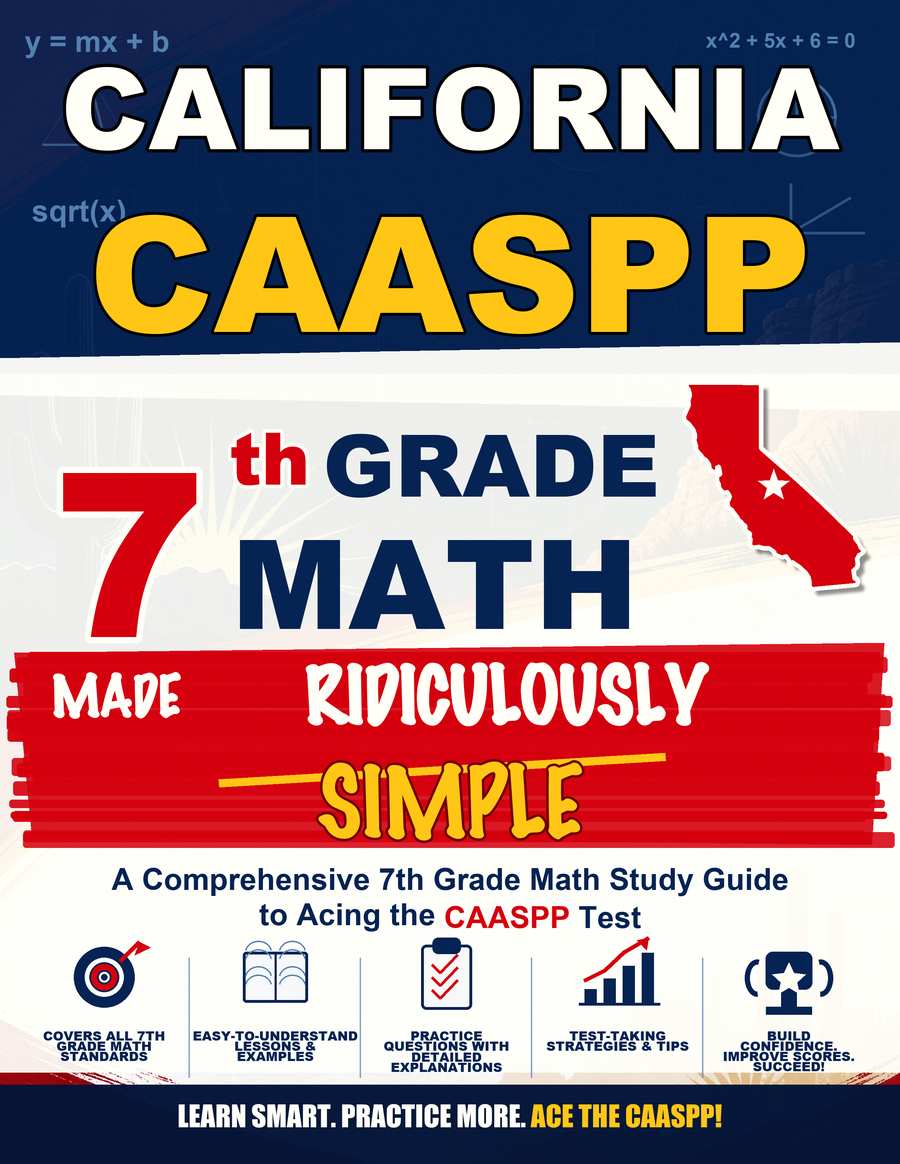
California CAASPP Grade 7 Math Made Ridiculously Simple
A step-by-step CAASPP Grade 7 math book that rebuilds every tested skill clearly and in order, built to match the California standards.
- Best starting point for the CAASPP math test
- Pairs with California flashcards and worksheets
- Use it before full timed practice tests
- Organized for students who need examples before drills
Step-by-step lessons
Short explanations show the move before the student practices it.
✍Worked examples
Examples translate CAASPP-style wording into clear math steps.
Targeted practice
Rebuild one skill at a time instead of jumping around.
Test-day bridge
After each topic, connect to formulas, flashcards, and practice questions.
How to use it
- Read one lesson and copy the worked example.
- Do a short worksheet set on the same topic.
- Review the matching flashcards or formulas.
- Try a mixed quiz and mark every miss.
Pair it with free tools
Choose the right California Grade 7 math book
California CAASPP Grade 7 Math Made Ridiculously Simple
Start here to rebuild CAASPP math from the ground up.
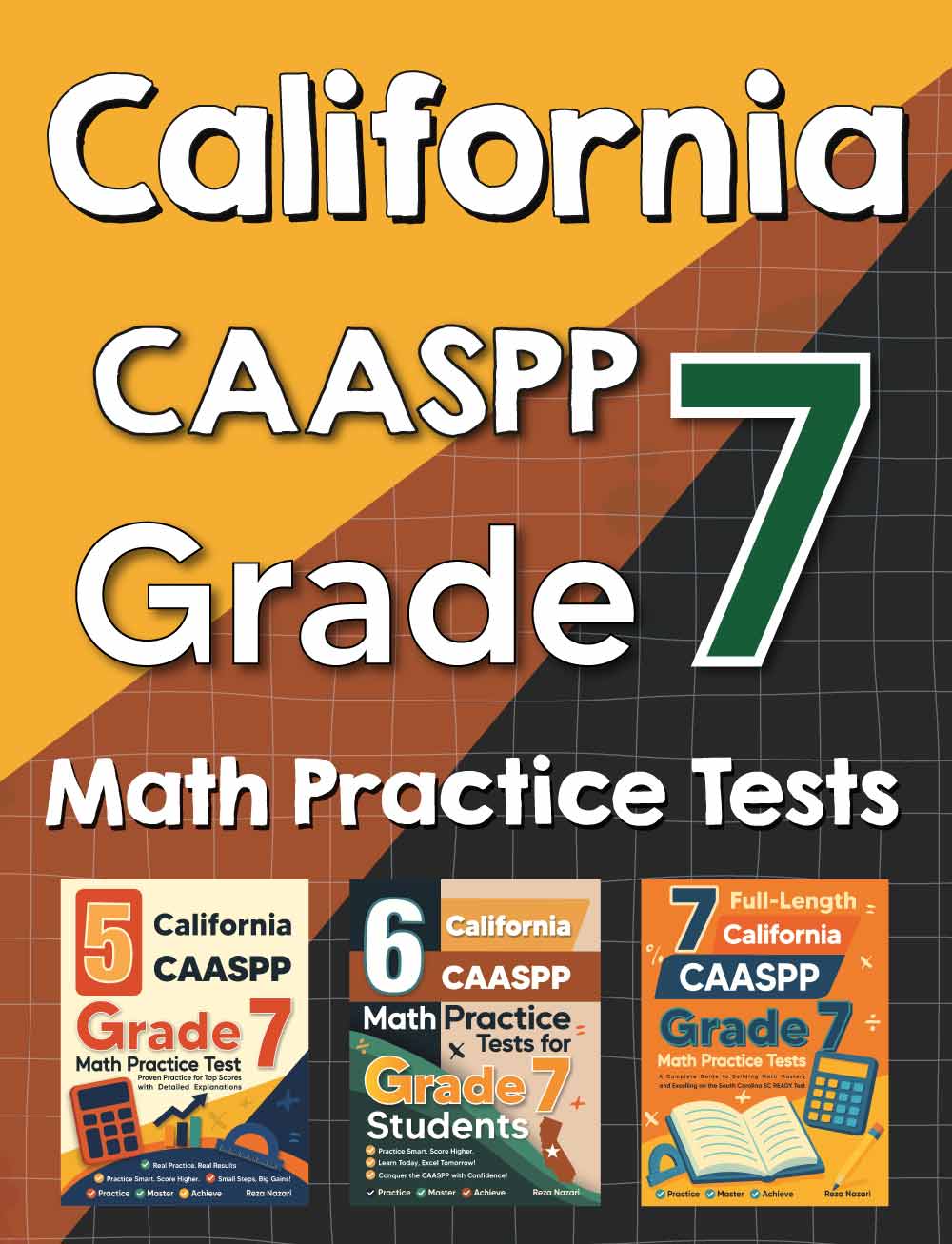
California CAASPP Grade 7 Math Preparation Bundle
The full prep library, study guide, workbook, and practice tests together.
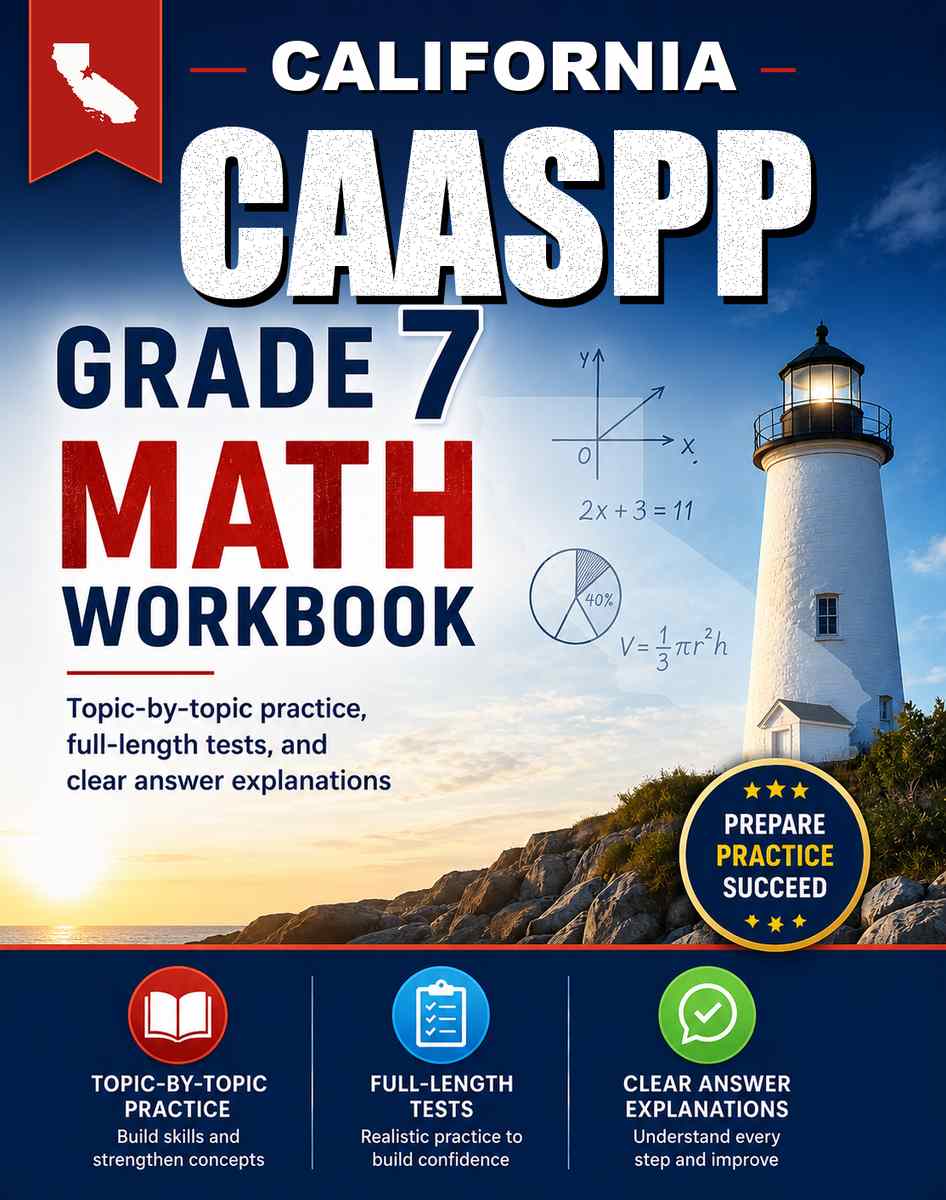
California CAASPP 7th Grade Math Workbook
Repeated practice by topic when a student needs more reps.
7 California CAASPP Grade 7 Math Practice Tests
Use after topic review to build pacing and test stamina.
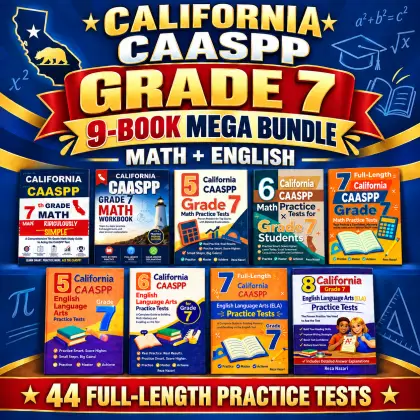
California CAASPP Grade 7 Math & ELA Mega Bundle
9 books and 44 full-length practice tests in one TPT bundle.
California Grade 7 math planning reference
Use this existing domain-organized reference for navigation. The official state document supplies the complete wording, examples, annotations, and mathematical practices. Check those details before treating a short entry as the full requirement.
7.RP · Ratios & Proportional Relationships
- 7.RPRatios and Proportional Relationships
- 7.RP.1Compute unit rates associated with ratios of fractions, including ratios of lengths, areas and other quantities measured in like or different units
- 7.RP.2Recognize and represent proportional relationships between quantities
- 7.RP.3Use proportional relationships to solve multistep ratio and percent problems
7.NS · The Number System
- 7.NSThe Number System
- 7.NS.1Apply and extend previous understandings of addition and subtraction to add and subtract rational numbers; represent addition and subtraction on a horizontal or vertical number line diagram
- 7.NS.2Apply and extend previous understandings of multiplication and division and of fractions to multiply and divide rational numbers
- 7.NS.3Solve real-world and mathematical problems involving the four operations with rational numbers
7.EE · Expressions & Equations
- 7.EEExpressions and Equations
- 7.EE.1Apply properties of operations as strategies to add, subtract, factor, and expand linear expressions with rational coefficients
- 7.EE.2Understand that rewriting an expression in different forms in a problem context can shed light on the problem and how the quantities in it are related
- 7.EE.3Solve multi-step real-life and mathematical problems posed with positive and negative rational numbers in any form (whole numbers, fractions, and decimals), using tools strategically. Apply properties of operations to calculate with numbers in any form; convert between forms as appropriate; and assess the reasonableness of answers using mental computation and estimation strategies
- 7.EE.4Use variables to represent quantities in a real-world or mathematical problem, and construct simple equations and inequalities to solve problems by reasoning about the quantities
7.G · Geometry
- 7.GGeometry
- 7.G.1Solve problems involving scale drawings of geometric figures, including computing actual lengths and areas from a scale drawing and reproducing a scale drawing at a different scale
- 7.G.2Draw (freehand, with ruler and protractor, and with technology) geometric shapes with given conditions. Focus on constructing triangles from three measures of angles or sides, noticing when the conditions determine a unique triangle, more than one triangle, or no triangle
- 7.G.3Describe the two-dimensional figures that result from slicing three-dimensional figures, as in plane sections of right rectangular prisms and right rectangular pyramids
- 7.G.4Know the formulas for the area and circumference of a circle and use them to solve problems; give an informal derivation of the relationship between the circumference and area of a circle
- 7.G.5Use facts about supplementary, complementary, vertical, and adjacent angles in a multi-step problem to write and solve simple equations for an unknown angle in a figure
- 7.G.6Solve real-world and mathematical problems involving area, volume and surface area of two- and three-dimensional objects composed of triangles, quadrilaterals, polygons, cubes, and right prisms
7.SP · Statistics & Probability
- 7.SPStatistics and Probability
- 7.SP.1Understand that statistics can be used to gain information about a population by examining a sample of the population; generalizations about a population from a sample are valid only if the sample is representative of that population. Understand that random sampling tends to produce representative samples and support valid inferences
- 7.SP.2Use data from a random sample to draw inferences about a population with an unknown characteristic of interest. Generate multiple samples (or simulated samples) of the same size to gauge the variation in estimates or predictions
- 7.SP.3Informally assess the degree of visual overlap of two numerical data distributions with similar variabilities, measuring the difference between the centers by expressing it as a multiple of a measure of variability
- 7.SP.4Use measures of center and measures of variability for numerical data from random samples to draw informal comparative inferences about two populations
- 7.SP.5Understand that the probability of a chance event is a number between 0 and 1 that expresses the likelihood of the event occurring. Larger numbers indicate greater likelihood. A probability near 0 indicates an unlikely event, a probability around 1/2 indicates an event that is neither unlikely nor likely, and a probability near 1 indicates a likely event
- 7.SP.6Approximate the probability of a chance event by collecting data on the chance process that produces it and observing its long-run relative frequency, and predict the approximate relative frequency given the probability
- 7.SP.7Develop a probability model and use it to find probabilities of events. Compare probabilities from a model to observed frequencies; if the agreement is not good, explain possible sources of the discrepancy
- 7.SP.8Find probabilities of compound events using organized lists, tables, tree diagrams, and simulation
Standards: California Common Core. Official source ↗
California Grade 7 math: useful study questions
Why can’t I combine a 25% discount and 8% tax into a 17% discount?
They use different bases in this problem. The discount uses the original price; the tax uses the discounted subtotal. Applying the two multipliers preserves those steps.
How does this Grade 7 guide relate to the state assessment?
It offers an independently written worked activity and selected curriculum references. Smarter Balanced is the state summative program; the linked practice settings and scores are separate. Read official guidance.
Grade 7 Math in Other States
Explore Grade 7 math standards, practice tests, and worksheets for every state.
- Alabama
- Alaska
- Arizona
- Arkansas
- Colorado
- Connecticut
- Delaware
- Florida
- Georgia
- Hawaii
- Idaho
- Illinois
- Indiana
- Iowa
- Kansas
- Kentucky
- Louisiana
- Maine
- Maryland
- Massachusetts
- Michigan
- Minnesota
- Mississippi
- Missouri
- Montana
- Nebraska
- Nevada
- New Hampshire
- New Jersey
- New Mexico
- New York
- North Carolina
- North Dakota
- Ohio
- Oklahoma
- Oregon
- Pennsylvania
- Rhode Island
- South Carolina
- South Dakota
- Tennessee
- Texas
- Utah
- Vermont
- Virginia
- Washington
- West Virginia
- Wisconsin
- Wyoming
- District of Columbia
Make This Your California CAASPP Starting Point
Take a timed practice test, find your weakest topic, and study it with the linked lessons, worksheets, and the CAASPP study guide.
Start a practice testA USEFUL NEXT STEP
California Grade 7 Math: study questions
Why can’t I combine a 25% discount and 8% tax into a 17% discount?
They use different bases in this problem. The discount uses the original price; the tax uses the discounted subtotal. Applying the two multipliers preserves those steps.
How does this Grade 7 guide relate to the state assessment?
It offers an independently written worked activity and selected curriculum references. Smarter Balanced is the state summative program; the linked practice settings and scores are separate.
Official source ↗Resources from Effortless Math · Editorial standards