LEARN · PRACTICE · EXPLORE
South Dakota Grade 7 English
Explain purpose and contrasting viewpoints. Read an original Grade 7 example, explain the evidence, and find South Dakota’s 2025 standards.
Focused lessons · Useful practice · Clear next steps
What do South Dakota 7th graders learn in ELA?
In 7th grade, South Dakota English language arts centers on how ideas and characters develop, comparing texts, and arguments with claims and counterclaims. Students take the South Dakota state grade 7 ELA test in the spring. This page explains each South Dakota grade 7 ELA standard and pairs it with short lessons, printable worksheets and a full-length practice test.
Printable South Dakota grade 7 ELA books:
- 5 South Dakota Smarter Balanced Grade 7 English Language Arts (ELA) Practice Tests
- 6 South Dakota Smarter Balanced Grade 7 English Language Arts (ELA) Practice Tests
- 7 South Dakota Smarter Balanced Grade 7 English Language Arts (ELA) Practice Tests
- 8 South Dakota Smarter Balanced Grade 7 English Language Arts (ELA) Practice Tests
- South Dakota Grade 7 ELA Preparation Bundle
Standards source: South Dakota adopted content standards.
Explain How an Author Responds to Another View
Explain purpose and contrasting viewpoints. Use this original short reading activity as a starting point, then transfer the reasoning to a classroom text chosen by the teacher.
Curriculum reference: South Dakota English Language Arts Standards, adopted April 14, 2025, from the South Dakota English language arts standards page.
South Dakota Grade 7 references for this activity
South Dakota adopted its revised English language arts standards on April 14, 2025. The department identifies 2026–27 for teaching to that edition. Its English webpage and assessed-standards timeline give different assessment transition dates, so this page does not infer a first test year for the new edition. Follow current assessment and school guidance. This example addresses one selected reading reference; the complete curriculum includes writing, language, speaking, listening, and foundational skills.
| Selected South Dakota reading reference | Activity focus | State-linked standards document |
|---|---|---|
| 7.RI.6 | Explain purpose and contrasting viewpoints | Read the state-linked document (PDF page 42) |
These selected reference labels identify an activity focus, with the correct grade and PDF page linked separately. Read the complete standards selected by the school and its learning sequence, including reading, writing, language, speaking, and listening. This short original example does not fulfill the entire curriculum or establish a student’s grade-level proficiency.
The rehearsal-room letter
This original classroom example is separate from official assessment questions.
A fictional student writes: “Some members prefer one long rehearsal because traveling twice is difficult. I understand that concern. I favor two shorter rehearsals because we could revise a difficult passage between sessions. I suggest trying two sessions for one week and asking members about both travel and preparation. I am not claiming that a second trip is easy for everyone.”
Try the activity
Identify the writer’s purpose and viewpoint. Explain how the writer distinguishes that viewpoint from the other members’ concern. Does acknowledging the concern mean the writer agrees with their preferred schedule?
Follow the reasoning
The purpose is to persuade readers to try two shorter rehearsals. The writer favors time to revise between sessions while other members favor avoiding a second trip. “I understand that concern” acknowledges their difficulty, but the stated preference remains two sessions. The proposed trial and questions address both travel and preparation, showing how the writer responds without claiming the concern disappears. A response should distinguish the competing reasons, the writer’s choice, and the concession. The letter reports no trial results, so it does not demonstrate which schedule produces better rehearsal or attendance.
Notice what needs more practice
Acknowledging a viewpoint is different from endorsing its proposed action. Also distinguish the writer’s stated intent from the reader’s own preference. The passage does not measure travel time or establish how many members support either view.
Grade 7 English worksheets
Choose printable practice that matches the skill being taught. Check the task, reading difficulty, and directions before assigning it; the collection is independently published.
Use the next session to build independence
- State the writer’s purpose and preferred action.
- Explain the other viewpoint in its own terms.
- Identify language that acknowledges the concern while maintaining a different choice.
Analyze a teacher-selected argument that addresses an opposing view. Explain the author’s response through specific wording and assess what it leaves unresolved. Keep purpose, viewpoint, and evidence distinct.
For more general reading and writing resources, visit the Grade 7 English Online Center.
South Dakota Grade 7 English: useful planning questions
Does acknowledging an opposing concern mean agreement?
Not necessarily. Explain whether the author accepts the concern, accepts the proposed action, modifies a position, or gives a different response.
Which standards does the school use?
South Dakota adopted its revised English language arts standards on April 14, 2025. The department identifies 2026–27 for teaching to that edition. Its English webpage and assessed-standards timeline give different assessment transition dates, so this page does not infer a first test year for the new edition. Follow current assessment and school guidance. This example addresses one selected reading reference; the complete curriculum includes writing, language, speaking, listening, and foundational skills. The school’s sequence also includes reading, writing, speaking, listening, and language work beyond this example.
Sources checked October 6, 2026. The department’s current 2026–27 assessment table places the general English and mathematics assessments in Grades 3–8, including Grade 7. Follow the school’s current directions and accommodations. This activity is not an official state assessment item. Read the South Dakota English assessment overview and English standards guidance. Independently published practice has its own directions and scoring. Its result does not predict a state performance level, and this original activity is not an official assessment item.
Grade 7 English in other states
When moving between school systems, compare the official curriculum and the school’s learning sequence. Use the national Online Center’s map to find another state’s resources.
Recommended South Dakota Grade 7 resources
Build a Strong South Dakota Grade 7 SBAC English Practice Library
These independently published resources have their own coverage and editions. Check the contents alongside South Dakota’s current English standards before choosing assessment preparation.
Use these South Dakota Grade 7 resources for reading comprehension, language, writing, and full-length practice where available. Click any cover to open the resource page.
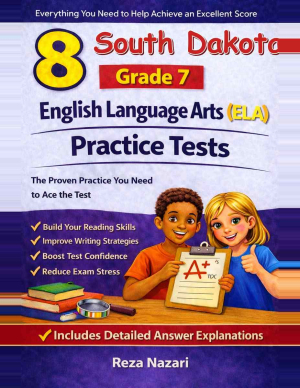 8 South Dakota Smarter Balanced Grade 7 English Language Arts (ELA) Practice Tests
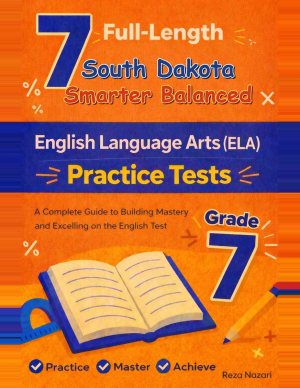 7 South Dakota Smarter Balanced Grade 7 English Language Arts (ELA) Practice Tests
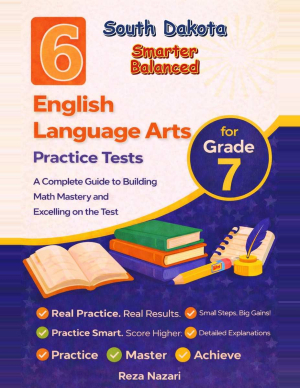 6 South Dakota Smarter Balanced Grade 7 English Language Arts (ELA) Practice Tests
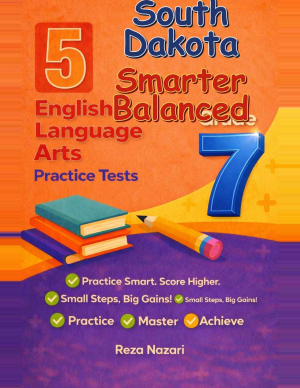 5 South Dakota Smarter Balanced Grade 7 English Language Arts (ELA) Practice Tests
More Grade 7 resources
A USEFUL NEXT STEP
South Dakota Grade 7 English: study questions
Does acknowledging an opposing concern mean agreement?
Not necessarily. Explain whether the author accepts the concern, accepts the proposed action, modifies a position, or gives a different response.
Where are the complete South Dakota Grade 7 requirements?
South Dakota adopted its revised English language arts standards on April 14, 2025. The department identifies 2026–27 for teaching to that edition. Its English webpage and assessed-standards timeline give different assessment transition dates, so this page does not infer a first test year for the new edition. Follow current assessment and school guidance. This example addresses one selected reading reference; the complete curriculum includes writing, language, speaking, listening, and foundational skills.
Official source ↗Resources from Effortless Math · Editorial standards