Free Grade 7 English Worksheets for Oregon Students
There is a covered porch on a cedar-shake house in Eugene where a seventh grader does homework under a yellow bulb because the rain starts at four and does not stop until after dinner. The porch has one wicker chair, one folding tray, a stack of looseleaf, and a coffee can full of pens. From the chair you can hear the rain on the metal eaves and the douglas firs at the back of the yard moving in the wind. The student is working on an extended-writing draft her ELA teacher assigned as performance-task practice. She has two source articles printed and clipped to a binder clip. She is making a planning chart, claim, three reasons, counterclaim, evidence per reason, before she writes a single sentence of the essay. The bulb is warm. The rain is loud. The page is filling up slowly and well.
That plan-first, draft-second rhythm fits OSAS the way nothing else does. Oregon administers the Oregon Statewide Assessment System (OSAS) in the spring at Grade 7, and the ELA portion uses the Smarter Balanced assessment, a computer-adaptive section of reading, listening, and language items paired with a performance task that asks the seventh grader to read sources, plan, draft, and revise an extended written response. The covered-porch planning chart is exactly what the performance task rewards on test day.
The Oregon ELA Standards organize Grade 7 across reading literature, reading informational text, writing, speaking and listening, and language. OSAS samples broadly across those strands and reports across four Smarter Balanced claims, reading, writing, listening, and research/inquiry, with a separate performance-task score.
This page gathers forty-three free printable Grade 7 ELA worksheets, every one mapped to a Grade 7 strand in the Oregon ELA Standards, every one printable at home, no signup.
What’s on this page
Each PDF opens with a Quick Review a seventh grader can read alone. The practice items mirror OSAS Smarter Balanced on-screen formats, multiple choice, multi-select, evidence-based selected response, drag-and-drop, hot-text highlighting, table completion, and short text-entry, and several PDFs are tuned for the performance-task workflow of read, plan, draft, revise. The answer keys explain every right answer and the trap behind every distractor.
Use the menu below to match the strand the ELA teacher emphasized this week. For OSAS, the writing block, planning-revising-editing, argument with counterclaim, gathering and citing sources, is the most direct rehearsal for the performance task.
Reading: Literature
- Citing Several Pieces of Textual Evidence, [RL.7.1] stack two or three converging quotes behind one inference
- Theme and Its Development Over the Text, [RL.7.2] write theme as a full sentence and trace its growth
- How Setting, Character, and Plot Interact, [RL.7.3] setting bends character, character drives plot
- Word Choice, Figurative Language, and Tone, [RL.7.4] denotation, connotation, and the tone they build together
- How Form Shapes Meaning in Drama and Poetry, [RL.7.5] sonnet, soliloquy, stage direction, stanza
- Developing and Contrasting Points of View, [RL.7.6] two perspectives in deliberate tension
- Comparing a Story to Its Audio, Film, or Stage Version, [RL.7.7] what each medium can and cannot do
- Comparing Fictional and Historical Portrayals, [RL.7.9] sort real history from authorial invention
Reading: Informational Text
- Citing Several Pieces of Evidence in Nonfiction, [RI.7.1] pull several article details toward one conclusion
- Two or More Central Ideas and Their Development, [RI.7.2] track an article teaching two things at once
- How Individuals, Events, and Ideas Interact, [RI.7.3] a person shapes an idea, an idea reshapes a person
- Word Meaning in Nonfiction: Figurative, Connotative, Technical, [RI.7.4] three jobs one nonfiction word does
- How Text Structure Develops the Author’s Ideas, [RI.7.5] problem-solution, compare-contrast, chronological
- Author’s Point of View and How They Distinguish It, [RI.7.6] find the position and the moves that mark it
- Comparing a Text to Its Audio or Video Version, [RI.7.7] what print emphasizes vs. What broadcast emphasizes
- Evaluating an Argument: Reasoning and Evidence, [RI.7.8] strong evidence vs. Filler, and the logic in between
- How Two Authors Shape Their Presentation of the Same Topic, [RI.7.9] same subject, different facts emphasized
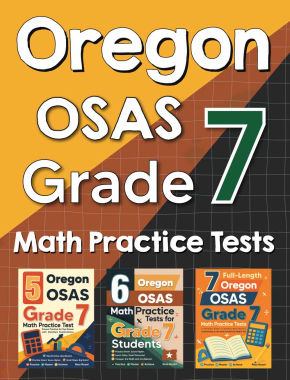
Working on Math Too? Try the Oregon OSAS Grade 7 Math Bundle
Many third graders are getting ready for the OSAS in both subjects. If your child also needs math practice that matches the same standards, this companion bundle is the shortest path, workbook, study guide, and full practice tests in one download.
Writing
- Argument Writing: Claims, Reasons, Evidence, and Counterclaims, [W.7.1] the counterclaim move performance tasks grade hardest
- Informative and Explanatory Writing, [W.7.2] thesis, ordered sections, transitions
- Narrative Writing, [W.7.3] pacing, dialogue, sensory description, an ending that lands
- Coherent Writing for Task, Purpose, and Audience, [W.7.4] one idea, three audiences, three versions
- Planning, Revising, and Editing, [W.7.5] the move at the heart of the performance task
- Short Research Projects: Question and Refocus, [W.7.7] let early findings rewrite the question
- Gathering, Evaluating, and Citing Sources, [W.7.8] author, date, publisher, citation the Oregon teacher expects
Speaking & Listening
- Collaborative Discussions, [SL.7.1] come prepared, listen first, disagree without dismissing
- Analyzing Information in Diverse Media, [SL.7.2] chart, clip, photo as one combined argument
- Evaluating a Speaker’s Argument, [SL.7.3] claim, reasons, evidence, gaps
- Presenting Claims with Focus and Coherence, [SL.7.4] open with the point, preview the order, hold to it
- Adapting Speech to Context, [SL.7.6] friend-talk and presentation-talk are different registers
Grammar
- Phrases and Clauses: Placement and Function, [L.7.1a] what each piece is doing, where it belongs
- Sentence Structures: Simple, Compound, Complex, Compound-Complex, [L.7.1b] count clauses, name the structure
- Avoiding Dangling and Misplaced Modifiers, [L.7.1c] the small error that makes a paragraph absurd
Conventions: Punctuation, Spelling
- Commas with Coordinate Adjectives, [L.7.2a] when two adjectives need a comma and when they do not
- Spelling Grade-Appropriate Words, [L.7.2b] homophones, doubled letters, common Grade 7 misses
Knowledge of Language and Style
- Precise and Concise Language, [L.7.3a] cut wordiness, replace vague verbs, pick the exact noun
Vocabulary and Word Study
- Using Context Clues, [L.7.4a] name the kind of clue and use it on purpose
- Greek and Latin Roots and Affixes, [L.7.4b] one root unlocks ten unrelated words
- Using Reference Materials Effectively, [L.7.4c] match the tool to the question
- Verifying Word Meaning, [L.7.4d] confirm the guess before committing
- Allusions and Figures of Speech, [L.7.5a] myth, Bible, literary references Grade 7 readers now catch
- Word Relationships: Synonyms, Antonyms, Analogies, [L.7.5b] name the relationship before picking the answer
- Connotation and Denotation, [L.7.5c] same fact, different feeling, different word
- Academic and Domain-Specific Vocabulary, [L.7.6] words that travel across subjects and words tied to one field
How to use these worksheets at home
Oregon families work around Oregon schedules. A Portland family might fit practice between an after-school MAX ride home and dinner. A Bend family might run a Saturday-morning session at the kitchen table before a hike on the Deschutes. A Salem family might use the half hour between a parent’s shift change and supper. A Coos Bay family might do practice in a back office at the harbor between school pickup and the boat return. The unit is one PDF, the work is twelve to fifteen minutes, and the page travels, to the covered porch, to a coffee-shop window on a wet Wednesday, to the passenger seat on the I-5 drive between Eugene and Portland.
The performance-task piece of OSAS rewards drafted writing more than any other component. Once a week, hand a seventh grader the W.7.1 argument PDF and the W.7.5 planning-and-revising PDF together. Twenty-five minutes, one prompt, one planning chart, one drafted paragraph that names a claim, supports it, and acknowledges a counterclaim. Drafted practice is the single best preparation for the spring performance task.
For the adaptive reading section, rotate one literature PDF, one informational PDF, and one vocabulary PDF per week. The combination trains the kind of cross-genre flexibility that adaptive items demand when the next question is selected from a different strand than the last one.
A note about OSAS in ELA
The Oregon Statewide Assessment System (OSAS) in Grade 7 ELA is administered in the spring on a computer. Oregon is a Smarter Balanced state, and the Grade 7 OSAS ELA test pairs a computer-adaptive section with a performance task. The adaptive section selects the next item based on a student’s recent answers and includes reading, listening, and language items. The performance task, Literary Analysis or Informational/Research, gives the student two or three sources, asks notes-based and short-response questions, and ends with an extended written response.
OSAS Grade 7 ELA reports across the four Smarter Balanced claims: reading, writing, listening, and research/inquiry, with a separate performance-task score that rolls up into the writing claim. Reading items cover textual evidence (RL.7.1, RI.7.1), theme and central idea (RL.7.2, RI.7.2), word meaning (RL.7.4, RI.7.4), text structure (RL.7.5, RI.7.5), point of view (RL.7.6, RI.7.6), and argument evaluation (RI.7.8). Language items cover compound-complex sentences (L.7.1b), dangling and misplaced modifiers (L.7.1c), coordinate-adjective commas (L.7.2a), precise language (L.7.3a), allusions (L.7.5a), and academic vocabulary (L.7.6).
The performance task is graded on three trait scores: purpose-and-organization, evidence-and-elaboration, and conventions of standard English. Counterclaim acknowledgement, source-evidence citation, and a planning step that survives the draft are the three highest-yield rehearsal moves for the spring window.
Want everything in one bundle?
Some Oregon families prefer one organized book to a list of standalone PDFs. The Grade 7 ELA Preparation Bundle organizes practice across the OSAS adaptive section and the performance task, short reading drills, focused vocabulary work, and timed argument-writing rehearsals, with full-length practice tests and answer keys that explain every choice.
Oregon Grade 7 ELA Preparation Bundle, four practice-test books, 26 unique full-length tests, complete answer keys with explanations.
A short closing
The rain on the cedar shake will start at four through most of the spring, the porch bulb will keep being warm, and the planning chart will keep doing more work than the first draft does. Bookmark this page, print one PDF before the next rainy afternoon, and let the small, steady covered-porch work carry an Oregon seventh grader cleanly into the spring OSAS window.
Best Bundle to Ace the Oregon OSAS Grade 7 ELA
Looking for the best resource to help your kid ace the Oregon OSAS? Try this bundle, four full practice-test books (5 + 6 + 7 + 8 tests) covering the same Grade 7 reading, writing, and language skills your child is already learning. Instant PDF download, answer keys included.


Related to This Article
More math articles
- The Ultimate 4th Grade STAAR Math Course (+FREE Worksheets)
- Why do AAA or SSA Not Prove Congruence?
- Using Apostrophes
- The substitution effect follows relative price
- The Best Algebra 1 Book for Kansas Students
- HiSET Testing Accommodations for Students with Disabilities
- Government Power and Individual Rights
- Traditional news media
- 6th Grade PSSA Math FREE Sample Practice Questions
- From Word Problems to Working Code: Using Python to Make Middle School Math Stick









What people say about "Free Grade 7 English Worksheets for Oregon"?
No one replied yet.