How to Write a Math-Based Analytical Paper Step by Step
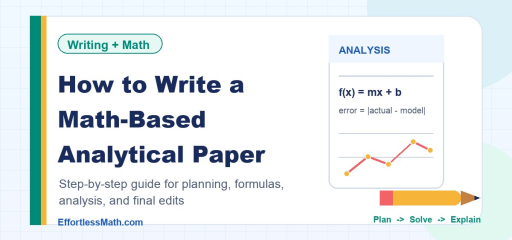
Math-based analytical papers are more than written solutions. They combine clear explanations, mathematical reasoning, and a strong argument. A good paper does show the answer; it also explains why the answer makes sense and how each step supports the final conclusion.
This type of paper can appear in mathematics, statistics, economics, physics, engineering, and data-based courses. Students may be asked to solve a complicated problem, compare methods, or explain numerical results. In every case, the writing should help the reader understand the logic behind the math.
A strong paper does not hide behind formulas. Each step is explained in simple academic terms. Students’ work becomes easier to understand when calculations are connected to clear interpretation.
Planning and Understanding the Problem
Before writing, students should begin by studying the assignment carefully. A math-based analytical paper needs a clear purpose. Without one, the paper can become a list of formulas instead of a structured analysis.
Start by identifying the main question. Ask what the paper needs to prove, solve, compare, or explain. Then review the information given in the task, including variables, data, limits, assumptions, and required methods. This early planning helps avoid unnecessary work later.
Many students also improve their writing by studying examples, reviewing instructor feedback, or using academic support resources. For instance, SpeedyPaper can be helpful for students who do not have enough time or energy to complete academic tasks on their own. In such cases, the service may help reduce workload, support academic progress, and provide a well-prepared finished paper when students need a ready solution.
Turning the Task into a Clear Question
A good analytical paper begins with a clear question. The question gives direction to the entire paper and helps the writer decide which formulas, models, and explanations are needed.
These steps can be included in a useful planning process:
- Define the main research problem or question.
- Identify the known values, unknown values, and assumptions.
- Select the mathematical model or method.
- Decide how the results will be explained.
- Check whether the method is appropriate for the purpose of the paper.
The paper is easier to write when the plan is clear. This helps students identify weak points before drafting. The writer should know why a formula was chosen, what the data represents, and how the data supports the analysis.
Structuring the Analytical Paper
The reader can follow the math and the writing more easily when the structure is clear. Most math-based analytical essays include an introduction, background, method, analysis, and discussion. The structure may vary depending on the assignment, but the paper should always move logically from the problem to the solution.
The introduction should explain the importance of the issue and state the purpose of the paper. For example, a student might write that the paper compares two methods of estimating probability or analyzes population growth with an exponential model.
The background section should explain key formulas and define important terms. This part should not become too long. It should include only the information the reader needs to understand the method and analysis.
Building a Logical Path
The paper should then explain the method. This section shows the reader how the study is being carried out. It may include an equation, theorem, statistical test, mathematical model, or proof.
It is important to write the method section clearly and concisely. Students should not rush into calculations. They should explain the reasoning behind the method before showing the work.
The analysis section applies the method. Here, the writer presents calculations, comparisons, or proofs. Each major step should connect to the one before it. A clear structure prevents the paper from feeling like separate pieces without a common purpose.
Writing the Mathematical Analysis
The central focus of the paper is mathematical analysis. In this section, the writer explains how the answer was reached. Calculations should be presented logically, and every important step should be accompanied by an explanation.
One common mistake is including equations without context. A correct formula is not enough on its own. The writer must also explain what the symbols mean and why the formula is being used. Clear explanation turns mathematical work into analytical writing.
Students should also avoid skipping steps. Even if a step seems obvious to the writer, it may not be obvious to the reader. Strong papers provide enough detail so another person can follow the reasoning without confusion.
Explaining Formulas in Words
Every formula should be introduced before it appears. For example, the writer can explain that a formula is used to measure the rate of change, estimate probability, compare quantities, or test a relationship. This makes the equation feel connected to the argument.
After solving or simplifying a formula, the result should be interpreted. A number alone is rarely enough. The paper should explain what the result means in relation to the original question.
For example, if a calculation shows that one method produces a smaller error rate, the writer should explain why that matters. If a model predicts growth, the writer should discuss what the prediction suggests. This interpretation is what makes the paper analytical rather than purely computational.
Editing and Improving Clarity
Editing is especially important in math-based analytical writing because small mistakes can change the meaning of the paper. Students should review both the language and the calculations. The final draft should be accurate, organized, and easy to follow.
During revision, check whether every section supports the main goal. If a calculation does not help answer the question, it may need to be removed or explained more clearly. If a paragraph repeats an earlier idea, it should be shortened or rewritten.
When editing the paper, students should focus on these points:
- Define all variables, symbols, and abbreviations.
- Check each calculation for accuracy.
- Explain how each result supports the main argument.
- Make transitions clear between sections.
- Remove repeated, vague, or confusing sentences.
Final Checks Before Submission
The final review should focus on flow. The paper should move from the problem to the method, then from the method to the analysis, and finally to the interpretation. Each section should prepare the reader for the next one.
Students should also check the assignment instructions, formatting rules, and citation style. If graphs or equations appear, they should be clearly labeled. Everything included in the paper should have a clear reason for being there.
A math-based analytical paper is not just correct. It should also be organized, clear, and readable. When writing and math work together, the final document becomes easier to understand and more persuasive.

Related to This Article
More math articles
- Community, Gemeinschaft, and Gesellschaft
- PMP Business Environment: Connect Project Work to Outcomes (2027 Prep)
- Algebra Puzzle – Challenge 34
- Top 10 Tips to Overcome TASC Math Anxiety
- How to Graph Exponential Functions?
- Math Topics You Need to Learn in Medicine
- Free Grade 3 English Worksheets Aligned to Common Core (CCSS)
- Free Grade 4 English Worksheets for Louisiana Students
- Indeterminate vs. Undefined Limits: 0/0, Infinity and DNE
- Free Kentucky KSA Grade 5 Math Worksheets: 49 Printable PDFs with Friendly Answer Keys






















What people say about "How to Write a Math-Based Analytical Paper"?
No one replied yet.