LEARN · PRACTICE · EXPLORE
Hawaii Grade 6 English
Trace an original proposal’s claims and reasons, test what its evidence supports, and use a selected current Hawaiʻi Grade 6 reading reference.
Focused lessons · Useful practice · Clear next steps
What do Hawaii 6th graders learn in ELA?
In 6th grade, Hawaii English language arts centers on citing textual evidence, central idea, word choice, and argument writing. Students take the Smarter Balanced grade 6 ELA test in the spring. This page explains each Hawaii grade 6 ELA standard and pairs it with short lessons, printable worksheets and a full-length practice test.
Printable Hawaii grade 6 ELA books:
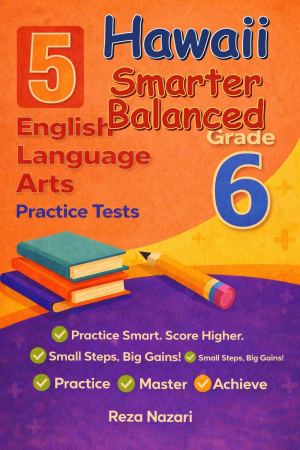
- 5-Hawaii-Smarter-Balanced Grade 6 Reading Language Arts Practice Tests
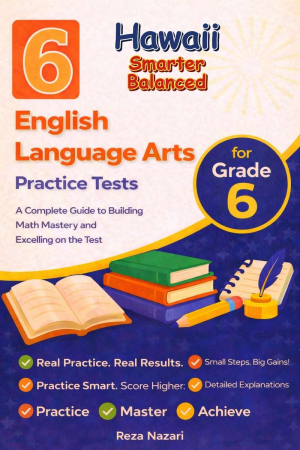
- 6-Hawaii-Smarter-Balanced Grade 6 Reading Language Arts Practice Tests
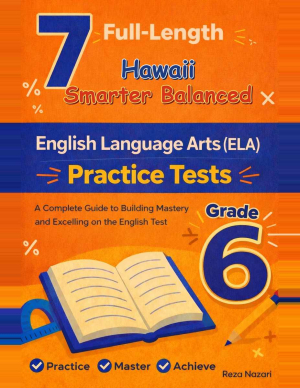
- 7-Hawaii-Smarter-Balanced Grade 6 Reading Language Arts Practice Tests
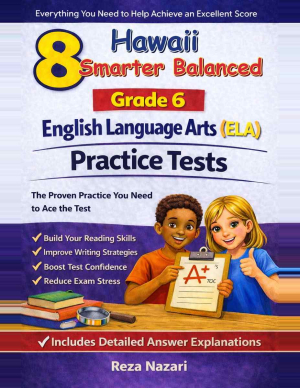
- 8-Hawaii-Smarter-Balanced Grade 6 Reading Language Arts Practice Tests
- Hawaii Grade 6 ELA Preparation Bundle
Standards source: Hawaiʻi English Language Arts, Hawaiʻi State Department of Education.
Use this Hawaii Grade 6 English page for daily literacy blocks, reteaching, enrichment, and targeted practice. The explanations are written for planning and learning support, not copied from official standards language.
Separate a supported concern from an unsupported promise
A proposal can contain a reasonable reason and an overstatement in the same paragraph. Read each claim separately. This original classroom argument includes a limited observation and two predictions, so the reader must distinguish evidence of a problem from proof that a proposed solution will work.
Curriculum source: Hawaiʻi Common Core Standards for English Language Arts, approved April 2024 and reprinted May 2026, from the Hawaiʻi DOE standards directory.
Hawaiʻi Grade 6 references for this activity
Hawaiʻi’s current English document includes Grade 6 expectations across reading, writing, language, speaking, and listening. The expectations selected here support this activity; use the whole document and the school’s sequence for wider coverage.
| Grade-level expectation | Activity focus | Official requirement |
|---|---|---|
| 6.RI.8 | Trace arguments and distinguish supported from unsupported claims | Read the state document (PDF page 26) |
These are selected grade-level expectations from Hawaiʻi’s current English standards. Activity labels describe a teaching focus rather than reproduce complete requirements. Read the linked grade-level document, including the reading, writing, language, speaking, and listening sections, alongside the school’s curriculum sequence.
A worked Grade 6 reading and writing activity
This original classroom example is separate from official assessment questions.
Proposal: At our last two art sessions, six students asked where spare paper was stored. We should put a clearly labeled paper shelf near the art-room door so students can see the location when they enter. This change will end every classroom delay in every subject.
Try the activity
Identify the proposed action, its stated reason, and the broad final promise. Explain which concern the observation supports and which outcome still needs checking. Write a more defensible final sentence without inventing new results.
Follow the reasoning
The action is to place a labeled shelf near the art-room door. The observation supports a concern that some students did not know where the spare paper was stored during the two sessions. A visible label is a plausible response to that information need, but the paragraph does not report a test of the new shelf. Its final sentence extends far beyond the evidence: questions about paper do not establish the cause of every delay in every subject. A more limited ending could say, “Try the shelf for the next art sessions and check whether fewer students need help finding paper.” That proposes a check rather than claim an already proven outcome.
Notice what needs more practice
Rejecting the final overstatement does not require dismissing the entire proposal. Evaluate the observation, the reasoning, and the prediction separately. Six students asking questions is not the same as six measured delays, and the paragraph does not give the total number of students. Do not convert the count into a percentage without that information. Nor does the text establish that a doorway shelf is the only workable response.
Grade 6 English worksheets
Choose a printable task that matches the skill being taught. Check its reading difficulty, directions, and edition alongside the current Hawaiʻi English document.
Use the next session to build independence
- List the proposal’s action and its separate claims.
- Match each claim with the actual reason or observation supplied.
- Limit the conclusion and identify evidence needed to check the prediction.
Compare the proposed shelf with a labeled storage area in another location. Decide what observations would help choose between them without assuming one is already better. Then write a short evaluation that acknowledges the supported information need and explains the unsupported reach of the final sentence. This activity selects an argument-reading requirement from Hawaiʻi’s current Grade 6 document; other reading, writing, language, and discussion requirements remain part of wider study.
For more general reading and writing resources, visit the Grade 6 English Online Center.
Hawaiʻi Grade 6 English: useful planning questions
Does an exaggerated conclusion make every part of an argument unsupported?
No. Evaluate the claims separately. A limited observation may support a concern even when a broad prediction goes beyond what the evidence shows.
Where are the complete state requirements?
Hawaiʻi’s current English document includes Grade 6 expectations across reading, writing, language, speaking, and listening. The expectations selected here support this activity; use the whole document and the school’s sequence for wider coverage. The school’s sequence also includes reading, writing, speaking, listening, and language work beyond this example.
Official sources checked October 6, 2026. Grade 6 is within the Smarter Balanced English language arts testing range. This original lesson is independent practice. Read the Hawaiʻi assessment overview and use the school’s guidance for preparation. The state learning-design directory identifies implementation of these revised English standards in 2025–26. The assessment overview also explains alternate and Kaiapuni assessment pathways; follow the school’s assignment and current guidance. This site’s practice and books are independently published. Check their editions and contents against current standards and assessment guidance.
Grade 6 English in other states
When moving between school systems, compare the official curriculum and the school’s learning sequence. Use the national Online Center’s map to find another state’s resources.
Recommended Hawaii Grade 6 resources
Build a Strong Hawaii Grade 6 SBAC English Practice Library
These independently published resources may use earlier Hawaiʻi English standards. Check the edition and contents alongside Hawaiʻi’s current English standards before choosing assessment preparation.
Use these Hawaii Grade 6 resources for reading comprehension, language, writing, and full-length practice where available. Click any cover to open the resource page.
More Grade 6 resources
A USEFUL NEXT STEP
Hawaii Grade 6 English: study questions
Does an exaggerated conclusion make every part of an argument unsupported?
No. Evaluate the claims separately. A limited observation may support a concern even when a broad prediction goes beyond what the evidence shows.
Where are the complete Hawaiʻi Grade 6 requirements?
Hawaiʻi’s current English document includes Grade 6 expectations across reading, writing, language, speaking, and listening. The expectations selected here support this activity; use the whole document and the school’s sequence for wider coverage.
Official source ↗Resources from Effortless Math · Editorial standards