LEARN · PRACTICE · EXPLORE
Kansas Grade 6 English
Evaluate an original reading-room proposal, separate a counted survey result from a universal claim, and practice a selected Kansas Grade 6 informational-reading expectation.
Focused lessons · Useful practice · Clear next steps
What do Kansas 6th graders learn in ELA?
In 6th grade, Kansas English language arts centers on citing textual evidence, central idea, word choice, and argument writing. Students take the KAP grade 6 ELA test in the spring. This page explains each Kansas grade 6 ELA standard and pairs it with short lessons and a full-length practice test.
Printable Kansas grade 6 ELA books:
- 5-Kansas-KAP-English Language Arts (ELA) Grade 6 Reading Language Arts Practice Tests
- 6-Kansas-KAP-English Language Arts (ELA) Grade 6 Reading Language Arts Practice Tests
- 7-Kansas-KAP-English Language Arts (ELA) Grade 6 Reading Language Arts Practice Tests
- 8-Kansas-KAP-English Language Arts (ELA) Grade 6 Reading Language Arts Practice Tests
- Kansas Grade 6 ELA Preparation Bundle
Standards source: Kansas English Language Arts, Kansas State Department of Education.
Evaluate what a small survey can support in an argument
An argument may offer useful evidence and still reach beyond it. This original proposal contains invented survey figures. Trace the writer’s claim, the reason offered for it, and the limits of the evidence before deciding how the wording should change.
Curriculum reference: 2023 Kansas English Language Arts Standards, updated February 2025, from the Kansas State Department of Education standards directory.
Kansas Grade 6 references for this activity
Kansas’s current directory links the 2023 English Language Arts standards, updated February 2025. Read the Grade 6 expectations in the full state document. The selected reference supports this activity; use the school’s sequence and the remaining expectations for wider coverage.
| Grade-level expectation | Activity focus | Official requirement |
|---|---|---|
| RI.6.8 | Trace claims and evaluate their supporting reasons and evidence | Read the state document (PDF page 52) |
These are selected grade-level expectations from Kansas’s current English standards. Activity labels describe a teaching focus rather than reproduce complete requirements. Read the linked state document’s complete grade-level expectations, including its grade-specific details, alongside the school’s curriculum sequence.
A worked Grade 6 reading and writing activity
This original classroom example is separate from official assessment questions.
We should open the reading room during the first ten minutes of lunch. In our invented class survey, 18 of 24 respondents said they wanted a quieter place to read. The room is already close to the lunch area. Opening it will make every student read more each day. We should ask the school about supervision and try the schedule for a week.
| Detail | Supported role | Limit |
|---|---|---|
| 18 of 24 respondents want quiet | Reported preference | Does not measure later reading |
| Room is nearby | Convenience reason | Does not settle supervision |
| Every student will read more | Predicted universal outcome | Not established by these details |
Try the activity
Identify the proposal and a supporting reason. What does the survey establish within this invented example? Which sentence makes a stronger claim than the available evidence supports, and how could the writer revise it?
Follow the reasoning
The proposal is to open the reading room for the first ten minutes of lunch. The stated interest in a quieter place supports a reason for considering the proposal. The survey records that 18 of 24 respondents expressed that preference. It does not measure later reading behavior. The claim that opening the room will make every student read more exceeds that evidence: a preference is not a demonstrated outcome, and respondents are not necessarily every student in the school. A narrower revision is that opening the room could give interested students a quieter reading option. The suggested supervised trial offers a way to gather additional information.
Notice what needs more practice
The counted response is evidence for an expressed preference, not proof of a future effect. Likewise, closeness to the lunch area concerns convenience, while supervision is a practical condition still to be settled. Do not reject every part of an argument just because one sentence overstates its case. Trace which detail supports which claim and identify where the connection is incomplete. The figures are invented for reading practice, not a published Kansas school survey. An actual proposal would need the real survey wording, respondent selection, timing, and school requirements before drawing a broader conclusion.
Use the next session to build independence
- Identify the proposal and trace its stated supporting details.
- Distinguish a reported preference from a measured result.
- Revise an unsupported claim and describe evidence a later trial could supply.
Write two possible trial questions: how many students use the room, and whether those students report having a quieter reading place. Explain that neither question alone establishes that every student reads more. A teacher can help design an actual record, keeping voluntary reports distinct from direct observations. Then read a different argument and repeat the claim–evidence comparison without copying the same conclusion automatically. Kansas Grade 6 asks readers to trace and evaluate specific claims; the strength of a conclusion depends on the evidence in the particular text.
For more general reading and writing resources, visit the Grade 6 English Online Center.
Kansas Grade 6 English: useful planning questions
Does a preference survey prove a future change in behavior?
No. In this example it records respondents’ stated preference. Evidence about what happens after a change would require a separate investigation.
Where are the complete state requirements?
Kansas’s current directory links the 2023 English Language Arts standards, updated February 2025. Read the Grade 6 expectations in the full state document. The selected reference supports this activity; use the school’s sequence and the remaining expectations for wider coverage. The school’s sequence also includes reading, writing, speaking, listening, and language work beyond this example.
Official sources checked October 6, 2026. Grade 6 is within the Kansas Assessment Program general summative English language arts testing range. This original lesson is independent practice. Read the Kansas assessment overview and use the school’s guidance for preparation. Read the 2026–27 Kansas assessment overview (PDF). Kansas’s 2026–27 assessment overview lists general summative English language arts and mathematics in Grades 3–8 and 10, and science in Grades 5, 8, and 11. The HGSS classroom-based assessment applies in Grades 4, 7, and one district-selected grade among 10, 11, and 12. The optional Grade 2 reading assessment is separate from the general summative ELA range. Eligible students use their assigned alternate-assessment pathway. Follow the school’s current assessment assignment, accommodations, and guidance; this classroom activity is independent practice and does not predict a state performance level. This site’s practice and books are independently published. Check their editions and contents against current standards and assessment guidance.
Grade 6 English in other states
When moving between school systems, compare the official curriculum and the school’s learning sequence. Use the national Online Center’s map to find another state’s resources.
Recommended Kansas Grade 6 resources
Build a Strong Kansas Grade 6 KAP English Practice Library
These independently published resources have their own coverage and editions. Check the contents alongside Kansas’s current English standards before choosing assessment preparation.
Use these Kansas Grade 6 resources for reading comprehension, language, writing, and full-length practice where available. Click any cover to open the resource page.
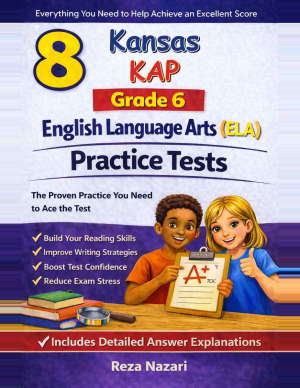 8-Kansas-KAP-English Language Arts (ELA) Grade 6 Reading Language Arts Practice Tests
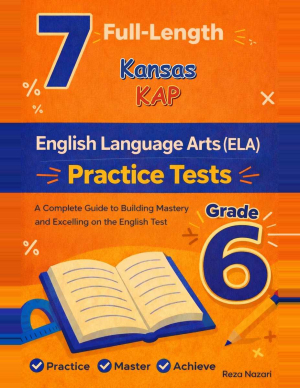 7-Kansas-KAP-English Language Arts (ELA) Grade 6 Reading Language Arts Practice Tests
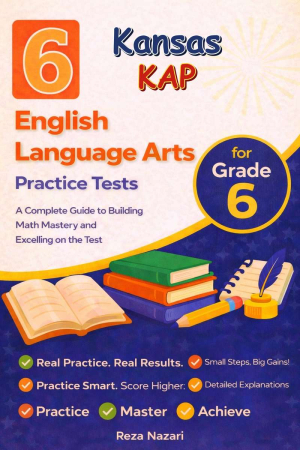 6-Kansas-KAP-English Language Arts (ELA) Grade 6 Reading Language Arts Practice Tests
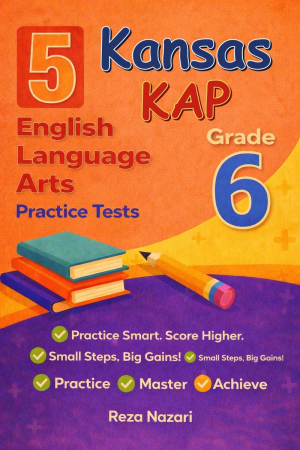 5-Kansas-KAP-English Language Arts (ELA) Grade 6 Reading Language Arts Practice Tests
More Grade 6 resources
A USEFUL NEXT STEP
Kansas Grade 6 English: study questions
Does a preference survey prove a future change in behavior?
No. In this example it records respondents’ stated preference. Evidence about what happens after a change would require a separate investigation.
Where are the complete Kansas Grade 6 requirements?
Kansas’s current directory links the 2023 English Language Arts standards, updated February 2025. Read the Grade 6 expectations in the full state document. The selected reference supports this activity; use the school’s sequence and the remaining expectations for wider coverage.
Official source ↗Resources from Effortless Math · Editorial standards