LEARN · PRACTICE · EXPLORE
Minnesota Grade 6 English
Analyze an original article comparing two classroom book systems, explain paragraph roles, and find Minnesota Grade 6 English learning references.
Focused lessons · Useful practice · Clear next steps
What do Minnesota 6th graders learn in ELA?
In 6th grade, Minnesota English language arts centers on citing textual evidence, central idea, word choice, and argument writing. Students take the Minnesota MCA grade 6 ELA test in the spring. This page explains each Minnesota grade 6 ELA standard and pairs it with short lessons and a full-length practice test.
Printable Minnesota grade 6 ELA books:
Standards source: Minnesota English Language Arts, Minnesota Department of Education.
Explain a paragraph’s role in a comparison
A paragraph can describe one option, connect two options, or explain a larger point. Examine how this original informational text organizes a comparison.
Curriculum reference: 2020 Minnesota K–12 English Language Arts Standards, February 2024 corrected edition, from the Minnesota Department of Education academic standards directory.
Minnesota Grade 6 references for this activity
Use Minnesota’s 2020 English Language Arts standards, February 2024 corrected edition. The state implementation page identifies full implementation in 2025–26. These selected benchmarks support one activity; use the complete framework and the school’s sequence for curriculum planning.
| Grade-level expectation | Activity focus | Official requirement |
|---|---|---|
| 6.1.5.2 | Paragraphs in informational structure | Read the state framework (PDF page 60) |
These selected benchmark labels describe an activity focus. Read the complete state requirements and the school’s sequence, including the framework’s reading, writing, discussion, media-literacy, and Dakota and Anishinaabe perspectives requirements. This original example does not represent those communities or fulfill the entire curriculum.
A worked Grade 6 reading and writing activity
This original classroom example is separate from official assessment questions.
Two Ways to Share Classroom Books
Paragraph 1: A fictional class is considering two systems for storing shared books. Both systems need a way to show where a borrowed book belongs when it is returned.
Paragraph 2: In the tray system, books are grouped by topic. A topic label is attached to each tray. A returned book goes into the tray with the matching label.
Paragraph 3: In the shelf system, books are arranged by author’s surname. Letter markers divide the shelf. A returned book goes beside books whose authors have nearby surnames.
Paragraph 4: The tray system helps a reader begin with a topic, while the shelf system helps a reader begin with an author. A student searching for a particular book may need different information in each system.
Paragraph 5: Either arrangement requires clear labels and consistent returns. The class should match its choice with how its readers usually search, then check how the chosen system works in practice.
Try the activity
What is the main organizational structure? Explain how Paragraphs 2 and 3 prepare for Paragraph 4. What would be lost if the text ended after Paragraph 3?
Follow the reasoning
The article uses comparison and contrast to explain two arrangements with the same general purpose. Paragraph 1 introduces the common task. Paragraphs 2 and 3 describe each option separately, using parallel details about arrangement, labels, and returns. Paragraph 4 brings those descriptions together and explains a meaningful difference in how a reader starts a search. Without it, the reader would have descriptions but less explanation of why the difference matters. Paragraph 5 identifies shared requirements and connects the comparison with a decision the class could make. These roles support the whole article; a paragraph’s function is more specific than simply being second or containing three sentences. The word while helps connect the two options in the direct comparison.
Notice what needs more practice
The article does not report timed trials or prove that one system is faster. Do not turn the recommendation to check a system in practice into invented evidence of success. Paragraph 4 compares search approaches; it is not a new step that students must perform after arranging shelves. A text can discuss practical actions while still being organized mainly as a comparison rather than a chronological procedure. Explain the relationship between ideas across paragraphs, using actual details rather than relying on one signal word alone.
Use the next session to build independence
- Identify the common subject and the options being compared.
- Label each paragraph’s contribution using a short phrase.
- Explain how a descriptive paragraph supports the direct comparison.
Draft a new paragraph that gives a clearly labeled hypothetical example of a reader searching for a topic. Decide where it would fit and explain which existing paragraph it would develop. Keep any imagined outcome separate from actual classroom findings. Then choose a teacher-selected informational text with a different structure, such as cause and effect, and analyze the role of one section. Compare how the two authors connect ideas rather than assume every informational text follows the same pattern.
For more general reading and writing resources, visit the Grade 6 English Online Center.
Minnesota Grade 6 English: useful planning questions
Can a paragraph describe details while supporting a comparison?
Yes. Separate descriptions can establish the features an author later compares. Explain the paragraph’s relationship to the whole text, not only its content.
Where are the complete state requirements?
Use Minnesota’s 2020 English Language Arts standards, February 2024 corrected edition. The state implementation page identifies full implementation in 2025–26. These selected benchmarks support one activity; use the complete framework and the school’s sequence for curriculum planning. The school’s sequence also includes reading, writing, speaking, listening, and language work beyond this example.
Sources checked October 6, 2026. The state assessment-design page identifies Reading MCA-IV beginning in spring 2026 for Grades 3–8 and 10, including Grade 6. Follow the school’s assigned assessment pathway and current directions. Read the Minnesota assessment-design page, and MDE English implementation guidance for later guidance. Independently published practice may use its own timer, question count, and scoring; those features are not official administration specifications or a prediction of a state performance level. Use the complete standards and the school’s learning sequence to choose further reading, writing, speaking, listening, and language work. This original classroom activity is not an official assessment item.
Grade 6 English in other states
When moving between school systems, compare the official curriculum and the school’s learning sequence. Use the national Online Center’s map to find another state’s resources.
Recommended Minnesota Grade 6 resources
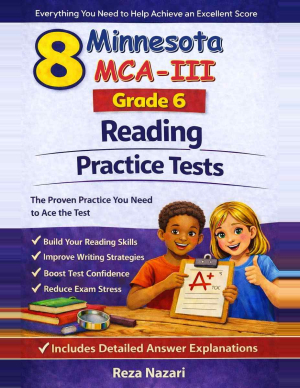
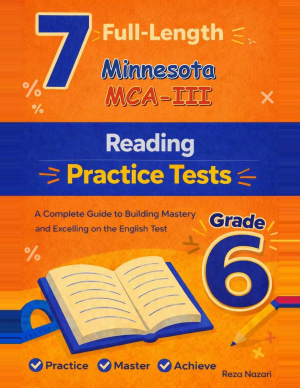
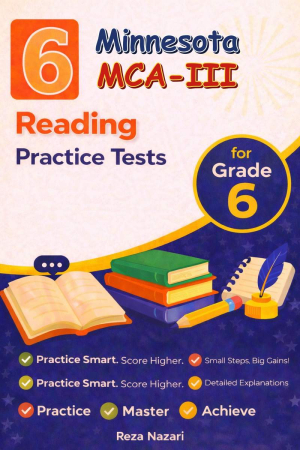
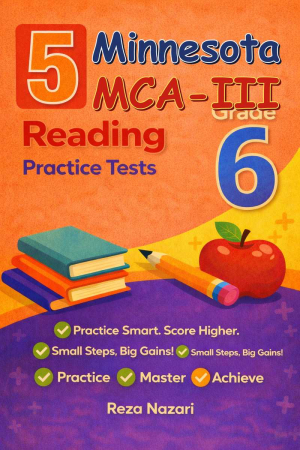
Build a Strong Minnesota Grade 6 MCA English Practice Library
These independently published resources have their own coverage and editions. Check the contents alongside Minnesota’s current English standards before choosing assessment preparation.
Use these Minnesota Grade 6 resources for reading comprehension, language, writing, and full-length practice where available. Click any cover to open the resource page.
More Grade 6 resources
A USEFUL NEXT STEP
Minnesota Grade 6 English: study questions
Can a paragraph describe details while supporting a comparison?
Yes. Separate descriptions can establish the features an author later compares. Explain the paragraph’s relationship to the whole text, not only its content.
Where are the complete Minnesota Grade 6 requirements?
Use Minnesota’s 2020 English Language Arts standards, February 2024 corrected edition. The state implementation page identifies full implementation in 2025–26. These selected benchmarks support one activity; use the complete framework and the school’s sequence for curriculum planning.
Official source ↗Resources from Effortless Math · Editorial standards