LEARN · PRACTICE · EXPLORE
Ohio Grade 6 English
Trace how an idea is introduced, illustrated, and elaborated in an original Grade 6 information text, with Ohio English references and printable practice.
Focused lessons · Useful practice · Clear next steps
What do Ohio 6th graders learn in ELA?
In 6th grade, Ohio English language arts centers on citing textual evidence, central idea, word choice, and argument writing. Students take the OST grade 6 ELA test in the spring. This page explains each Ohio grade 6 ELA standard and pairs it with short lessons and a full-length practice test.
Printable Ohio grade 6 ELA books:
- 5-Ohio-OST-English Language Arts (ELA) Grade 6 Reading Language Arts Practice Tests
- 6-Ohio-OST-English Language Arts (ELA) Grade 6 Reading Language Arts Practice Tests
- 7-Ohio-OST-English Language Arts (ELA) Grade 6 Reading Language Arts Practice Tests
- 8-Ohio-OST-English Language Arts (ELA) Grade 6 Reading Language Arts Practice Tests
- Ohio Grade 6 ELA Preparation Bundle
Standards source: Ohio adopted content standards.
Trace an Idea’s Development
Trace how an idea is introduced, illustrated, and elaborated in an original Grade 6 information text, with Ohio English references and printable practice. Use the teacher’s course sequence to connect this short activity with wider literacy work.
Curriculum reference: Ohio’s Learning Standards for English Language Arts, 2017 (transition reference), from the Ohio English language arts standards and transition page.
Ohio Grade 6 references for this activity
Ohio adopted revised K–8 English language arts standards in 2026. The state identifies 2026–2027 as a transition year and 2027–2028 as the first implementation year. This activity uses a selected reference from the 2017 standards during that transition. Check the school’s adopted sequence and the state’s transition guidance when deciding which edition to use; reading, writing, speaking, listening, and language work extend beyond this example.
| Selected Ohio reading reference | Activity focus | State-linked standards document |
|---|---|---|
| RI.6.3 | Analyze how a key individual, event, or idea is introduced, illustrated, and elaborated | Read the state-linked document (PDF page 25) |
For the upcoming implementation, read the 2026 revised K–8 English standards (PDF, with unchanged high-school standards included) and the state’s transition guidance.
These selected reference labels identify an activity focus, with the correct grade and PDF page linked separately. Read the complete standards selected by the school and its learning sequence, including reading, writing, language, speaking, and listening. This short original example does not fulfill the entire curriculum or establish a student’s grade-level proficiency.
Why a checklist needs a sequence
This original classroom example is separate from official assessment questions.
A checklist can remind a group what to do, but its order matters when one action depends on another. A list is more useful when it shows those dependencies.
Imagine a class preparing a seed tray. Filling the tray before adding labels may cover the spots where labels need to go. Listing “place labels” before “fill tray” makes the dependency visible.
A group can review a draft checklist by asking which actions must happen first and which can occur independently. Changing the order addresses a sequence problem; adding a missing action addresses a completeness problem. Both checks can improve the plan.
Try the activity
Identify the key idea. Explain how the first paragraph introduces it, the second illustrates it, and the third elaborates it. What distinction does the final paragraph add?
Follow the reasoning
The key idea is that a useful checklist considers the order of dependent actions. The first paragraph introduces that principle directly. The imagined seed-tray example illustrates it with a concrete case: filling can interfere with placing labels, so the order should account for that relation. The final paragraph elaborates the idea by offering a review question and distinguishing sequence from completeness. A list may include all actions yet place them in an unhelpful order, or arrange its listed actions well yet omit something necessary. This progression gives readers a general principle, an illustration, and a broader way to apply it.
Notice what needs more practice
The example is invented to illustrate a dependency, not a claim about every seed tray’s design. The final paragraph distinguishes two problems; it does not say one review guarantees success. A response that only names “checklists” misses how the idea develops.
Use the next session to build independence
- State the key idea precisely.
- Explain what the concrete example adds.
- Trace the distinction introduced at the end.
Choose a teacher-selected article that develops an idea through an example. Identify its introduction, illustration, and elaboration. Explain how a later qualification or distinction extends the original idea.
For more general reading and writing resources, visit the Grade 6 English Online Center.
Ohio Grade 6 English: useful planning questions
Does every paragraph perform the same job?
No. A paragraph can introduce, illustrate, qualify, or extend an idea. Explain its contribution to the development.
Which standards does the school use?
Ohio adopted revised K–8 English language arts standards in 2026. The state identifies 2026–2027 as a transition year and 2027–2028 as the first implementation year. This activity uses a selected reference from the 2017 standards during that transition. Check the school’s adopted sequence and the state’s transition guidance when deciding which edition to use; reading, writing, speaking, listening, and language work extend beyond this example. The school’s sequence also includes reading, writing, speaking, listening, and language work beyond this example.
Sources checked October 6, 2026. The state’s English assessment overview includes Ohio’s State Tests in Grades 3–8, including Grade 6. The standards directory says test revisions will follow the new standards; it does not establish a specific new-test administration date. Confirm the school’s current test directions, assigned pathway, and accommodations. Read the Ohio English assessment overview and English standards and transition guidance. Independently published practice has its own directions and scoring. Its result does not predict a state performance level, and this original activity is not an official assessment item.
Grade 6 English in other states
When moving between school systems, compare the official curriculum and the school’s learning sequence. Use the national Online Center’s map to find another state’s resources.
Recommended Ohio Grade 6 resources
Build a Strong Ohio Grade 6 OST English Practice Library
These independently published resources have their own coverage and editions. Check the contents alongside Ohio’s current English standards before choosing assessment preparation.
Use these Ohio Grade 6 resources for reading comprehension, language, writing, and full-length practice where available. Click any cover to open the resource page.
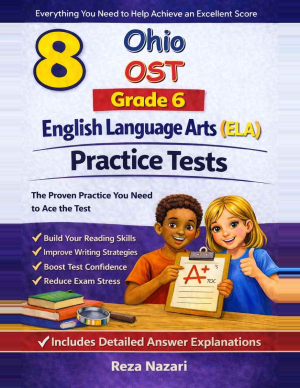 8-Ohio-OST-English Language Arts (ELA) Grade 6 Reading Language Arts Practice Tests
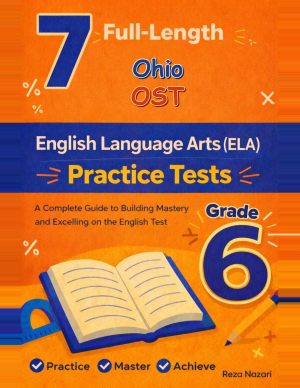 7-Ohio-OST-English Language Arts (ELA) Grade 6 Reading Language Arts Practice Tests
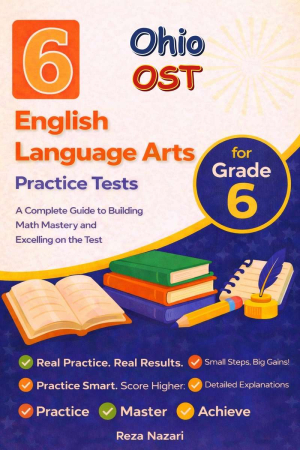 6-Ohio-OST-English Language Arts (ELA) Grade 6 Reading Language Arts Practice Tests
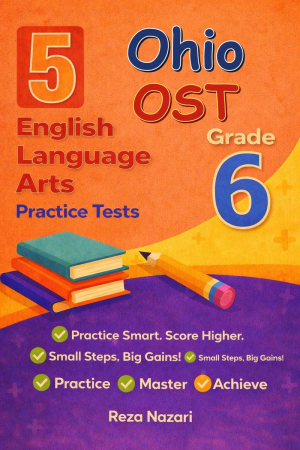 5-Ohio-OST-English Language Arts (ELA) Grade 6 Reading Language Arts Practice Tests
More Grade 6 resources
A USEFUL NEXT STEP
Ohio Grade 6 English: study questions
Does every paragraph perform the same job?
No. A paragraph can introduce, illustrate, qualify, or extend an idea. Explain its contribution to the development.
Where are the complete Ohio Grade 6 requirements?
Ohio adopted revised K–8 English language arts standards in 2026. The state identifies 2026–2027 as a transition year and 2027–2028 as the first implementation year. This activity uses a selected reference from the 2017 standards during that transition. Check the school’s adopted sequence and the state’s transition guidance when deciding which edition to use; reading, writing, speaking, listening, and language work extend beyond this example.
Official source ↗Resources from Effortless Math · Editorial standards