LEARN · PRACTICE · EXPLORE
Oregon Grade 6 English
Analyze how the middle section of an original Grade 6 story changes its plot and develops a theme, with Oregon English references and printable practice.
Focused lessons · Useful practice · Clear next steps
What do Oregon 6th graders learn in ELA?
In 6th grade, Oregon English language arts centers on citing textual evidence, central idea, word choice, and argument writing. Students take the OSAS grade 6 ELA test in the spring. This page explains each Oregon grade 6 ELA standard and pairs it with short lessons and a full-length practice test.
Printable Oregon grade 6 ELA books:
Standards source: Oregon adopted content standards.
Explain a Section’s Role in the Whole
Analyze how the middle section of an original Grade 6 story changes its plot and develops a theme, with Oregon English references and printable practice. Connect the activity with the books and writing work assigned by the school.
Curriculum reference: Oregon English Language Arts and Literacy Standards, 2019 (transition reference), from the Oregon English language arts standards and transition page.
Oregon Grade 6 references for this activity
Oregon adopted new K–12 English language arts and literacy standards on June 18, 2026, with implementation scheduled for 2028–2029. This activity uses a selected 2019 reference during the transition. Confirm the school’s course sequence and edition before assigning standards-specific work. The adopted 2026 document has revised coding; do not treat an old reference label as a complete crosswalk.
| Selected Oregon reading reference | Activity focus | State-linked standards document |
|---|---|---|
| 6.RL.5 | Analyze how a section fits the overall structure and develops theme, setting, or plot | Read the state-linked document (PDF page 58) |
For the upcoming implementation, read the 2026 adopted K–12 English language arts and literacy standards (PDF) and the state’s implementation timetable.
These selected reference labels identify an activity focus, with the correct grade and PDF page linked separately. Read the complete standards selected by the school and its learning sequence, including reading, writing, language, speaking, and listening. This short original example does not fulfill the entire curriculum or establish a student’s grade-level proficiency.
The missing sound
This original classroom example is separate from official assessment questions.
Part 1
The recording group wanted a track of the school bell. Ellis held the microphone near the entrance and pressed record. At playback, shoes and voices drowned out the bell.
Part 2
Ellis wanted to delete the track. June asked to hear it again. “The footsteps tell us when people arrived,” she said. They listened to the noises as parts of a scene instead of treating each one as a mistake.
Part 3
The group kept the first track and made a second recording for comparison. At the presentation, they explained how the same entrance sounded during a busy arrival and a quieter moment.
Try the activity
Explain how Part 2 fits between the original plan and the ending. How does June’s request redirect the plot? Describe a possible theme supported by all three sections. What would be unclear without the middle section?
Follow the reasoning
Part 1 establishes a narrow goal and a recording that seems to miss it. Part 2 supplies the turning point: June asks for another hearing and interprets the footsteps as useful information. That shift makes the ending’s comparison of two entrance scenes understandable. Instead of simply replacing a bad track, the group changes how it defines useful sound. A supported theme is that reconsidering an apparent mistake can reveal a new possibility. Part 3 develops that possibility by using both recordings. Without Part 2, readers would not see why the group decides to retain the first track or broaden its presentation. The section’s role is therefore causal and thematic, not merely that it comes second.
Notice what needs more practice
The excerpt does not show that every mistake is useful or that the second recording contains only the bell. A possible theme should fit these events without becoming an unlimited rule. No audience response or technical recording quality is reported.
Use the next session to build independence
- Locate the change in how the problem is viewed.
- Connect the turning point with the ending.
- Explain what its removal would do to the plot and theme.
Analyze a chapter, scene, or stanza in a teacher-selected work. Explain what comes before it, what it changes, and how that change shapes the whole. Support a theme with more than one section.
For more general reading and writing resources, visit the Grade 6 English Online Center.
Oregon Grade 6 English: useful planning questions
How is a section’s role different from its summary?
A summary tells what happens there. An analysis also explains why that part matters to the work’s structure, plot, setting, or theme.
Which standards does the school use?
Oregon adopted new K–12 English language arts and literacy standards on June 18, 2026, with implementation scheduled for 2028–2029. This activity uses a selected 2019 reference during the transition. Confirm the school’s course sequence and edition before assigning standards-specific work. The adopted 2026 document has revised coding; do not treat an old reference label as a complete crosswalk. The school’s sequence also includes reading, writing, speaking, listening, and language work beyond this example.
Sources checked October 6, 2026. The state’s English assessment overview includes the OSAS English summative test in Grades 3–8 and 11, including Grade 6. It also describes local speaking and writing performance assessments in Grades 3–8. Confirm the school’s assigned assessment pathway, current directions, and accommodations; this independent activity is not an official OSAS or local performance assessment. Read the Oregon English assessment overview and English standards and transition guidance. Independently published practice has its own directions and scoring. Its result does not predict a state performance level, and this original activity is not an official assessment item.
Grade 6 English in other states
When moving between school systems, compare the official curriculum and the school’s learning sequence. Use the national Online Center’s map to find another state’s resources.
Recommended Oregon Grade 6 resources
Build a Strong Oregon Grade 6 OSAS English Practice Library
These independently published resources have their own coverage and editions. Check the contents alongside Oregon’s current English standards before choosing assessment preparation.
Use these Oregon Grade 6 resources for reading comprehension, language, writing, and full-length practice where available. Click any cover to open the resource page.
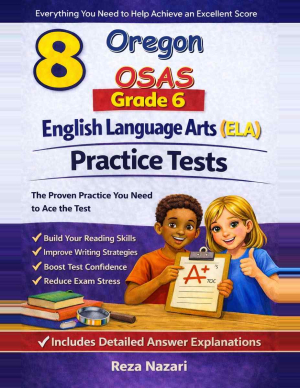
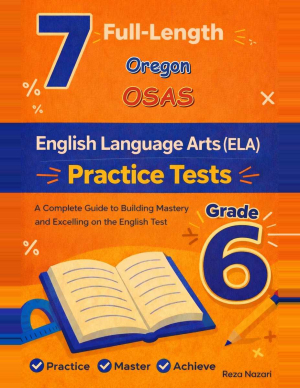
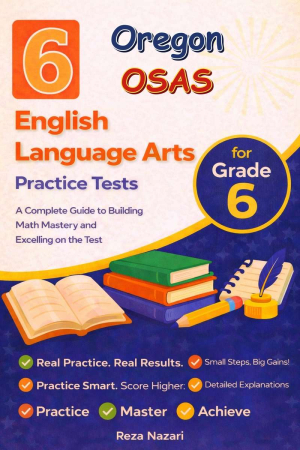
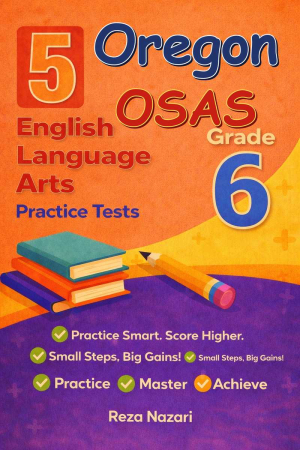
More Grade 6 resources
A USEFUL NEXT STEP
Oregon Grade 6 English: study questions
How is a section’s role different from its summary?
A summary tells what happens there. An analysis also explains why that part matters to the work’s structure, plot, setting, or theme.
Where are the complete Oregon Grade 6 requirements?
Oregon adopted new K–12 English language arts and literacy standards on June 18, 2026, with implementation scheduled for 2028–2029. This activity uses a selected 2019 reference during the transition. Confirm the school’s course sequence and edition before assigning standards-specific work. The adopted 2026 document has revised coding; do not treat an old reference label as a complete crosswalk.
Official source ↗Resources from Effortless Math · Editorial standards