


LEARN · PRACTICE · EXPLORE
Illinois Grade 6 English
Evaluate an original club proposal, identify supported and unsupported claims, and use a selected Illinois Grade 6 informational-reading reference.
Focused lessons · Useful practice · Clear next steps
What do Illinois 6th graders learn in ELA?
In 6th grade, Illinois English language arts centers on citing textual evidence, central idea, word choice, and argument writing. Students take the IAR grade 6 ELA test in the spring. This page explains each Illinois grade 6 ELA standard and pairs it with short lessons and a full-length practice test.
Printable Illinois grade 6 ELA books:


IAR Grade 6 ELA: Test Facts and Scores
Illinois 6th graders take the Illinois Assessment of Readiness (IAR) in English language arts each spring. Scores run from 650 to 850. Under the performance levels Illinois adopted in August 2025, 741 or higher is Proficient for Grade 6.
| Test | Illinois Assessment of Readiness (IAR), Grade 6 English Language Arts |
|---|---|
| 2027 testing window | Online: March 1–April 16, 2027; paper: March 1–April 2, 2027 |
| Performance levels | Below Proficient, Approaching Proficient, Proficient, Above Proficient (four levels since 2025) |
| Official information | ISBE IAR page |
Grade 6 ELA score ranges
| Performance level | Score range |
|---|---|
| Below Proficient | 650 to 704 |
| Approaching Proficient | 705 to 740 |
| Proficient | 741 to 779 |
| Above Proficient | 780 to 850 |
Practice on this page: Illinois standards
Facts from the Illinois State Board of Education, checked November 23, 2026: ISBE: Illinois Assessment of Readiness (IAR); ISBE: 2026–27 Illinois state assessment dates; ISBE: ELA cut scores and score ranges (August 2025); ISBE: Right-Sizing Illinois’ Benchmarks for Proficiency FAQ.
All 41 Illinois Grade 6 English Language Arts Standards
Every Grade 6 standard in the Common Core State Standards for English Language Arts, which Illinois uses as its state ELA standards, grouped by strand. Lettered sub-standards sit under each numbered standard in the official document. Open a strand to see its standards.
Reading: Literature (9)
| RL.6.1 | Cite textual evidence to support analysis of what a text says explicitly and inferences drawn from it. |
|---|---|
| RL.6.2 | Determine a theme or central idea, how it is conveyed through details, and summarize without personal opinion. |
| RL.6.3 | Describe how a plot unfolds in episodes and how characters respond or change as the plot moves toward a resolution. |
| RL.6.4 | Determine the meaning of words and phrases, including figurative and connotative meanings, and analyze word choice for meaning and tone. |
| RL.6.5 | Analyze how a particular sentence, chapter, scene or stanza fits into the overall structure and develops theme, setting or plot. |
| RL.6.6 | Explain how an author develops the point of view of the narrator or speaker. |
| RL.6.7 | Compare and contrast reading a story, drama or poem with listening to or viewing an audio, video or live version. |
| RL.6.9 | Compare and contrast texts in different forms or genres on their approaches to similar themes and topics. |
| RL.6.10 | By the end of the year, read and understand literature in the grades 6–8 complexity band proficiently. |
Reading: Informational Text (10)
| RI.6.1 | Cite textual evidence to support analysis of what an informational text says explicitly and inferences drawn from it. |
|---|---|
| RI.6.2 | Determine a central idea, how it is conveyed through details, and summarize without personal opinion. |
| RI.6.3 | Analyze in detail how a key individual, event or idea is introduced, illustrated and elaborated. |
| RI.6.4 | Determine the meaning of words and phrases, including figurative, connotative and technical meanings. |
| RI.6.5 | Analyze how a sentence, paragraph, chapter or section fits into the structure of a text. |
| RI.6.6 | Determine an author’s point of view or purpose and explain how it is conveyed. |
| RI.6.7 | Integrate information presented in different media or formats as well as in words to build understanding of a topic. |
| RI.6.8 | Trace and evaluate the argument and specific claims in a text, telling supported claims from unsupported ones. |
| RI.6.9 | Compare and contrast one author’s presentation of events with that of another, such as a memoir and a biography. |
| RI.6.10 | By the end of the year, read and understand literary nonfiction in the grades 6–8 complexity band proficiently. |
Writing (10)
| W.6.1 | Write arguments to support claims with clear reasons and relevant evidence from credible sources, in a formal style with a conclusion. |
|---|---|
| W.6.2 | Write informative texts that introduce a topic, organize ideas, develop them with facts, definitions and quotations, and conclude. |
| W.6.3 | Write narratives that engage the reader with a context, narrative techniques, transitions, precise language and a conclusion. |
| W.6.4 | Produce clear and coherent writing in which the development, organization and style fit the task, purpose and audience. |
| W.6.5 | With guidance, develop and strengthen writing by planning, revising, editing, rewriting or trying a new approach. |
| W.6.6 | Use technology, including the Internet, to produce and publish writing; show keyboarding skills to type three pages in one sitting. |
| W.6.7 | Conduct short research projects to answer a question, drawing on several sources and refocusing the inquiry when appropriate. |
| W.6.8 | Gather information from print and digital sources, assess credibility, quote or paraphrase while avoiding plagiarism, and give bibliographic information. |
| W.6.9 | Draw evidence from literary or informational texts to support analysis, reflection and research. |
| W.6.10 | Write routinely over extended and short time frames for a range of tasks, purposes and audiences. |
Speaking and Listening (6)
| SL.6.1 | Engage in collaborative discussions, coming prepared, following rules for collegial discussion, and reflecting on multiple perspectives. |
|---|---|
| SL.6.2 | Interpret information presented in diverse media and formats and explain how it contributes to a topic, text or issue. |
| SL.6.3 | Delineate a speaker’s argument and specific claims, telling supported claims from unsupported ones. |
| SL.6.4 | Present claims and findings logically with pertinent details and good eye contact, volume and pronunciation. |
| SL.6.5 | Include multimedia components and visual displays in presentations to clarify information. |
| SL.6.6 | Adapt speech to a variety of contexts and tasks, showing command of formal English when appropriate. |
Language (6)
| L.6.1 | Use standard grammar: pronoun case, intensive pronouns, shifts in pronoun number and person, and vague pronouns. |
|---|---|
| L.6.2 | Use capitalization, punctuation and spelling correctly, including commas, parentheses and dashes for nonrestrictive elements. |
| L.6.3 | Use knowledge of language: vary sentence patterns for meaning and style, and keep a consistent style and tone. |
| L.6.4 | Find the meaning of unknown words using context, Greek and Latin affixes and roots, and reference materials. |
| L.6.5 | Interpret figures of speech, use word relationships, and distinguish connotations of words with similar definitions. |
| L.6.6 | Acquire and use grade-appropriate general academic and domain-specific words and phrases. |
Codes follow the Common Core numbering; descriptions are our plain-English summaries. Checked November 23, 2026: ISBE: Illinois Learning Standards (standards and courses).
Standards source: Illinois English Language Arts, Illinois State Board of Education.
Separate recorded evidence from an unsupported prediction
An argument may combine useful evidence with a prediction that the evidence does not establish. Readers can evaluate each claim separately instead of accepting or rejecting the entire passage at once. The following club note and its counts are invented for reading practice.
Curriculum reference: Illinois Learning Standards incorporating Common Core English Language Arts/Literacy, from the Illinois State Board of Education standards directory.
Illinois Grade 6 references for this activity
Illinois’s current English document includes Grade 6 expectations across reading, writing, language, speaking, and listening. The expectations selected here support this activity; use the whole document and the school’s sequence for wider coverage.
| Grade-level expectation | Activity focus | Official requirement |
|---|---|---|
| RI.6.8 | Trace claims and distinguish supported from unsupported ones | Read the state document (PDF page 39) |
These are selected grade-level expectations from Illinois’s current English standards. Activity labels describe a teaching focus rather than reproduce complete requirements. Read the linked state document, including the reading, writing, language, speaking, and listening sections and grade-level progression, alongside the school’s curriculum sequence.
A worked Grade 6 reading and writing activity
This original classroom example is separate from official assessment questions.
Our art club should keep a shared sign-out sheet for scissors. During five meetings, we recorded eleven interruptions to ask who had the scissors. A sheet would let members check the last recorded borrower. It will eliminate every delay and make all our projects finish early.
| Claim | Supplied support | Conclusion |
|---|---|---|
| Locating scissors interrupted meetings | Eleven recorded interruptions in five meetings | Supported within that record |
| A sheet could show the last borrower | Reason about a recorded loan | Plausible mechanism to test |
| Every project will finish early | No project-completion evidence | Not established by the passage |
Try the activity
Identify the proposed action and trace its reason. Explain what the recorded interruptions support and what they do not establish. Distinguish the practical reasoning about a borrower record from the prediction about every delay and every project. Suggest a more supportable version of the final sentence.
Follow the reasoning
The interruption count supports the statement that locating scissors caused a problem during the five recorded meetings. The proposed sheet has a reasoned connection to that problem: it could show the last borrower if members record loans consistently. The evidence does not establish that all delays involve missing scissors or that a new sheet will always be complete. The promise that every project will finish early goes beyond the supplied information. A revised sentence might propose testing whether the sheet reduces time spent locating scissors.
Notice what needs more practice
An unsupported prediction is not disproved merely because the passage lacks evidence for it. The correct distinction is that the stated record does not establish the prediction. Also keep a reason separate from an observed result: the explanation of how a sheet could help is reasoning, not evidence that this club has already tried it successfully. The word recorded matters because the count describes a particular observation period rather than every meeting the club has ever held.
Use the next session to build independence
- Underline the specific claim being evaluated.
- Match it with the reason or evidence the author supplies.
- State the supported conclusion and identify what remains unestablished.
Add an invented follow-up record from a trial: fewer locating interruptions, but two delays waiting for glue to dry. Explain how that could support a narrower claim about scissors while leaving the promise about every delay unsupported. Label the added record as a new scenario. Then read a longer informational argument and make a separate note for each important claim. One supported detail does not automatically support every sentence around it. This short activity introduces claim evaluation; wider classroom reading should include authentic longer texts and their evidence.
For more general reading and writing resources, visit the Grade 6 English Online Center.
Illinois Grade 6 English: useful planning questions
Does missing support prove that a prediction is false?
No. It means the supplied evidence does not establish that prediction. The interruption count supports a locating problem, but it does not establish that the sheet will eliminate all delays.
Where are the complete state requirements?
Illinois’s current English document includes Grade 6 expectations across reading, writing, language, speaking, and listening. The expectations selected here support this activity; use the whole document and the school’s sequence for wider coverage. The school’s sequence also includes reading, writing, speaking, listening, and language work beyond this example.
Official sources checked October 6, 2026. Grade 6 is within the IAR English language arts testing range. This original lesson is independent practice. Read the Illinois assessment overview and use the school’s guidance for preparation. IAR measures English language arts and mathematics in Grades 3–8. Follow the school’s current assessment assignment, accommodations, and guidance; this classroom activity is independent practice and does not predict a state performance level. This site’s practice and books are independently published. Check their editions and contents against current standards and assessment guidance.
Grade 6 English in other states
When moving between school systems, compare the official curriculum and the school’s learning sequence. Use the national Online Center’s map to find another state’s resources.
Recommended Illinois Grade 6 resources
Build a Strong Illinois Grade 6 IAR English Practice Library
These independently published resources have their own coverage and editions. Check the contents alongside Illinois’s current English standards before choosing assessment preparation.
Use these Illinois Grade 6 resources for reading comprehension, language, writing, and full-length practice where available. Click any cover to open the resource page.
 8-Illinois-IAR-English Language Arts (ELA) Grade 6 Reading Language Arts Practice Tests
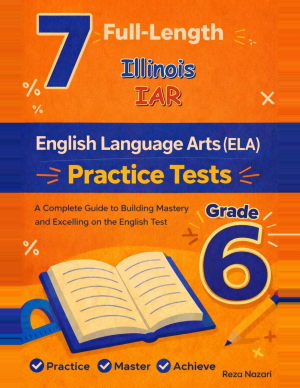 7-Illinois-IAR-English Language Arts (ELA) Grade 6 Reading Language Arts Practice Tests
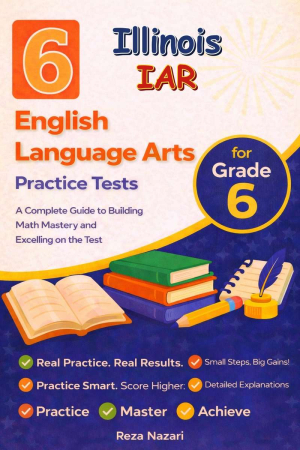 6-Illinois-IAR-English Language Arts (ELA) Grade 6 Reading Language Arts Practice Tests
 5-Illinois-IAR-English Language Arts (ELA) Grade 6 Reading Language Arts Practice Tests
More Grade 6 resources
Illinois Grade 6 English: 10-Question Challenge
Ten questions on reading, grammar, vocabulary, and writing for Illinois 6th graders, each with a short explanation.
Giving human actions (whispering) to wind is personification.
Checking each measurement twice shows she is very careful.
Choose another state
Grade 6 English in Every State
Select a state on the map to open its Grade 6 English page. You are viewing Illinois.
All states A–Z
A USEFUL NEXT STEP
Illinois Grade 6 English: study questions
Does missing support prove that a prediction is false?
No. It means the supplied evidence does not establish that prediction. The interruption count supports a locating problem, but it does not establish that the sheet will eliminate all delays.
Where are the complete Illinois Grade 6 requirements?
Illinois’s current English document includes Grade 6 expectations across reading, writing, language, speaking, and listening. The expectations selected here support this activity; use the whole document and the school’s sequence for wider coverage.
Official source ↗Resources from Effortless Math · Editorial standards