LEARN · PRACTICE · EXPLORE
Maryland Grade 6 English
Combine words and data in a Grade 6 reading activity, with a worked response, learning resources, and selected Maryland 2025 English standards references.
Focused lessons · Useful practice · Clear next steps
What do Maryland 6th graders learn in ELA?
In 6th grade, Maryland English language arts centers on citing textual evidence, central idea, word choice, and argument writing. Students take the MCAP grade 6 ELA test in the spring. This page explains each Maryland grade 6 ELA standard and pairs it with short lessons and a full-length practice test.
Printable Maryland grade 6 ELA books:
Standards source: Maryland English Language Arts, Maryland State Department of Education (archived backup).
Combine a report with its numerical evidence
Grade 6 readers build an explanation by combining words and quantities. This fictional school-library report includes a table that supports part of the conclusion while leaving another part uncertain.
Curriculum reference: 2025 Maryland English standards: selected grade-level strand (archived PDF), from the Maryland State Department of Education standards directory (archived backup).
Maryland Grade 6 references for this activity
The state’s standards directory identifies revised 2025 Maryland College and Career Ready Standards for English Language Arts. Use the Grade 6 column of the selected strand document; neighboring columns show prerequisite and later expectations. These selected references support the activity and do not cover the whole English curriculum.
| Grade-level expectation | Activity focus | Official requirement |
|---|---|---|
| RI.6.7 | Integrate quantitative information with words | Read the archived state document (PDF page 19) |
| RI.6.1 | Textual evidence supporting an explanation | Read the archived state document (PDF page 2) |
These are selected grade-level expectations from the revised 2025 Maryland English standards. Activity labels describe a teaching focus rather than reproduce complete requirements. Read the linked state document’s complete grade-level expectations, including its grade-specific details, alongside the school’s curriculum sequence.
A worked Grade 6 reading and writing activity
This original classroom example is separate from official assessment questions.
Library checkout report
During a four-week trial, the library kept a second checkout desk open at lunchtime. The number of books checked out during that period was higher than in the four weeks before the trial. The librarian thinks the extra desk helped students borrow books. The report also notes that a new class reading project began during the trial. Neither period includes weekend checkouts. These invented values are for reading practice, not results from a Maryland school.
| Period | Weeks counted | Books checked out |
|---|---|---|
| Before trial | 4 | 120 |
| During trial | 4 | 156 |
Try the activity
Combine the paragraph and table to describe the change. What does the table add that the paragraph does not quantify? Evaluate whether the report establishes that the extra desk alone caused the increase. Use both formats in one coherent explanation.
Follow the reasoning
The table records 156 checkouts during the trial compared with 120 before it, an increase of 36 books across equal four-week periods. The words identify the change in desk availability and explain that a new reading project also began. Together, the formats show higher lunchtime borrowing during a period with at least two changes. The numerical comparison supports the statement that the total rose, while the written context limits the causal conclusion. The extra desk may have helped, but these observations do not separate its effect from the project’s effect or other differences. A coherent response links the quantity and context rather than offering a paragraph summary followed by an unrelated subtraction.
Notice what needs more practice
Books checked out are not necessarily distinct students. One student may borrow several books, so 156 does not mean 156 borrowers. Equal duration helps comparison but does not prove equal attendance, opening days, or demand. The report excludes weekends; do not expand its totals into all library use. The table does not contain waiting times, so it cannot establish that the line moved faster. To check the model answer, confirm both the subtraction and the units, then ask whether each inference comes from evidence actually present in the report.
Use the next session to build independence
- Read the table headings, units, and time spans.
- Combine the numerical change with the paragraph’s context.
- Identify a conclusion the evidence does not establish.
Read a teacher-selected informational text with a graph, map, or table. Ask students to explain what the visual or numerical format adds and what the words clarify. Have them revise a response that relies on only one format. A later task can introduce another relevant source and compare its scope, definitions, and evidence before combining conclusions.
For more general reading and writing resources, visit the Grade 6 English Online Center.
Maryland Grade 6 English: useful planning questions
Does a numerical increase prove the report’s causal claim?
The increase establishes a change in the reported count. A causal explanation needs evidence that addresses other changes and plausible alternatives, including the reading project mentioned here.
Where are the complete state requirements?
The state’s standards directory identifies revised 2025 Maryland College and Career Ready Standards for English Language Arts. Use the Grade 6 column of the selected strand document; neighboring columns show prerequisite and later expectations. These selected references support the activity and do not cover the whole English curriculum. The school’s sequence also includes reading, writing, speaking, listening, and language work beyond this example.
Sources checked October 6, 2026. Grade 6 is in the statewide English assessment grade range. Maryland announced a transition from MCAP to MSTAR beginning in 2026–27. Follow the school’s current assignment and administration directions, including an alternate pathway if assigned. The May 2026 state board report (PDF page 12, archived copy) describes the MSTAR transition. Older MCAP-named books and practice linked here retain their published names and should be checked against current school guidance; they are independent supplements. Their question counts, timers, and scoring are not official MSTAR specifications or predictions of a state performance level. The MSDE website displayed a maintenance notice during review and linked an archived backup. The standards links here use working archived copies of the state’s revised documents, not a claim that the live site was available. Check the MSDE website and school guidance for later updates. This original classroom activity is not an official assessment item.
Grade 6 English in other states
When moving between school systems, compare the official curriculum and the school’s learning sequence. Use the national Online Center’s map to find another state’s resources.
Recommended Maryland Grade 6 resources
Build a Strong Maryland Grade 6 MCAP English Practice Library
These independently published resources have their own coverage and editions. Check the contents alongside Maryland’s current English standards before choosing assessment preparation.
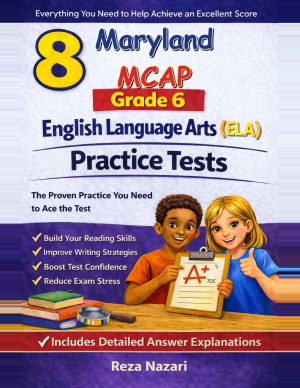
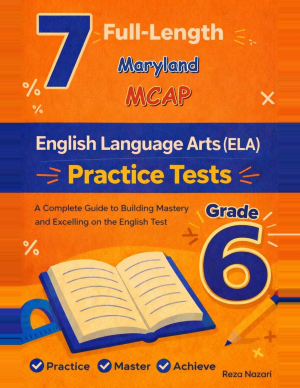
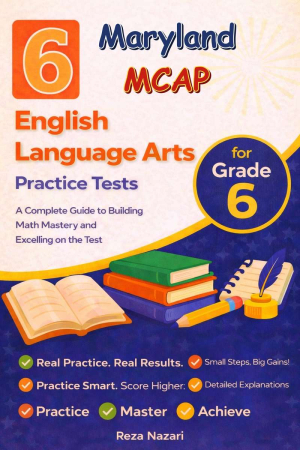
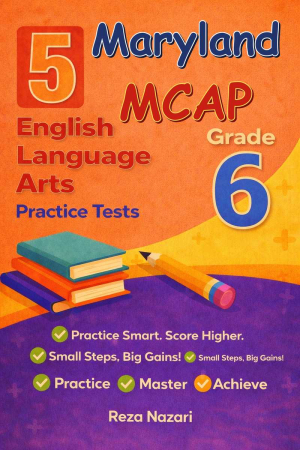
Use these Maryland Grade 6 resources for reading comprehension, language, writing, and full-length practice where available. Click any cover to open the resource page.
More Grade 6 resources
A USEFUL NEXT STEP
Maryland Grade 6 English: study questions
Does a numerical increase prove the report’s causal claim?
The increase establishes a change in the reported count. A causal explanation needs evidence that addresses other changes and plausible alternatives, including the reading project mentioned here.
Where are the complete Maryland Grade 6 requirements?
The state’s standards directory identifies revised 2025 Maryland College and Career Ready Standards for English Language Arts. Use the Grade 6 column of the selected strand document; neighboring columns show prerequisite and later expectations. These selected references support the activity and do not cover the whole English curriculum.
Official source ↗Resources from Effortless Math · Editorial standards