


LEARN · PRACTICE · EXPLORE
New York Grade 6 English
Compare an original written notice with its companion table, explain what each format makes clear, and use New York Grade 6 English resources for practice.
Focused lessons · Useful practice · Clear next steps
What do New York 6th graders learn in ELA?
In 6th grade, New York English language arts centers on citing textual evidence, central idea, word choice, and argument writing. Students take the New York State grade 6 ELA test in the spring. This page explains each New York grade 6 ELA standard and pairs it with short lessons and a full-length practice test.
Printable New York grade 6 ELA books:

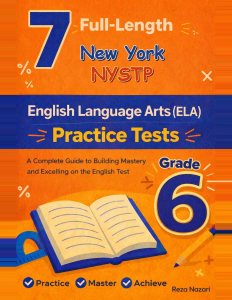
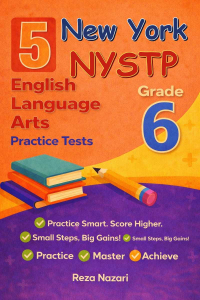
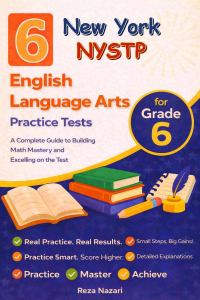
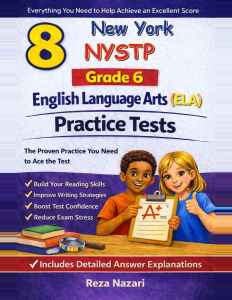
New York State Grade 6 ELA Test: Facts and Scores
New York 6th graders take the Grade 6 English Language Arts Test each spring (April/May). It has two sessions on two days and no time limit within the school day. On the 2026 test, scale scores ran from 371 to 498, and 450 or higher is NYS Level 3, proficient.
| Test | New York State Grade 6 English Language Arts Test |
|---|---|
| Who takes it | Public school students in grades 3 through 8 |
| Sessions | Two sessions over two days; students may work as long as they need within the regular school day |
| Questions | Reading passages with multiple-choice questions and written responses |
| Official practice | Past NYSED grades 3–8 tests (released questions, free) |
Grade 6 ELA performance levels
| Performance level | 2026 scale scores |
|---|---|
| NYS Level 1 (below proficient) | 371 to 430 |
| NYS Level 2 (partially proficient) | 431 to 449 |
| NYS Level 3 (proficient) | 450 to 469 |
| NYS Level 4 (excels) | 470 to 498 |
Practice on this page: New York standards
Facts from the New York State Education Department, checked November 23, 2026: NYSED: 2026 performance levels and scale score ranges, grades 3–8; NYSED: Educator Guide to the 2026 Grades 3–8 ELA Tests; NYSED: past grades 3–8 tests.
All 26 New York Grade 6 ELA Standards
Every Grade 6 standard in the New York State Next Generation English Language Arts Learning Standards, grouped by strand. The Grade 6 state ELA Test measures the reading and writing standards. Open a group to see its standards.
Reading (Literary and Informational Text) (9)
| 6R1 | Cite textual evidence to support an analysis of what the text says explicitly/implicitly and make logical inferences. (RI&RL) |
|---|---|
| 6R2 | Determine a theme or central idea of a text and how it is developed by key supporting details over the course of a text; summarize a text (RI&RL) |
| 6R3 | In literary texts, describe how events unfold, as well as how characters respond or change as the plot moves toward a resolution. (RL) In informational texts, analyze how individuals, events, and ideas are introduced, relate to each other, and are developed. (RI) |
| 6R4 | Determine the meaning of words and phrases as they are used in a text, including figurative and connotative meanings. Analyze the impact of specific word choices on meaning, tone, and mood, including words with multiple meanings. (RI&RL) |
| 6R5 | In literary texts, analyze how a particular sentence, paragraph, stanza, chapter, scene, or section fits into the overall structure of a text and how it contributes to the development of theme, central idea, setting, or plot. (RL) In informational texts, analyze how a particular sentence, paragraph, chapter, or section fits into the overall structure of a text and how it contributes to the development of theme or central ideas. (RI) |
| 6R6 | In literary texts, identify the point of view and explain how it is developed and conveys meaning. (RL) In informational texts, explain how an author’s geographic location or culture affects his or her perspective. (RI) |
| 6R7 | Compare and contrast how different formats, including print and digital media, contribute to the understanding of a subject. (RI&RL) |
| 6R8 | Trace and evaluate the development of an argument and specific claims in texts, distinguishing claims that are supported by reasons and relevant evidence from claims that are not. (RI&RL) |
| 6R9 | Use established criteria in order to evaluate the quality of texts. Make connections to other texts, ideas, cultural perspectives, eras, and personal experiences. (RI&RL) |
Writing (7)
| 6W1 | Write arguments to support claims with clear reasons and relevant evidence. |
|---|---|
| 6W2 | Write informative/explanatory texts to examine a topic and convey ideas, concepts, and information through the selection, organization, and analysis of relevant content. GRADE |
| 6W3 | Write narratives to develop real or imagined experiences or events using effective techniques, descriptive details and sequencing |
| 6W4 | Create a poem, story, play, artwork, or other response to a text, author, theme, or personal experience. |
| 6W5 | Draw evidence from literary or informational texts to support analysis, reflection, and research. Apply the grade 6 Reading Standards to both literary and informational text, where applicable. |
| 6W6 | Conduct research to answer questions, including self-generated questions, drawing on multiple sources and refocusing the inquiry when appropriate. |
| 6W7 | Gather relevant information from multiple sources; assess the credibility of each source; quote or paraphrase the data and conclusions of others; avoid plagiarism and provide basic bibliographic information for sources. |
Speaking and Listening (6)
| 6SL1 | Engage effectively in a range of collaborative discussions with diverse partners; express ideas clearly and persuasively, and build on those of other. |
|---|---|
| 6SL2 | Interpret information presented in diverse formats (e.g., including visual, quantitative, and oral) and explain how it relates to a topic, text, or issue under study. |
| 6SL3 | Delineate a speaker’s argument and specific claims, distinguishing claims that are supported by reasons and evidence from claims that are not. |
| 6SL4 | Present claims and findings, sequencing ideas logically and using relevant descriptions, facts, and details to accentuate central ideas or themes; use appropriate eye contact, adequate volume, and clear enunciation. |
| 6SL5 | Include digital media and/or visual displays in presentations to clarify information and emphasize and enhance central ideas or themes. |
| 6SL6 | Adapt speech to a variety of contexts and tasks, demonstrating command of formal English when indicated or appropriate. |
Language (4)
| 6L3 | Use knowledge of language and its conventions when writing, speaking, reading, or listening. |
|---|---|
| 6L4 | Determine or clarify the meaning of unknown and multiple-meaning words and phrases, choosing flexibly from a range of strategies. |
| 6L5 | Demonstrate understanding of figurative language, word relationships, and nuances in word meanings. |
| 6L6 | Acquire and accurately use general academic and content-specific words and phrases; apply vocabulary knowledge when considering a word or phrase important to comprehension or expression. |
Language Standards 1 and 2 (conventions, punctuation and spelling) are organized in grade bands in Appendix A of the standards document. RL and RI mark literary and informational text.
Codes and wording from the NYSED standards document (main statement of each standard; sub-parts and examples are in the official document). Checked November 23, 2026: NYSED: New York State Next Generation English Language Arts Learning Standards (2017).
Standards source: New York adopted content standards.
Comparing Information Formats
Compare an original written notice with its companion table, explain what each format makes clear, and use New York Grade 6 English resources for practice. Use this focused activity alongside the school’s wider reading, writing, speaking, listening, and language sequence.
Curriculum reference: 2017 New York State Next Generation English Language Arts Learning Standards, from the New York English Language Arts standards page.
New York Grade 6 references for this activity
New York’s English Language Arts page links the 2017 Next Generation ELA Learning Standards. The state’s implementation timeline places Pre-K–8 instruction under those standards from September 2022, with Grades 3–8 assessment first aligned in Spring 2023. The selected reading references below identify this activity’s focus; use the complete grade requirements and the school’s broader literacy program.
| Selected New York reading reference | Activity focus | State-hosted standards document |
|---|---|---|
| 6R1 | Cite evidence for explanation | Read the state-hosted document (PDF page 74) |
| 6R7 | Compare how formats contribute to understanding | Read the state-hosted document (PDF page 74) |
These selected reference labels identify an activity focus, with the correct grade and PDF page linked separately. Read the complete standards selected by the school and its learning sequence, including reading, writing, language, speaking, and listening. This short original example does not fulfill the entire curriculum or establish a student’s grade-level proficiency.
A notice and its companion display
This original classroom example is separate from official assessment questions.
Written notice
The class lending station opens during lunch on Tuesday and Thursday. Tuesday lends drawing tools; Thursday lends measuring tools. Returns are accepted on either opening day. The station stays closed on Wednesday while volunteers check the equipment. A request for an extra opening day has been discussed but not approved.
| Opening day | Items lent | Returns accepted |
|---|---|---|
| Tuesday | Drawing tools | Yes |
| Thursday | Measuring tools | Yes |
Try the activity
Use both formats to explain when a measuring tool can be borrowed and returned. What does the table make quick to compare, and what does the prose explain that the table leaves out? Does the display establish that an extra day has been approved?
Follow the reasoning
The table makes the two opening days and their different lending categories easy to compare: measuring tools are lent on Thursday, while returns are accepted on Tuesday and Thursday. The written notice supplies the reason for Wednesday’s closure and distinguishes a discussed request from an approved opening. A reader can use the table to locate a day quickly and use the prose to understand the reason and unresolved proposal. The table is not contradictory merely because it omits those details; it presents fewer kinds of information. Neither format approves an extra day. Both represent the same fictional station, and a combined answer should identify which detail comes from which format rather than treating the shorter display as a complete account.
Notice what needs more practice
Do not confuse the day a type of tool is lent with the days it can be returned. A table’s empty coverage of Wednesday is not itself an explanation of the closure. Read headings and cells together. This print-and-table comparison is a focused formats activity; broader 6R7 work can include teacher-selected digital media.
Use the next session to build independence
- Read the column headings before individual cells.
- Use the notice to locate reasons or conditions.
- Compare each format’s strengths and omissions with specific evidence.
Design a revised display that adds a short note about Wednesday while keeping the lending schedule easy to scan. Explain the tradeoff between quick comparison and detailed explanation. Compare a teacher-selected print resource and digital presentation of the same subject for a broader formats task.
For more general reading and writing resources, visit the Grade 6 English Online Center.
New York Grade 6 English: useful planning questions
Is a shorter display necessarily less reliable?
No. It may accurately organize selected information. Check its purpose and omissions, then use the companion text for details outside its scope.
Which standards does the school use?
New York’s English Language Arts page links the 2017 Next Generation ELA Learning Standards. The state’s implementation timeline places Pre-K–8 instruction under those standards from September 2022, with Grades 3–8 assessment first aligned in Spring 2023. The selected reading references below identify this activity’s focus; use the complete grade requirements and the school’s broader literacy program. The school’s sequence also includes reading, writing, speaking, listening, and language work beyond this example.
Sources checked October 6, 2026. The 2026–2027 NYSED schedule places Grades 3–8 ELA, including Grade 6, in an April 5–May 14, 2027 window. Each school sets its grade/subject administration dates within that window; ELA uses two consecutive school days. Confirm the learner’s assigned pathway, accommodations, and current school directions. Read the official 2026–2027 testing schedule (PDF), NYSED schedules page, ELA standards page, and instruction and assessment implementation timeline (PDF). Independently published practice has its own directions and scoring. Its result does not predict a state performance level, and this original activity is not an official assessment item.
Grade 6 English in other states
When moving between school systems, compare the official curriculum and the school’s learning sequence. Use the national Online Center’s map to find another state’s resources.
More Grade 6 resources
New York Grade 6 English: 10-Question Challenge
Ten questions on reading, grammar, vocabulary, and writing for New York 6th graders, each with a short explanation.
Giving human actions (whispering) to wind is personification.
Strong evidence is specific and measurable, such as survey data.
Choose another state
Grade 6 English in Every State
Select a state on the map to open its Grade 6 English page. You are viewing New York.
All states A–Z
A USEFUL NEXT STEP
New York Grade 6 English: study questions
Is a shorter display necessarily less reliable?
No. It may accurately organize selected information. Check its purpose and omissions, then use the companion text for details outside its scope.
Where are the complete New York Grade 6 requirements?
New York’s English Language Arts page links the 2017 Next Generation ELA Learning Standards. The state’s implementation timeline places Pre-K–8 instruction under those standards from September 2022, with Grades 3–8 assessment first aligned in Spring 2023. The selected reading references below identify this activity’s focus; use the complete grade requirements and the school’s broader literacy program.
Official source ↗Resources from Effortless Math · Editorial standards