LEARN · PRACTICE · EXPLORE
Massachusetts Grade 6 English
Analyze how a sentence connects a story’s earlier detail with its ending, using an original passage and Massachusetts Grade 6 English references.
Focused lessons · Useful practice · Clear next steps
What do Massachusetts 6th graders learn in ELA?
In 6th grade, Massachusetts English language arts centers on citing textual evidence, central idea, word choice, and argument writing. Students take the MCAS grade 6 ELA test in the spring. This page explains each Massachusetts grade 6 ELA standard and pairs it with short lessons and a full-length practice test.
Printable Massachusetts grade 6 ELA books:
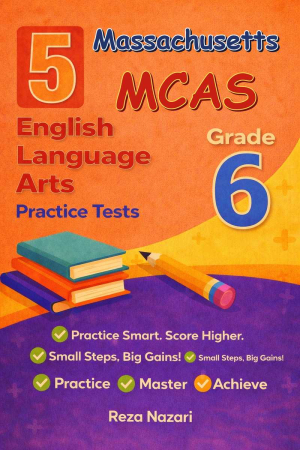
- 5-Massachusetts-MCAS Grade 6 Reading Language Arts Practice Tests
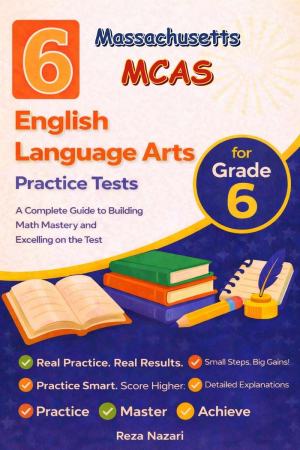
- 6-Massachusetts-MCAS Grade 6 Reading Language Arts Practice Tests
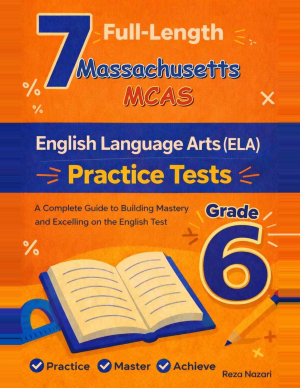
- 7-Massachusetts-MCAS Grade 6 Reading Language Arts Practice Tests
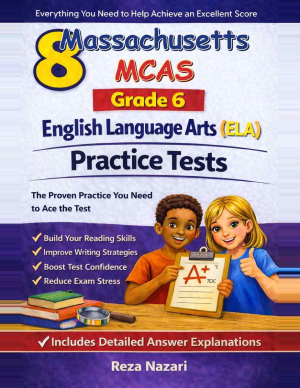
- 8-Massachusetts-MCAS Grade 6 Reading Language Arts Practice Tests
- Massachusetts Grade 6 ELA Preparation Bundle
Standards source: Massachusetts English Language Arts, Massachusetts Department of Elementary and Secondary Education.
Explain the work a single sentence does in a story
A sentence can do more than report an event. Trace how it connects earlier information with the direction of the plot and a possible theme.
Curriculum reference: 2017 Massachusetts English Language Arts and Literacy Framework, from the Massachusetts Department of Elementary and Secondary Education current frameworks directory.
Massachusetts Grade 6 references for this activity
The state’s current frameworks directory links the 2017 Massachusetts English Language Arts and Literacy Framework, adopted in March 2017. Read the individual Grade 6 requirements and the school’s sequence. These selected references support this activity; they do not cover the whole English curriculum.
| Grade-level expectation | Activity focus | Official requirement |
|---|---|---|
| RL.6.5 | How a sentence contributes to structure and theme or plot | Read the state framework (PDF page 93) |
| RL.6.1 | Textual evidence supporting analysis | Read the state framework (PDF page 93) |
These are selected grade-level expectations from the current 2017 Massachusetts English framework. Activity labels describe a teaching focus rather than reproduce complete requirements. Read the linked state document’s complete grade-level expectations, including its grade-specific details, alongside the school’s curriculum sequence.
A worked Grade 6 reading and writing activity
This original classroom example is separate from official assessment questions.
At the first rehearsal, Mia hid her unfinished song beneath the bench. Everyone else had arrived with neat pages. When the teacher asked for a melody, Mia shook her head. Later, Jun played three uncertain notes and laughed. “That is all I have so far.” Mia recognized one note from her own tune. She pulled the crumpled page from beneath the bench. By the end of rehearsal, the two unfinished melodies had become the beginning of a duet.
Try the activity
Analyze the sentence She pulled the crumpled page from beneath the bench. Explain how it connects with the opening and contributes to the plot’s movement toward the duet. Use text evidence, and distinguish analysis from a summary or a personal opinion about Mia.
Follow the reasoning
The sentence reverses the opening action: Mia first hides the song, then retrieves it. Between those actions, Jun shares an unfinished melody, which gives her a reason to reconsider keeping hers hidden. Pulling out the page marks a change from withholding her work to making it available for collaboration. That change makes the final duet possible. The sentence therefore joins the earlier bench detail with the ending and helps develop a possible theme about sharing unfinished work. The analysis depends on the sequence, including Jun’s admission and the combined melodies, rather than treating the retrieval as an isolated movement.
Notice what needs more practice
Saying Mia gets a paper is an accurate summary of the action but does not explain its structural contribution. Saying she should have been braver is a personal judgment unless connected to the text’s development. The passage suggests discomfort about unfinished work through the neat pages and her initial refusal; it does not explicitly name every feeling. Nor does it say the duet is complete or publicly performed. Keep inferences proportionate to the evidence. A single sentence can contribute to several aspects of a work, and the chosen focus should be supported by surrounding details.
Use the next session to build independence
- Connect the chosen sentence with an earlier repeated detail.
- Identify what changes before and after that sentence.
- Explain how the change contributes to the ending or a supported theme.
Compare a version that omits the retrieval sentence. Discuss what the reader would then have to infer about how Mia’s song entered the duet. Restore the sentence and revise the explanation of its role. In a longer classroom work, choose another specific sentence or scene and locate its contribution to setting, plot, or theme. Keep the quoted or paraphrased evidence close to the analysis. Massachusetts’s Grade 6 requirement concerns structural contribution, so simply listing events or identifying a theme without tracing the chosen part needs further practice.
For more general reading and writing resources, visit the Grade 6 English Online Center.
Massachusetts Grade 6 English: useful planning questions
Is describing a sentence’s event the same as analyzing its role?
No. Analysis explains how that event connects with surrounding parts and contributes to plot, setting, or theme. Use the before-and-after sequence as evidence.
Where are the complete state requirements?
The state’s current frameworks directory links the 2017 Massachusetts English Language Arts and Literacy Framework, adopted in March 2017. Read the individual Grade 6 requirements and the school’s sequence. These selected references support this activity; they do not cover the whole English curriculum. The school’s sequence also includes reading, writing, speaking, listening, and language work beyond this example.
Sources checked October 6, 2026. Grade 6 is within the MCAS English language arts testing range. The state overview identifies English language arts and mathematics testing in Grades 3–8 and 10. Follow the school’s assigned pathway and current administration directions. The official MCAS overview states that MCAS is untimed within a regular school day. Independently published practice may use its own timer, question count, and scoring; those features are not official MCAS specifications or a prediction of a state performance level. Use the complete framework and the school’s learning sequence to choose further reading, writing, speaking, listening, and language work. This original classroom activity is not an official assessment item.
Grade 6 English in other states
When moving between school systems, compare the official curriculum and the school’s learning sequence. Use the national Online Center’s map to find another state’s resources.
Recommended Massachusetts Grade 6 resources
Build a Strong Massachusetts Grade 6 MCAS English Practice Library
These independently published resources have their own coverage and editions. Check the contents alongside Massachusetts’s current English standards before choosing assessment preparation.
Use these Massachusetts Grade 6 resources for reading comprehension, language, writing, and full-length practice where available. Click any cover to open the resource page.
More Grade 6 resources
A USEFUL NEXT STEP
Massachusetts Grade 6 English: study questions
Is describing a sentence’s event the same as analyzing its role?
No. Analysis explains how that event connects with surrounding parts and contributes to plot, setting, or theme. Use the before-and-after sequence as evidence.
Where are the complete Massachusetts Grade 6 requirements?
The state’s current frameworks directory links the 2017 Massachusetts English Language Arts and Literacy Framework, adopted in March 2017. Read the individual Grade 6 requirements and the school’s sequence. These selected references support this activity; they do not cover the whole English curriculum.
Official source ↗Resources from Effortless Math · Editorial standards