LEARN · PRACTICE · EXPLORE
Georgia Grade 6 English
Compare two original accounts of a rehearsal-room change, explain their organization, and use current Georgia Grade 6 structure expectations.
Focused lessons · Useful practice · Clear next steps
What do Georgia 6th graders learn in ELA?
In 6th grade, Georgia English language arts centers on citing textual evidence, central idea, word choice, and argument writing. Students take the Georgia Milestones grade 6 ELA test in the spring. This page explains each Georgia grade 6 ELA standard and pairs it with short lessons and a full-length practice test.
Printable Georgia grade 6 ELA books:
Standards source: Georgia English Language Arts, Georgia Department of Education.
Compare a chronological report with a problem-and-response explanation
The same events can support different organizational choices. A record of what happened emphasizes order; an explanation of a response emphasizes a problem and why an action addressed it. Look for relationships between ideas rather than choose a structure from one signal word alone.
Curriculum source: Georgia’s K-12 English Language Arts Standards, approved May 2023 and fully implemented in 2025–26, from the GaDOE English standards directory.
Georgia Grade 6 references for this activity
Georgia’s current Grade 6 English document contains grade-level expectations alongside broader standards and practices. The expectations selected here support this activity; use the whole document and the school’s sequence for wider coverage.
| Grade-level expectation | Activity focus | Official requirement |
|---|---|---|
| 6.T.SS.1.a | Explain how organization serves meaning and purpose | Read the primary standards document, page 19 |
| 6.T.SS.1.d | Organize a coherent multi-paragraph text | Read the primary standards document, page 19 |
These are selected grade-level expectations from Georgia’s current English standards. Activity labels describe a teaching focus rather than reproduce complete requirements. Read the linked grade-level document, including its broader standards and practices, alongside the school’s curriculum sequence.
A worked Grade 6 reading and writing activity
This original classroom example is separate from official assessment questions.
Account A: On Monday, the drama club practiced in a room beside a busy corridor. Several actors asked for lines to be repeated. On Tuesday, the club moved rehearsal to the quieter reading room. On Wednesday, the actors completed the scene with fewer requests for repetition.
Account B: Corridor noise made dialogue difficult to hear during rehearsal. To address that problem, the club moved to the quieter reading room. The next rehearsal had fewer requests for lines to be repeated, suggesting that the change helped. The club still needed to check whether the room remained available for future sessions.
Try the activity
Explain how each account organizes its information and what purpose that organization serves. Then plan two paragraphs that explain the problem and response while preserving the limits of the reported result.
Follow the reasoning
Account A organizes the events by day and helps readers reconstruct the sequence. Account B begins with the hearing problem, links the move to its purpose, and then describes a result and an unresolved issue. Its organization helps readers evaluate the response rather than only track dates. The accounts share the room change and fewer repetition requests. Account B’s claim remains limited: the result suggests help, rather than proving that every actor heard every line perfectly.
Notice what needs more practice
Calling both accounts chronological because both mention a later rehearsal misses B’s main relationship between problem and response. Calling B a proven cause-and-effect study also overstates the information. A coherent explanation can use more than one relationship, including sequence, purpose, and a qualified result. Keep the facts consistent when reorganizing them: the account does not state how many requests occurred or that the new room is permanently available.
Use the next session to build independence
- List the common events and identify which information each account emphasizes.
- Connect the organization to a likely reader need, such as a sequence record or an explanation of a decision.
- Plan paragraphs with a clear opening, supporting details, and a conclusion that fits the reported result.
Draft one paragraph establishing the hearing problem and a second explaining the move, result, and next question. Use connected terms such as rehearsal, dialogue, and repetition requests to maintain cohesion without repeating every sentence. Compare the draft with a day-by-day version for a club diary. Discuss which arrangement better fits each audience and purpose. The structural choice should help readers follow the ideas; it need not force every text into one rigid formula.
For more general reading and writing resources, visit the Grade 6 English Online Center.
Georgia Grade 6 English: useful planning questions
Does a text’s structure depend on one signal word?
No. Examine how its ideas are related across the text. Account B includes a later event, but its main organization connects a problem with a response, result, and remaining question.
Where are the complete state requirements?
Georgia’s current Grade 6 English document contains grade-level expectations alongside broader standards and practices. The expectations selected here support this activity; use the whole document and the school’s sequence for wider coverage. The school’s sequence also includes reading, writing, speaking, listening, and language work beyond this example.
Official sources checked October 5, 2026. Grade 6 is within the Georgia Milestones English language arts testing range. This original lesson is independent practice. Read the Georgia Milestones overview and use the school’s guidance for preparation. Georgia’s new English standards were fully implemented in 2025–26, alongside revised assessments. This site’s practice and books are independently published. Check their editions and contents against current standards and assessment guidance.
Grade 6 English in other states
When moving between school systems, compare the official curriculum and the school’s learning sequence. Use the national Online Center’s map to find another state’s resources.
Recommended Georgia Grade 6 resources
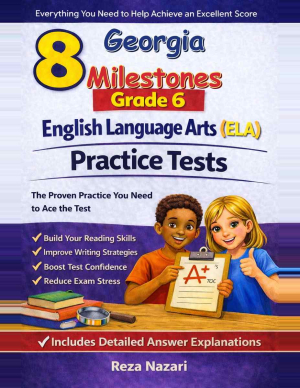
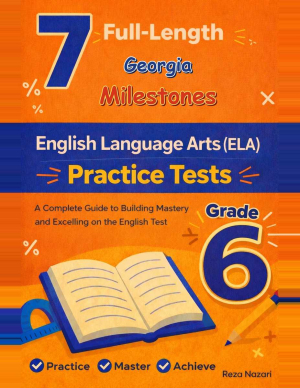
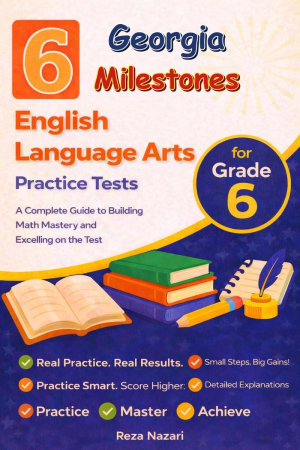
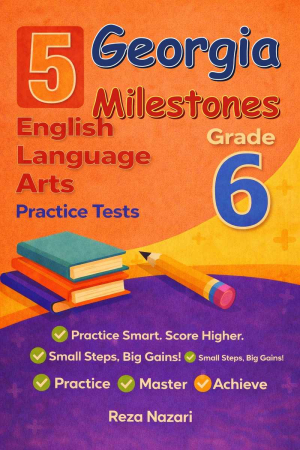
Build a Strong Georgia Grade 6 Milestones English Practice Library
These independently published resources may use earlier Georgia English standards. Check the edition and contents alongside GaDOE’s current English standards before choosing assessment preparation.
Use these Georgia Grade 6 resources for reading comprehension, language, writing, and full-length practice where available. Click any cover to open the resource page.
More Grade 6 resources
A USEFUL NEXT STEP
Georgia Grade 6 English: study questions
Does a text’s structure depend on one signal word?
No. Examine how its ideas are related across the text. Account B includes a later event, but its main organization connects a problem with a response, result, and remaining question.
Where are the complete Georgia Grade 6 requirements?
Georgia’s current Grade 6 English document contains grade-level expectations alongside broader standards and practices. The expectations selected here support this activity; use the whole document and the school’s sequence for wider coverage.
Official source ↗Resources from Effortless Math · Editorial standards