LEARN · PRACTICE · EXPLORE
Michigan Grade 6 English
Trace the introduction and development of an archivist in an original profile, explain the role of examples, and use Michigan Grade 6 English resources.
Focused lessons · Useful practice · Clear next steps
What do Michigan 6th graders learn in ELA?
In 6th grade, Michigan English language arts centers on citing textual evidence, central idea, word choice, and argument writing. Students take the M-STEP grade 6 ELA test in the spring. This page explains each Michigan grade 6 ELA standard and pairs it with short lessons and a full-length practice test.
Printable Michigan grade 6 ELA books:
Standards source: Michigan English Language Arts, Michigan Department of Education.
Analyze how a text develops a key individual
An informational profile can introduce a person through a task, then develop the account with examples and added detail. Trace what each part contributes.
Curriculum reference: Michigan K–12 English Language Arts Standards, from the Michigan Department of Education academic standards directory.
Michigan Grade 6 references for this activity
The state’s academic standards directory links the Michigan K–12 English Language Arts Standards, adopted by the State Board of Education in 2010. Read the individual Grade 6 requirements and the school’s sequence. These selected references support this activity; they do not cover the whole English curriculum.
| Grade-level expectation | Activity focus | Official requirement |
|---|---|---|
| RI.6.3 | How an individual is introduced, illustrated, and elaborated | Read the state framework (PDF page 39) |
| RI.6.1 | Text evidence supporting analysis | Read the state framework (PDF page 39) |
These are selected grade-level expectations from the currently linked Michigan English standards adopted in 2010. Activity labels describe a teaching focus rather than reproduce complete requirements. Read the linked state document’s complete grade-level expectations, including its grade-specific details, alongside the school’s curriculum sequence.
A worked Grade 6 reading and writing activity
This original classroom example is separate from official assessment questions.
When a box of unlabeled community photographs reached the archive, volunteer curator Jo began with a question: which details could identify their places and dates? In one photograph, a shop sign supplied a street name. Jo compared it with a dated town directory before attaching a tentative label. Other images lacked such clues, so she recorded what remained unknown instead of assigning an exact year. Her work included photographing the backs, noting handwriting, and checking each proposed identification against available records. This invented profile illustrates a careful process rather than document an actual curator.
Try the activity
Explain how the profile introduces Jo, illustrates her method with an example, and elaborates her work. Identify the contribution of the uncertain photographs, using details from the passage rather than add a biography.
Follow the reasoning
The opening introduces Jo through the arrival of unlabeled photographs and her question about identifying details. The shop-sign photograph provides a specific example of her method: use a clue, compare it with a dated record, and keep the label tentative. The images without clear clues show a limit to the process and her decision to record uncertainty. The list of tasks on the backs and in handwriting broadens the account beyond a single successful clue. Together these parts develop an individual through her work and choices. The passage does not supply her age, training, or an entire career, so those would be additions rather than analysis.
Notice what needs more practice
A list of events is not enough unless it explains how the author develops the account. The dated directory is not proof of an exact photograph date; the label remains tentative in the text. Calling Jo someone who knows every answer contradicts her handling of unknown details. Asking what each example reveals can help a learner connect the passage’s organization with its portrayal of a person. This activity analyzes an invented informational profile, not a claim that the described archival procedure establishes a particular historical fact.
Use the next session to build independence
- Identify the task and question used to introduce Jo.
- Explain what the shop-sign example illustrates.
- Trace how uncertainty and added tasks elaborate the portrayal.
Remove the sentence about images without clues and compare how the shortened version presents Jo’s work. Explain what nuance disappears, then restore it. Read a teacher-selected nonfiction profile and mark the introduction, a specific example, and later elaboration. Check whether an anecdote illustrates a supported characteristic or encourages a conclusion beyond the available evidence. In writing a short profile, choose details that develop an individual without inventing missing facts. Follow the school’s wider Grade 6 reading and writing sequence and use suitable texts for independent work.
For more general reading and writing resources, visit the Grade 6 English Online Center.
Michigan Grade 6 English: useful planning questions
Is listing a profile’s events the same as analyzing how it develops a person?
No. Explain how the introduction, examples, and added details shape the portrayal. In this profile, recording uncertainty limits an interpretation that Jo can identify every photograph.
Where are the complete state requirements?
The state’s academic standards directory links the Michigan K–12 English Language Arts Standards, adopted by the State Board of Education in 2010. Read the individual Grade 6 requirements and the school’s sequence. These selected references support this activity; they do not cover the whole English curriculum. The school’s sequence also includes reading, writing, speaking, listening, and language work beyond this example.
Sources checked October 6, 2026. The currently linked 2025–26 state guide identifies M-STEP English language arts and mathematics in Grades 3–7, including Grade 6. Follow the school’s current assigned assessment pathway and directions. Read the state assessment guide, PDF page 24, and MDE assessment updates for later guidance. Independently published practice may use its own timer, question count, and scoring; those features are not official administration specifications or a prediction of a state performance level. Use the complete standards and the school’s learning sequence to choose further reading, writing, speaking, listening, and language work. This original classroom activity is not an official assessment item.
Grade 6 English in other states
When moving between school systems, compare the official curriculum and the school’s learning sequence. Use the national Online Center’s map to find another state’s resources.
Recommended Michigan Grade 6 resources
Build a Strong Michigan Grade 6 M-STEP English Practice Library
These independently published resources have their own coverage and editions. Check the contents alongside Michigan’s current English standards before choosing assessment preparation.
Use these Michigan Grade 6 resources for reading comprehension, language, writing, and full-length practice where available. Click any cover to open the resource page.
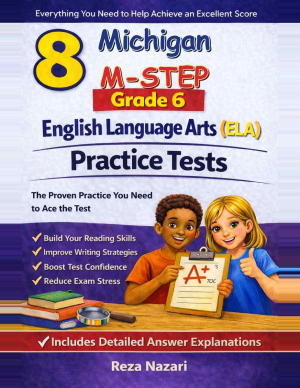
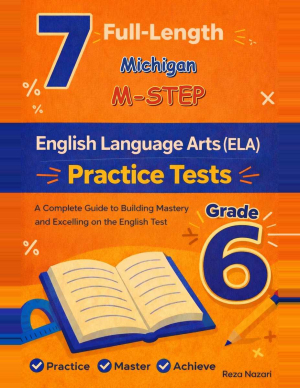
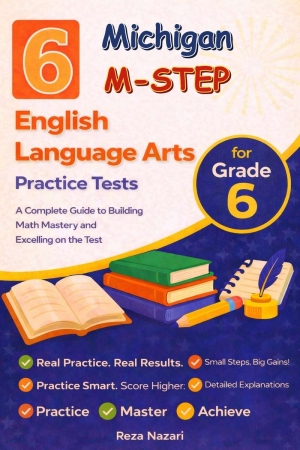
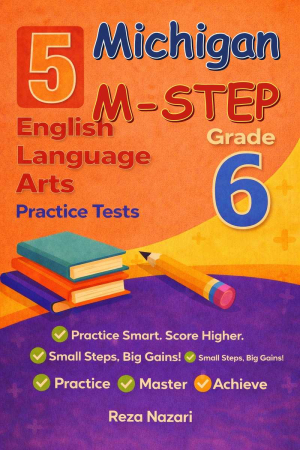
More Grade 6 resources
A USEFUL NEXT STEP
Michigan Grade 6 English: study questions
Is listing a profile’s events the same as analyzing how it develops a person?
No. Explain how the introduction, examples, and added details shape the portrayal. In this profile, recording uncertainty limits an interpretation that Jo can identify every photograph.
Where are the complete Michigan Grade 6 requirements?
The state’s academic standards directory links the Michigan K–12 English Language Arts Standards, adopted by the State Board of Education in 2010. Read the individual Grade 6 requirements and the school’s sequence. These selected references support this activity; they do not cover the whole English curriculum.
Official source ↗Resources from Effortless Math · Editorial standards