LEARN · PRACTICE · EXPLORE
Delaware Grade 6 English
Revise an original ambiguous notebook sentence, compare its possible meanings, and use Delaware Grade 6 pronoun and writing-revision references.
Focused lessons · Useful practice · Clear next steps
What do Delaware 6th graders learn in ELA?
In 6th grade, Delaware English language arts centers on citing textual evidence, central idea, word choice, and argument writing. Students take the Smarter Balanced grade 6 ELA test in the spring. This page explains each Delaware grade 6 ELA standard and pairs it with short lessons and a full-length practice test.
Printable Delaware grade 6 ELA books:
- 5-Delaware-Smarter-Balanced Grade 6 Reading Language Arts Practice Tests
- 5 Delaware Smarter Balanced Grade 6 Math Practice Tests
- 6-Delaware-Smarter-Balanced Grade 6 Reading Language Arts Practice Tests
- 7-Delaware-Smarter-Balanced Grade 6 Reading Language Arts Practice Tests
- 7 Delaware Smarter Balanced Grade 6 Math Practice Tests
- 8-Delaware-Smarter-Balanced Grade 6 Reading Language Arts Practice Tests
- Delaware Grade 6 ELA Preparation Bundle
- Delaware Smarter Balanced Grade 6 Math Preparation Bundle
- Delaware Smarter Balanced Grade 6 Math Made Ridiculously Simple
Standards source: Delaware ELA standards, Delaware Department of Education.
Make clear who owns an object in a sentence
A sentence can be grammatically familiar yet leave the reader unsure who a pronoun identifies. Revising that uncertainty begins with deciding the intended meaning. The example here shows why replacing a pronoun is sometimes more helpful than adding more description.
Curriculum source: Common Core State Standards for English Language Arts & Literacy, adopted for Delaware English language arts in 2010, from the Delaware Department of Education ELA resource directory.
Delaware Grade 6 references for this activity
Delaware’s ELA/literacy standards use the Common Core State Standards. The full ELA document contains the Grade 6 expectations across its subject strands. These are selected references for the activity on this page; use the full document for curriculum planning.
| Core Standards reference | Activity focus | Official requirement |
|---|---|---|
| L.6.1d | Recognize and correct unclear pronoun references | Read the primary standards document, page 52 |
| W.6.5 | Strengthen writing through revision and editing | Read the primary standards document, page 43 |
These are selected CCSS references used in Delaware’s ELA/literacy standards. Activity labels describe a teaching focus rather than reproduce the full requirements. Districts develop their own curriculum sequence; use the complete document and the school’s plan for wider coverage.
A worked Grade 6 reading and writing activity
This original classroom example is separate from official assessment questions.
At the door, Lena handed Mira her notebook. Mira thanked Lena and opened the first page.
Try the activity
Explain why her in the first sentence leaves notebook ownership unclear. Write two revisions: one making the notebook Lena’s, and another making it Mira’s. Then choose one meaning for your own continuation and keep it consistent.
Follow the reasoning
Both Lena and Mira could be the person identified by her. The second sentence tells us who opens the notebook but does not settle who owns it. To choose Lena as owner, write, “At the door, Lena handed Mira the notebook that belonged to Lena.” To choose Mira, write, “At the door, Lena returned Mira’s notebook.” The second revision also introduces the idea of returning it, so use that wording only if it matches the intended story. A narrower revision is simply “Lena handed Mira Mira’s notebook.”
Notice what needs more practice
A student may select Lena solely because that name appears first. Position alone does not remove the uncertainty in this sentence. Another response may add “blue notebook” but leave her unchanged; color makes the object more specific without clarifying its owner. A strong revision answers the actual reader question. Repeating a name can be useful while drafting; afterward, consider a smoother sentence that preserves the chosen meaning.
Use the next session to build independence
- Locate the pronoun and list its plausible referents.
- State the intended meaning before editing.
- Replace or restructure the unclear reference.
- Read the next sentence to check that the revision remains consistent.
Draft a continuation in which the owner explains what the notebook contains. Ask a partner to identify the owner without extra hints. Then check a longer paragraph for it, they, this, or that when several ideas or people appear nearby. Do not replace every pronoun with a noun; pronouns help writing when their reference is clear. Revise the ones that make a reader guess, and explain what uncertainty each change resolves.
For more general reading and writing resources, visit the Grade 6 English Online Center.
Delaware Grade 6 English: useful planning questions
Will adding an adjective fix an unclear pronoun?
Only if it resolves the actual uncertainty. A color may identify an object more precisely while still leaving its owner unclear. Revise the reference or sentence structure to clarify the intended meaning.
Where are the complete state requirements?
Delaware’s ELA/literacy standards use the Common Core State Standards. The full ELA document contains the Grade 6 expectations across its subject strands. These are selected references for the activity on this page; use the full document for curriculum planning. The school’s sequence also includes reading, writing, speaking, listening, and language work beyond this example.
State sources checked October 5, 2026. Grade 6 is within the Delaware Smarter Balanced English language arts testing range. This original lesson is independent practice. Read the official assessment overview and use the school’s guidance for preparation.
Grade 6 English in other states
When moving between school systems, compare the official curriculum and the school’s learning sequence. Use the national Online Center’s map to find another state’s resources.
Recommended Delaware Grade 6 resources
Build a Strong Delaware Grade 6 DeSSA English Practice Library
Use these Delaware Grade 6 resources for reading comprehension, language, writing, and full-length practice where available. Click any cover to open the resource page.
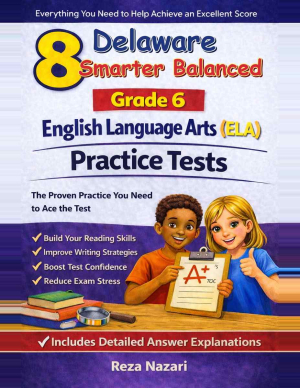 8-Delaware-Smarter-Balanced Grade 6 Reading Language Arts Practice Tests
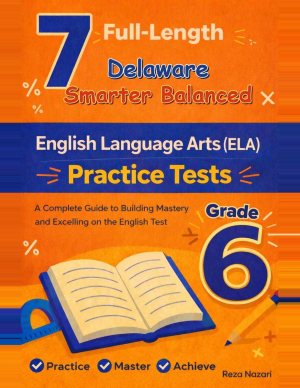 7-Delaware-Smarter-Balanced Grade 6 Reading Language Arts Practice Tests
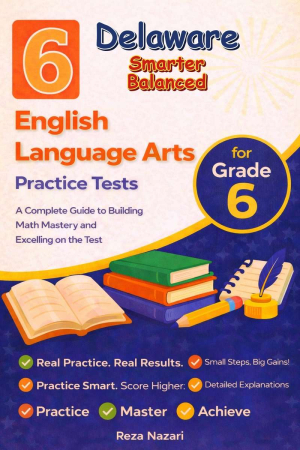 6-Delaware-Smarter-Balanced Grade 6 Reading Language Arts Practice Tests
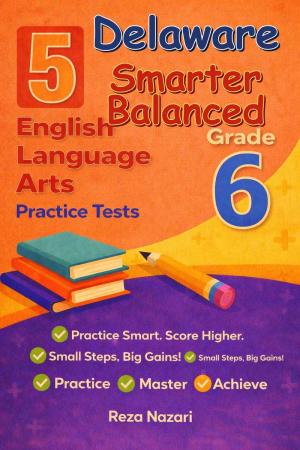 5-Delaware-Smarter-Balanced Grade 6 Reading Language Arts Practice Tests
Related Grade 6 math preparation
A USEFUL NEXT STEP
Delaware Grade 6 English: study questions
Will adding an adjective fix an unclear pronoun?
Only if it resolves the actual uncertainty. A color may identify an object more precisely while still leaving its owner unclear. Revise the reference or sentence structure to clarify the intended meaning.
Where are the complete Delaware Grade 6 requirements?
Delaware’s ELA/literacy standards use the Common Core State Standards. The full ELA document contains the Grade 6 expectations across its subject strands. These are selected references for the activity on this page; use the full document for curriculum planning.
Official source ↗Resources from Effortless Math · Editorial standards