LEARN · PRACTICE · EXPLORE
District of Columbia Grade 8 English
Compare two original proposals about library hours, identify factual and interpretive disagreements, and use selected DC Grade 8 reading and argument references.
Focused lessons · Useful practice · Clear next steps
Standards source: District of Columbia Standards of Learning, DC Office of the State Superintendent of Education.
Locate the disagreement before choosing a claim
Two writers can disagree because they report different facts or because they interpret the same information differently. This paired-text activity makes those possibilities visible. The authors, numbers, and library are fictional teaching material, not a local survey.
Curriculum source: Common Core State Standards for English Language Arts & Literacy, adopted in DC in July 2010, from the OSSE standards directory.
District of Columbia Grade 8 references for this activity
District of Columbia’s ELA/literacy standards use the Common Core State Standards. The full ELA document contains the Grade 8 expectations across its subject strands. These are selected references for the activity on this page; use the full document for curriculum planning.
| Core Standards reference | Activity focus | Official requirement |
|---|---|---|
| RI.8.9 | Conflicting information and interpretations across texts | Read the primary standards document, page 39 |
| W.8.1b | Logical reasons and credible, relevant evidence | Read the primary standards document, page 42 |
These are selected CCSS references used in District of Columbia’s ELA/literacy standards. Activity labels describe a teaching focus rather than reproduce the full requirements. Districts develop their own curriculum sequence; use the complete document and the school’s plan for wider coverage.
A worked Grade 8 reading and writing activity
This original classroom example is separate from official assessment questions.
Writer A: During four trial afternoons, the library recorded 24 student visits after the usual closing time. The extra hour should continue because those visits show that students use it.
Writer B: The same four-afternoon record shows 24 student visits after the usual closing time. That short trial does not establish how many different students attended or whether demand will continue. We should collect more information before extending the hours permanently.
Try the activity
Identify one fact the writers agree on and the decision they disagree about. Explain whether the disagreement is factual or interpretive in these texts. Then write a qualified recommendation using the evidence and its limits.
Follow the reasoning
Both writers report 24 visits during the same four trial afternoons. They disagree about what that record warrants: Writer A supports continuation, while Writer B wants more evidence before a permanent decision. The disagreement is mainly about interpretation and the sufficiency of evidence, rather than a conflicting visit count. A visit is not necessarily a different student. A possible recommendation is to continue a limited trial while tracking attendance and staffing needs, rather than claiming the short record proves lasting demand.
Notice what needs more practice
Do not turn 24 visits into 24 unique students without evidence. Also avoid treating Writer B as someone who says the extra hour was never used: that author accepts the visit count. If a student calls the writers’ disagreement factual, ask which reported fact differs. Compare that answer with a hypothetical revision in which one writer reports 18 visits for exactly the same period; that would introduce a factual conflict needing investigation.
Grade 8 English worksheets
Choose printable practice that matches the skill being taught. Check the task, reading difficulty, and directions before assigning it; the collection is independently published.
Use the next session to build independence
- Record the shared fact, each recommendation, and the reason connecting evidence to recommendation.
- Identify information that would help evaluate the proposals, such as unique attendance, staffing, or a longer trial.
- Write a recommendation acknowledging the other interpretation. Explain what the current evidence supports and what additional evidence could change the decision.
Apply the routine to two teacher-selected informational texts with clear source information. First locate the exact disagreement; then evaluate the evidence relevant to it. Agreement on one fact does not require agreement on every conclusion.
For more general reading and writing resources, visit the Grade 8 English Online Center.
District of Columbia Grade 8 English: useful planning questions
Do different recommendations always mean the facts conflict?
No. These writers agree on 24 visits but differ about whether that short record supports a permanent change. Identify the exact factual or interpretive disagreement before evaluating the conclusions.
Where are the complete state requirements?
District of Columbia’s ELA/literacy standards use the Common Core State Standards. The full ELA document contains the Grade 8 expectations across its subject strands. These are selected references for the activity on this page; use the full document for curriculum planning. The school’s sequence also includes reading, writing, speaking, listening, and language work beyond this example.
Official sources checked October 5, 2026. Grade 8 is within the DC CAPE Next English language arts testing range. This original lesson is independent practice. Read the official assessment overview and use the school’s guidance for preparation. DC CAPE Next begins with the spring 2027 administration; OSSE says the educational standards have not changed. This site’s practice and books are independently published resources, not official items or a certified match to the new test design.
Grade 8 English in other states
When moving between school systems, compare the official curriculum and the school’s learning sequence. Use the national Online Center’s map to find another state’s resources.
Recommended District of Columbia Grade 8 resources
Build a Strong District of Columbia Grade 8 DC CAPE English Practice Library
These independently published resources may reflect earlier DC CAPE editions. Check the edition and contents alongside OSSE’s DC CAPE Next guidance before choosing assessment preparation.
Use these District of Columbia Grade 8 resources for reading comprehension, language, writing, and full-length practice where available. Click any cover to open the resource page.
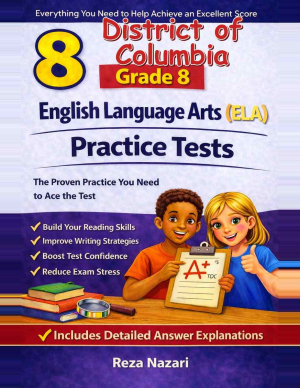 8 District of Columbia DC CAPE Grade 8 English Language Arts (ELA) Practice Tests
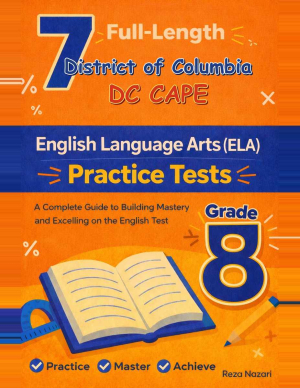 7 District of Columbia DC CAPE Grade 8 English Language Arts (ELA) Practice Tests
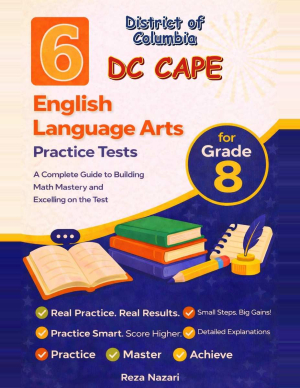 6 District of Columbia DC CAPE Grade 8 English Language Arts (ELA) Practice Tests
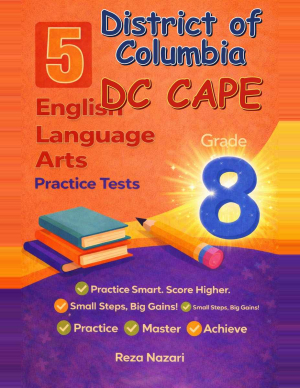 5 District of Columbia DC CAPE Grade 8 English Language Arts (ELA) Practice Tests
More Grade 8 resources
A USEFUL NEXT STEP
District of Columbia Grade 8 English: study questions
Do different recommendations always mean the facts conflict?
No. These writers agree on 24 visits but differ about whether that short record supports a permanent change. Identify the exact factual or interpretive disagreement before evaluating the conclusions.
Where are the complete District of Columbia Grade 8 requirements?
District of Columbia’s ELA/literacy standards use the Common Core State Standards. The full ELA document contains the Grade 8 expectations across its subject strands. These are selected references for the activity on this page; use the full document for curriculum planning.
Official source ↗Resources from Effortless Math · Editorial standards