LEARN · PRACTICE · EXPLORE
Maine Grade 8 English
Evaluate a walking-route proposal, distinguish evidence from a broad assumption, and use Maine Grades 6–8 argument-analysis references and worksheets.
Focused lessons · Useful practice · Clear next steps
What do Maine 8th graders learn in ELA?
In 8th grade, Maine English language arts centers on evaluating arguments, analyzing tone and word choice, and research-based writing. Students take the Maine Through Year grade 8 ELA test in the spring. This page explains each Maine grade 8 ELA standard and pairs it with short lessons, printable worksheets and a full-length practice test.
Printable Maine grade 8 ELA books:
Standards source: Maine English Language Arts, Maine Department of Education.
Evaluate whether a small group’s responses support a broad claim
Analyze a fictional walking-route proposal. Separate the stated responses, the recommendation, and the assumptions needed to move from one to the other.
Curriculum reference: 2020 Maine English Language Arts/Literacy Standards (Word document), from the Maine Department of Education standards directory.
Maine Grade 8 references for this activity
Use the 2020 Maine English Language Arts/Literacy Standards linked from the state review directory. Reading expectations are organized by individual grades through Grade 5 and by a shared Grades 6–8 band. These selections describe the activity’s teaching focus. Read the complete relevant grade or band and the school’s instructional sequence.
| State reference | Activity focus | Official requirement |
|---|---|---|
| Reading Standard 10 · Grades 6–8 | Evaluate claims, reasoning and qualifications | Read the complete state Word document |
| Reading Standard 4 · Grades 6–8 | Support analysis with several details | Read the complete state Word document |
These selected references identify an independently paraphrased teaching focus. For Grades 6–8, the requirements belong to a shared band rather than a separately prescribed year. Read the complete state document alongside the school’s sequence.
A worked Grade 8 reading and writing activity
This original classroom example is separate from official assessment questions.
Our neighborhood should add a dog-walking route beside the community field. Ten dog owners answered a question at our club meeting, and all ten said they would use a marked route. Their answers show interest among the owners who responded. However, only club members at that meeting were asked; other field users and nearby residents were not included. A route might make walks easier to organize, but deciding its location would also require information about other uses of the field. We recommend discussing a possible route with those groups before selecting a site.
Try the activity
Identify the proposal, the stated evidence, and a qualifying statement. Would the ten answers justify saying every neighborhood household wants the route? Explain whether the final recommendation preserves the limits of the responses.
Follow the reasoning
The proposal is to add a dog-walking route. The stated evidence is that ten dog owners at one club meeting said they would use it. The sentence limiting participation qualifies what those responses establish: they describe interest among that group, not every household or every field user. The idea that a route might help organize walks is a possible benefit rather than a measured result in the report. The final recommendation asks for discussion with groups not included before choosing a location. That next step acknowledges the limitation instead of treating the ten answers as complete community agreement.
Notice what needs more practice
All ten is a complete count of the responses described, but it is not a complete count of the neighborhood. The problem with a broad conclusion is the scope of the group asked, not an arithmetic error. Students should also separate wanting a route from agreeing on its site. The passage gives no evidence about possible locations or the views of residents who were not asked. A useful critique names the missing information and its relevance to the claim. It need not accuse the fictional club of dishonesty: the paragraph itself states the limitation and recommends seeking other perspectives.
Grade 8 English worksheets
Choose printable practice that matches the skill being taught. Check the task, reading difficulty, and directions before assigning it; the collection is independently published.
Use the next session to build independence
- Identify exactly who supplied the responses.
- Match the evidence to a claim of appropriate scope.
- Explain how the qualification affects the recommended next step.
Revise the final recommendation into an immediate decision and compare how well each ending follows from the same evidence. Then write one question that could gather relevant information from a group excluded from the original responses. Make clear that a proposed question does not provide an answer until responses are obtained. For transfer, evaluate a longer teacher-selected argument by separating facts, evidence, reasoning, opinions, and qualifications. Consider whether the evidence is relevant and sufficient for the actual claim. This fictional proposal is for reading analysis, not a real community survey or a decision about public land.
For more general reading and writing resources, visit the Grade 8 English Online Center.
Maine Grade 8 English: useful planning questions
Does all ten mean every household supports the route?
No. All ten refers to the dog owners who answered at one club meeting. The text explicitly says other users and residents were not included.
Where are the complete state requirements?
Use the 2020 Maine English Language Arts/Literacy Standards linked from the state review directory. Reading expectations are organized by individual grades through Grade 5 and by a shared Grades 6–8 band. These selections describe the activity’s teaching focus. Read the complete relevant grade or band and the school’s instructional sequence. The school’s sequence also includes reading, writing, speaking, listening, and language work beyond this example.
Official sources checked October 6, 2026. Grade 8 is within the Maine Through Year Assessment Grades 3–8 reading range. The official overview identifies Common Core as its accountability standards and states that testing is untimed. Follow the school’s assigned pathway and current directions. Read the Maine Through Year Assessment overview. This original activity supports classroom reading and writing within the Maine Learning Results; it is independently published, not an official state question, a replica of assessment timing or scoring, or a complete curriculum-alignment certification. Check supplemental books and practice against the school’s current requirements.
Grade 8 English in other states
When moving between school systems, compare the official curriculum and the school’s learning sequence. Use the national Online Center’s map to find another state’s resources.
Recommended Maine Grade 8 resources
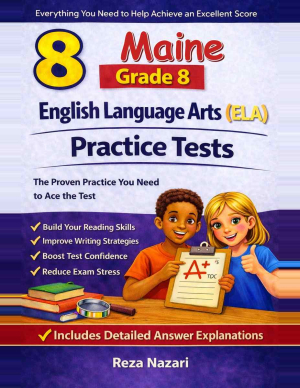
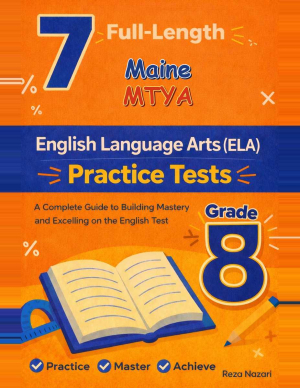
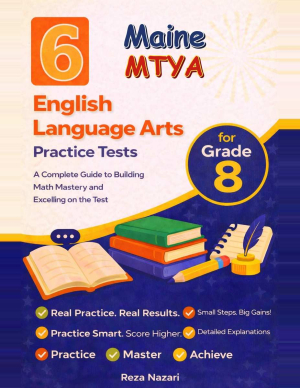
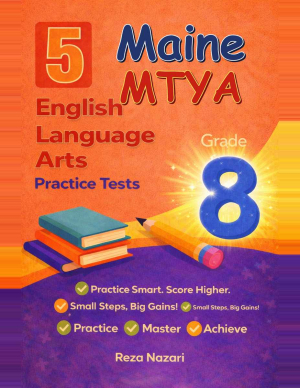
Build a Strong Maine Grade 8 Through Year Assessment English Practice Library
These independently published resources have their own coverage and editions. Check the contents alongside Maine’s current English standards before choosing assessment preparation.
Use these Maine Grade 8 resources for reading comprehension, language, writing, and full-length practice where available. Click any cover to open the resource page.
More Grade 8 resources
A USEFUL NEXT STEP
Maine Grade 8 English: study questions
Does all ten mean every household supports the route?
No. All ten refers to the dog owners who answered at one club meeting. The text explicitly says other users and residents were not included.
Where are the complete Maine Grade 8 requirements?
Use the 2020 Maine English Language Arts/Literacy Standards linked from the state review directory. Reading expectations are organized by individual grades through Grade 5 and by a shared Grades 6–8 band. These selections describe the activity’s teaching focus. Read the complete relevant grade or band and the school’s instructional sequence.
Official source ↗Resources from Effortless Math · Editorial standards