LEARN · PRACTICE · EXPLORE
Montana Grade 8 English
Build Montana Grade 8 English skills with an original conflicting accounts and interpretation lesson, worked response, worksheets and clearly dated standards guidance.
Focused lessons · Useful practice · Clear next steps
What do Montana 8th graders learn in ELA?
In 8th grade, Montana English language arts centers on evaluating arguments, analyzing tone and word choice, and research-based writing. Students take the MAST grade 8 ELA test in the spring. This page explains each Montana grade 8 ELA standard and pairs it with short lessons, printable worksheets and a full-length practice test.
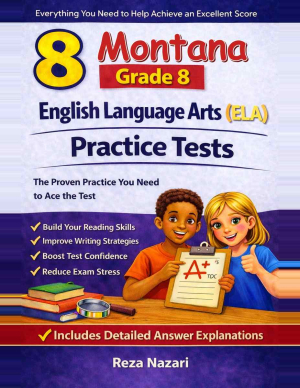
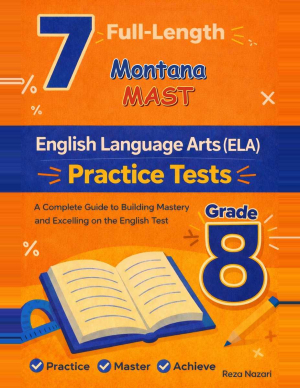
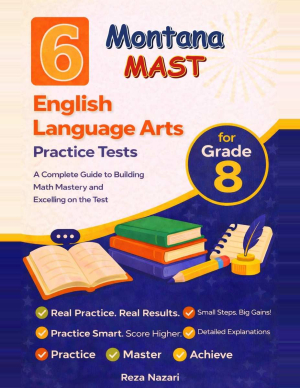
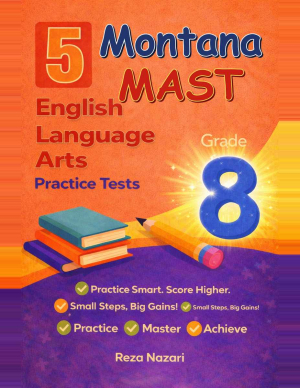
Printable Montana grade 8 ELA books:
Standards source: Montana English Language Arts, Montana Office of Public Instruction.
Locate a disagreement about fact or interpretation
Two accounts can disagree about a recorded number, the meaning of that number, or both. Read these original reports about one imagined school event. Identify each disagreement precisely before deciding what evidence would resolve it.
Curriculum reference: Montana ELA and Literacy standards, adopted November 2011, from the Montana Office of Public Instruction ELA directory.
Montana Grade 8 references for this activity
OPI currently lists its November 2011 ELA standards alongside adopted replacement standards scheduled for implementation in July 2027. The selected references here use the current 2011 framework, not an assumption that the replacement is already implemented. Follow the school’s curriculum and transition guidance, and read the complete grade-level requirements.
| Grade-level expectation | Activity focus | Official requirement |
|---|---|---|
| RI.8.9 | Conflicting accounts and interpretation | Read the state framework (PDF page 17) |
Read the adopted replacement standards for July 2027 implementation. This is transition planning, not a statement that these requirements are already in force for this activity.
Montana’s complete literacy expectations include American Indian texts and perspectives. Choose resources through the OPI directory’s tribally vetted IEFA materials and the school’s approved curriculum. These original examples do not represent tribal narratives or fulfill that broader requirement.
These selected reference labels identify an activity focus, with the grade column and PDF page linked separately. Read the complete state requirements and the school’s sequence, including reading, writing, language, speaking, and listening. This short original example does not fulfill the entire curriculum or establish a student’s grade-level proficiency.
A worked Grade 8 reading and writing activity
This original classroom example is separate from official assessment questions.
Report A: The signup sheet listed 24 volunteers for Friday’s exhibit. The coordinator counted 18 volunteers present at opening. Attendance was disappointing because the coordinator had planned a station for each person who signed up.
Report B: The signup sheet listed 24 volunteers for the same exhibit. A helper counted 20 volunteers at opening. Attendance was encouraging because the helper thought at least 15 volunteers would be enough to start the event.
Try the activity
Which statement creates a factual disagreement? Which statements express different interpretations? Explain what additional information could address each, without choosing one report merely because you prefer its conclusion.
Follow the reasoning
Both reports give 24 signups for the same event. Their opening counts conflict: 18 and 20 cannot both be the same complete count at the same cutoff under the same definition. The judgments disappointing and encouraging are interpretations based on different expectations. The coordinator compares attendance with 24 planned stations; the helper compares it with a minimum of 15 to start. Even if the count were settled at 18, those standards could still lead to different judgments. To address the factual conflict, check the underlying attendance record, the exact cutoff, and who each count includes. To assess the interpretations, examine the event’s goals and the relevant staffing needs.
Notice what needs more practice
The passages do not establish that either person lies, that two volunteers leave, or that one count includes visitors. Those are possibilities to investigate, not reported explanations. Agreeing on the signup total does not settle the attendance total. Nor does a positive adjective prove a report is more accurate. Keep the numeric conflict separate from the criteria behind the evaluative language.
Grade 8 English worksheets
Choose printable practice that matches the skill being taught. Check the task, reading difficulty, and directions before assigning it; the collection is independently published.
Use the next session to build independence
- List what the reports agree on and isolate the two conflicting numbers.
- Identify the expectations behind each evaluation of attendance.
- Name the record needed to check the count and the criteria needed to assess the judgments.
Compare teacher-selected accounts of a real event in a later session. Note each source’s date, definitions, evidence, and perspective. Montana’s broader expectations include texts by and about American Indians; use tribally vetted or school-approved sources for that work, without treating these invented reports as a substitute.
For more general reading and writing resources, visit the Grade 8 English Online Center.
Montana Grade 8 English: useful planning questions
Would settling the number settle every disagreement?
No. The writers use different criteria for judging attendance. A confirmed count may resolve the factual conflict while their interpretations still differ.
Where are the complete state requirements?
OPI currently lists its November 2011 ELA standards alongside adopted replacement standards scheduled for implementation in July 2027. The selected references here use the current 2011 framework, not an assumption that the replacement is already implemented. Follow the school’s curriculum and transition guidance, and read the complete grade-level requirements. The school’s sequence also includes reading, writing, speaking, listening, and language work beyond this example.
Sources checked October 6, 2026. OPI identifies Montana Aligned to Standards Through-Year (MAST) as the general reading/language arts assessment in Grades 3–8, including Grade 8. Follow the school’s assigned assessment pathway and current administration directions. Read the Montana required-assessments overview and the OPI ELA directory for current guidance. Independently published practice may use its own timer, question count, and scoring; those features are not official administration specifications or a prediction of a state performance level. Use the complete standards and the school’s learning sequence to choose further reading, writing, speaking, listening, and language work. This original classroom activity is not an official assessment item.
Grade 8 English in other states
When moving between school systems, compare the official curriculum and the school’s learning sequence. Use the national Online Center’s map to find another state’s resources.
Recommended Montana Grade 8 resources
Build a Strong Montana Grade 8 MAST English Practice Library
These independently published resources have their own coverage and editions. Check the contents alongside Montana’s current English standards before choosing assessment preparation.
Use these Montana Grade 8 resources for reading comprehension, language, writing, and full-length practice where available. Click any cover to open the resource page.
More Grade 8 resources
A USEFUL NEXT STEP
Montana Grade 8 English: study questions
Would settling the number settle every disagreement?
No. The writers use different criteria for judging attendance. A confirmed count may resolve the factual conflict while their interpretations still differ.
Where are the complete Montana Grade 8 requirements?
OPI currently lists its November 2011 ELA standards alongside adopted replacement standards scheduled for implementation in July 2027. The selected references here use the current 2011 framework, not an assumption that the replacement is already implemented. Follow the school’s curriculum and transition guidance, and read the complete grade-level requirements.
Official source ↗Resources from Effortless Math · Editorial standards