LEARN · PRACTICE · EXPLORE
Minnesota Grade 8 English
Evaluate invented library-hours sources, distinguish perspective from evidence, and find Minnesota Grade 8 English benchmarks and learning resources.
Focused lessons · Useful practice · Clear next steps
What do Minnesota 8th graders learn in ELA?
In 8th grade, Minnesota English language arts centers on evaluating arguments, analyzing tone and word choice, and research-based writing. Students take the Minnesota MCA grade 8 ELA test in the spring. This page explains each Minnesota grade 8 ELA standard and pairs it with short lessons, printable worksheets and a full-length practice test.
Standards source: Minnesota English Language Arts, Minnesota Department of Education.
Test whether sources can support a majority claim
A relevant source may still be too limited for a broad claim. Compare these invented records before deciding what they can establish about students’ preferences.
Curriculum reference: 2020 Minnesota K–12 English Language Arts Standards, February 2024 corrected edition, from the Minnesota Department of Education academic standards directory.
Minnesota Grade 8 references for this activity
Use Minnesota’s 2020 English Language Arts standards, February 2024 corrected edition. The state implementation page identifies full implementation in 2025–26. These selected benchmarks support one activity; use the complete framework and the school’s sequence for curriculum planning.
| Grade-level expectation | Activity focus | Official requirement |
|---|---|---|
| 8.1.9.2 | Source evaluation | Read the state framework (PDF page 78) |
These selected benchmark labels describe an activity focus. Read the complete state requirements and the school’s sequence, including the framework’s reading, writing, discussion, media-literacy, and Dakota and Anishinaabe perspectives requirements. This original example does not represent those communities or fulfill the entire curriculum.
A worked Grade 8 reading and writing activity
This original classroom example is separate from official assessment questions.
Question: Did a majority of the 120 eligible students favor later library hours?
Source A — An undated, unnamed online poster: “Everyone wants a later closing time!” It displays 91 likes but identifies neither the users nor a survey method.
Source B — A librarian’s dated survey summary: All 120 eligible students were invited. Eighty-four responded once each; 57 preferred the current closing time and 27 preferred a later one. The summary does not report the preferences of the 36 nonrespondents.
Source C — A later-hours campaign committee’s dated meeting notes: Of its 18 volunteer participants, 16 supported later hours.
All three sources and counts are invented classroom materials, not findings from an actual Minnesota school.
| Source | Describes | Main limit |
|---|---|---|
| A: poster | Unverified likes | Users and meaning unknown |
| B: survey | 84 of 120 eligible students | 36 preferences missing |
| C: campaign | 18 volunteers | Group may favor its cause |
Try the activity
Evaluate each source’s perspective, credibility, relevance, and sufficiency for the stated question. What can Source B establish about respondents? What would still be needed to answer for all 120 students?
Follow the reasoning
Source A concerns the topic but does not establish who liked the poster or whether likes mean support for its specific proposal. Everyone is broader than its supplied evidence. Source B documents an invitation and one response per participant, making its method more assessable within this hypothetical record. Only 27 of 84 respondents favor later hours, so it does not show a respondent majority supporting the change. The 36 missing responses prevent a definite majority conclusion about all 120 students: even adding every nonrespondent to the 27 would give 63 supporters, while none would leave 27. Source C represents a volunteer campaign group whose membership may favor its cause. Its 16 supporters are relevant to that group but cannot be treated as a representative result for all eligible students.
Notice what needs more practice
An identified author and date help a reader investigate a source; they do not automatically certify its accuracy. A campaign perspective also does not make every statement false. Ask which claim the documented method can support. Do not combine the three counts as separate students: membership could overlap, and likes may come from people outside the eligible group. Do not invent nonrespondents’ choices. The calculation illustrates sufficiency, while checking original records and collection procedures would matter in a real investigation. The task asks about a majority of 120, not simply whether some students prefer later hours.
Grade 8 English worksheets
Choose printable practice that matches the skill being taught. Check the task, reading difficulty, and directions before assigning it; the collection is independently published.
Use the next session to build independence
- Match each source with the exact population and question.
- Inspect authorship, purpose, dates, and collection methods.
- State a supported conclusion and the evidence still missing.
Draft a response that distinguishes the respondent result from the unanswered whole-group question. Then describe a follow-up process for gathering the missing preferences while preventing duplicate responses and retaining the original question wording. Discuss how changed wording might make two surveys difficult to compare. With teacher-selected real sources, record their publishers, purposes, evidence, and limitations before using them in an argument. Include relevant contrasting perspectives, but evaluate what each can support rather than counting agreement as proof.
For more general reading and writing resources, visit the Grade 8 English Online Center.
Minnesota Grade 8 English: useful planning questions
Can a source be relevant without being sufficient?
Yes. Campaign notes concern library hours but describe their participants, not all eligible students. Match the evidence’s population and method with the claim being evaluated.
Where are the complete state requirements?
Use Minnesota’s 2020 English Language Arts standards, February 2024 corrected edition. The state implementation page identifies full implementation in 2025–26. These selected benchmarks support one activity; use the complete framework and the school’s sequence for curriculum planning. The school’s sequence also includes reading, writing, speaking, listening, and language work beyond this example.
Sources checked October 6, 2026. The state assessment-design page identifies Reading MCA-IV beginning in spring 2026 for Grades 3–8 and 10, including Grade 8. Follow the school’s assigned assessment pathway and current directions. Read the Minnesota assessment-design page, and MDE English implementation guidance for later guidance. Independently published practice may use its own timer, question count, and scoring; those features are not official administration specifications or a prediction of a state performance level. Use the complete standards and the school’s learning sequence to choose further reading, writing, speaking, listening, and language work. This original classroom activity is not an official assessment item.
Grade 8 English in other states
When moving between school systems, compare the official curriculum and the school’s learning sequence. Use the national Online Center’s map to find another state’s resources.
Recommended Minnesota Grade 8 resources
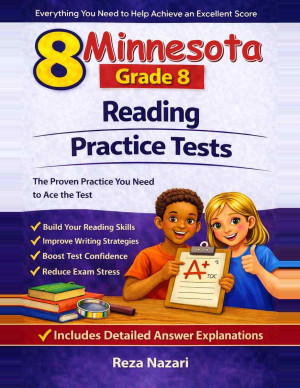
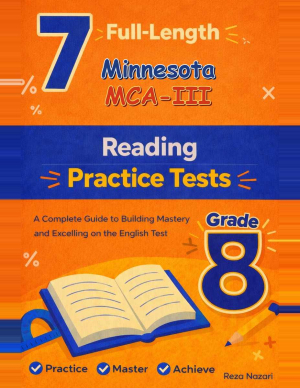
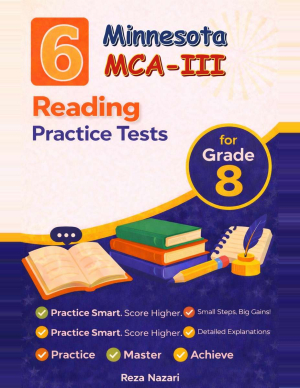
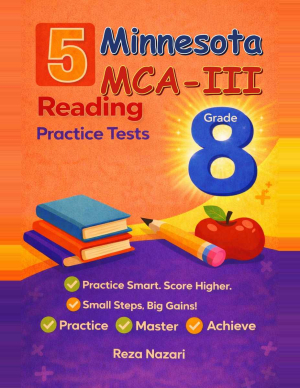
Build a Strong Minnesota Grade 8 MCA English Practice Library
These independently published resources have their own coverage and editions. Check the contents alongside Minnesota’s current English standards before choosing assessment preparation.
Use these Minnesota Grade 8 resources for reading comprehension, language, writing, and full-length practice where available. Click any cover to open the resource page.
More Grade 8 resources
A USEFUL NEXT STEP
Minnesota Grade 8 English: study questions
Can a source be relevant without being sufficient?
Yes. Campaign notes concern library hours but describe their participants, not all eligible students. Match the evidence’s population and method with the claim being evaluated.
Where are the complete Minnesota Grade 8 requirements?
Use Minnesota’s 2020 English Language Arts standards, February 2024 corrected edition. The state implementation page identifies full implementation in 2025–26. These selected benchmarks support one activity; use the complete framework and the school’s sequence for curriculum planning.
Official source ↗Resources from Effortless Math · Editorial standards