LEARN · PRACTICE · EXPLORE
New Hampshire Grade 8 English
Review New Hampshire Grade 8 English with a purposeful verb-voice revision, worked grammar explanations, printable practice, and selected curriculum references.
Focused lessons · Useful practice · Clear next steps
What do New Hampshire 8th graders learn in ELA?
In 8th grade, New Hampshire English language arts centers on evaluating arguments, analyzing tone and word choice, and research-based writing. Students take the NH SAS grade 8 ELA test in the spring. This page explains each New Hampshire grade 8 ELA standard and pairs it with short lessons, printable worksheets and a full-length practice test.
Printable New Hampshire grade 8 ELA books:
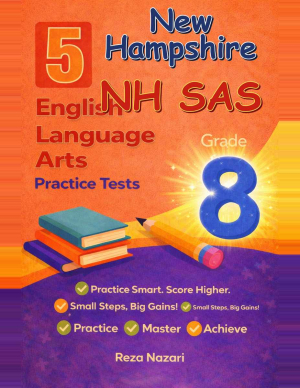
- 5 New Hampshire NH SAS Grade 8 English Language Arts (ELA) Practice Tests
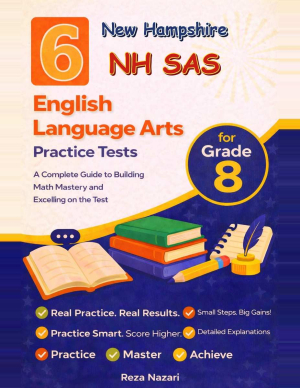
- 6 New Hampshire NH SAS Grade 8 English Language Arts (ELA) Practice Tests
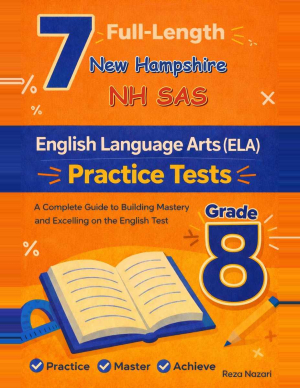
- 7 New Hampshire NH SAS Grade 8 English Language Arts (ELA) Practice Tests
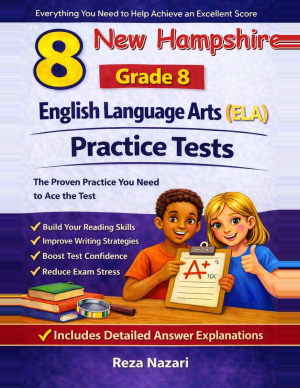
- 8 New Hampshire NH SAS Grade 8 English Language Arts (ELA) Practice Tests
- New Hampshire Grade 8 ELA Preparation Bundle
Standards source: New Hampshire school-approval rules, Ed 306.29.
Grade 8: revise an unintended shift while preserving meaning
Active and passive voice can both serve a writer’s purpose. Revision requires noticing whether a shift helps the reader or disrupts the intended focus. This original editing task follows one narrator’s actions and compares two ways to describe them. Students explain a choice instead of applying a rule that passive voice is always wrong.
Curriculum reference: 2010 Common Core ELA/literacy standards, original publisher’s document, from the New Hampshire school-approval rules (Ed 306.29).
New Hampshire Grade 8 references for this activity
New Hampshire’s current school-approval rules, Ed 306.29, allow local boards to use the adopted 2010 Common Core English standards or approved alternative academic standards. Confirm the school’s choice and competencies first. The selected Common Core references here were checked in the original publisher’s 2010 document, using the correct grade column. These references identify this activity’s focus and are not a complete local curriculum checklist.
| Selected Common Core reference | Activity focus | Publisher’s document |
|---|---|---|
| L.8.1b | Use active and passive verb voice | Read the publisher’s document (PDF page 52) |
| L.8.1d | Recognize and correct an inappropriate voice shift | Read the publisher’s document (PDF page 52) |
These selected reference labels identify an activity focus, with the grade column and PDF page linked separately. Read the complete standards selected by the school and its learning sequence, including reading, writing, language, speaking, and listening. This short original example does not fulfill the entire curriculum or establish a student’s grade-level proficiency.
Who is doing the work in this account?
This original classroom example is separate from official assessment questions.
I measured the display board. The title was written by me. Then I checked the spacing and moved the labels.
Try the activity
The narrator intends to emphasize what they did throughout the account. Revise the middle sentence to keep that focus consistent. Then explain a situation in which a passive version could serve a different purpose.
Follow the reasoning
A consistent revision is: “I measured the display board. I wrote the title. Then I checked the spacing and moved the labels.” The original middle sentence makes the title its subject, while the surrounding sentences keep the narrator’s actions in focus. Changing it to “I wrote the title” maintains that intended pattern. The passive form is grammatical; the issue is its purpose in this account. In a description focused on the display itself, “The title was written across the top” could be suitable because the placement of the title matters more than who wrote it. Removing the actor in that version changes which information the sentence supplies.
Notice what needs more practice
A sentence with was is not automatically passive: “I was tired” does not describe an action performed on its subject. Ask whether the subject receives the action, and inspect the verb construction in context. Likewise, different voices are not automatically an error in a paragraph. A deliberate shift can direct attention to another subject. The task specifies a consistent actor-focused account; that purpose guides this revision.
Grade 8 English worksheets
Choose printable practice that matches the skill being taught. Check the task, reading difficulty, and directions before assigning it; the collection is independently published.
Use the next session to build independence
- Name the subject and action in each supplied sentence. Identify the focus change before editing.
- Revise the middle sentence, then read the whole account to check that actions, sequence, and meaning still fit.
- Draft a second version focused on the finished display. Explain where passive voice helps and where an unexplained voice or mood shift would confuse the reader.
Use a short classroom paragraph for the next edit and check both voice and mood in context. A question, request, statement, or hypothetical condition can change a sentence’s job. Make each shift intentional. This activity concentrates on one voice issue; it does not cover every verbal form or all Grade 8 language work.
For more general reading and writing resources, visit the Grade 8 English Online Center.
New Hampshire Grade 8 English: useful planning questions
Is every passive sentence a mistake?
No. Passive voice can place useful emphasis on an action or its recipient. Here, the narrator wants to emphasize their own actions, so revising the middle sentence maintains that focus. Judge a shift in context and preserve the intended meaning.
Which standards does the school use?
New Hampshire’s current school-approval rules, Ed 306.29, allow local boards to use the adopted 2010 Common Core English standards or approved alternative academic standards. Confirm the school’s choice and competencies first. The selected Common Core references here were checked in the original publisher’s 2010 document, using the correct grade column. These references identify this activity’s focus and are not a complete local curriculum checklist. The school’s sequence also includes reading, writing, speaking, listening, and language work beyond this example.
Sources checked October 6, 2026. The 2025–2026 public NH SAS manual describes general ELA testing in Grades 3–8, including Grade 8, with reading and writing sessions. Confirm the learner’s assigned pathway and the school’s current directions. Read the public NH SAS manual resource page, students and families portal and school-approval rules. The manual reviewed here is the 2025–2026 edition; confirm later-year directions with the school. Independently published practice has its own timing and scoring and does not predict a state performance level. Use local competencies and the teacher’s sequence for further reading, writing, speaking, listening, and language work. This original activity is not an official assessment item.
Grade 8 English in other states
When moving between school systems, compare the official curriculum and the school’s learning sequence. Use the national Online Center’s map to find another state’s resources.
Recommended New Hampshire Grade 8 resources
Build a Strong New Hampshire Grade 8 NH SAS English Practice Library
These independently published resources have their own coverage and editions. Check the contents alongside New Hampshire’s current English standards before choosing assessment preparation.
Use these New Hampshire Grade 8 resources for reading comprehension, language, writing, and full-length practice where available. Click any cover to open the resource page.
More Grade 8 resources
A USEFUL NEXT STEP
New Hampshire Grade 8 English: study questions
Is every passive sentence a mistake?
No. Passive voice can place useful emphasis on an action or its recipient. Here, the narrator wants to emphasize their own actions, so revising the middle sentence maintains that focus. Judge a shift in context and preserve the intended meaning.
Where are the complete New Hampshire Grade 8 requirements?
New Hampshire’s current school-approval rules, Ed 306.29, allow local boards to use the adopted 2010 Common Core English standards or approved alternative academic standards. Confirm the school’s choice and competencies first. The selected Common Core references here were checked in the original publisher’s 2010 document, using the correct grade column. These references identify this activity’s focus and are not a complete local curriculum checklist.
Official source ↗Resources from Effortless Math · Editorial standards