LEARN · PRACTICE · EXPLORE
Hawaii Grade 8 English
Analyze an original story scene, connect dialogue with a character’s decision, and use a selected current Hawaiʻi Grade 8 literature reference.
Focused lessons · Useful practice · Clear next steps
What do Hawaii 8th graders learn in ELA?
In 8th grade, Hawaii English language arts centers on evaluating arguments, analyzing tone and word choice, and research-based writing. Students take the Smarter Balanced grade 8 ELA test in the spring. This page explains each Hawaii grade 8 ELA standard and pairs it with short lessons, printable worksheets and a full-length practice test.
Printable Hawaii grade 8 ELA books:
- 5 Hawaii Smarter Balanced Grade 8 English Language Arts (ELA) Practice Tests
- 6 Hawaii Smarter Balanced Grade 8 English Language Arts (ELA) Practice Tests
- 7 Hawaii Smarter Balanced Grade 8 English Language Arts (ELA) Practice Tests
- 8 Hawaii Smarter Balanced Grade 8 English Language Arts (ELA) Practice Tests
- Hawaii Grade 8 ELA Preparation Bundle
Standards source: Hawaiʻi English Language Arts, Hawaiʻi State Department of Education.
Use this Hawaii Grade 8 English page for daily literacy blocks, reteaching, enrichment, and targeted practice. The explanations are written for planning and learning support, not copied from official standards language.
Explain how a line of dialogue moves a story forward
Dialogue can do more than identify who is speaking. A particular line can give a character information that changes the next action. Read this original scene with attention to what the character plans before the conversation and what changes after it. Support the connection rather than simply retell the scene.
Curriculum source: Hawaiʻi Common Core Standards for English Language Arts, approved April 2024 and reprinted May 2026, from the Hawaiʻi DOE standards directory.
Hawaiʻi Grade 8 references for this activity
Hawaiʻi’s current English document includes Grade 8 expectations across reading, writing, language, speaking, and listening. The expectations selected here support this activity; use the whole document and the school’s sequence for wider coverage.
| Grade-level expectation | Activity focus | Official requirement |
|---|---|---|
| 8.RL.3.a | Explain how dialogue or incidents affect action and decisions | Read the state document (PDF page 39) |
These are selected grade-level expectations from Hawaiʻi’s current English standards. Activity labels describe a teaching focus rather than reproduce complete requirements. Read the linked grade-level document, including the reading, writing, language, speaking, and listening sections, alongside the school’s curriculum sequence.
A worked Grade 8 reading and writing activity
This original classroom example is separate from official assessment questions.
Maya packed the club’s finished video into her bag and reached for the door. She intended to submit it alone.
“The ending still uses Jun’s drawing,” Tessa said. “Did Jun see the version we changed?”
Maya stopped with her hand on the handle. She opened the bag again. “Not yet. I thought the new ending was close enough.”
“Close enough for us might not mean the same thing to Jun,” Tessa replied.
Maya placed the video notes on the table. “Then we should ask before I submit it.”
Try the activity
Identify the line that introduces a problem with Maya’s plan. Explain how the dialogue and the following actions lead to her decision. Distinguish an inference supported by the scene from an unsupported judgment about Maya’s whole character.
Follow the reasoning
Tessa’s question about whether Jun has seen the changed version introduces information missing from Maya’s plan to submit alone. Maya’s pause and reopened bag show an immediate response. Her explanation that the ending seemed close enough reveals the assumption behind that plan. Tessa’s next line challenges the assumption, and Maya’s final statement changes the action from immediate submission to asking Jun first. The explanation links particular dialogue with the decision; it does not merely list that the characters talked.
Notice what needs more practice
The scene supports an inference that Maya is willing to reconsider this plan. It does not establish that she always ignores others or always makes the right decision. Jun has not spoken in the passage, so the reader cannot claim to know whether Jun approves of the revised ending. Likewise, submitting the video is a future action after the scene; the text stops at Maya’s decision to ask. Keep the interpretation within the available lines and incidents.
Grade 8 English worksheets
Choose printable practice that matches the skill being taught. Check the task, reading difficulty, and directions before assigning it; the collection is independently published.
Use the next session to build independence
- Identify the plan before the conversation.
- Connect a particular line with the character’s response and changed decision.
- Support the explanation with actions while noting what the scene leaves unknown.
Remove Tessa’s second line and consider whether Maya’s final decision remains equally well explained. Then write an alternate response in which Maya decides to ask Jun after a different piece of information. Discuss how the new dialogue changes the reader’s understanding of the decision. This practice selects one part of the current literature requirement; a wider reading program also involves other literary elements, evidence, language, and interpretation.
For more general reading and writing resources, visit the Grade 8 English Online Center.
Hawaiʻi Grade 8 English: useful planning questions
Can this scene show Jun’s opinion of the changed ending?
No. Jun does not speak in the passage. The scene shows Maya deciding to ask, but it does not give Jun’s response.
Where are the complete state requirements?
Hawaiʻi’s current English document includes Grade 8 expectations across reading, writing, language, speaking, and listening. The expectations selected here support this activity; use the whole document and the school’s sequence for wider coverage. The school’s sequence also includes reading, writing, speaking, listening, and language work beyond this example.
Official sources checked October 6, 2026. Grade 8 is within the Smarter Balanced English language arts testing range. This original lesson is independent practice. Read the Hawaiʻi assessment overview and use the school’s guidance for preparation. The state learning-design directory identifies implementation of these revised English standards in 2025–26. The assessment overview also explains alternate and Kaiapuni assessment pathways; follow the school’s assignment and current guidance. This site’s practice and books are independently published. Check their editions and contents against current standards and assessment guidance.
Grade 8 English in other states
When moving between school systems, compare the official curriculum and the school’s learning sequence. Use the national Online Center’s map to find another state’s resources.
Recommended Hawaii Grade 8 resources
Build a Strong Hawaii Grade 8 SBAC English Practice Library
These independently published resources may use earlier Hawaiʻi English standards. Check the edition and contents alongside Hawaiʻi’s current English standards before choosing assessment preparation.
Use these Hawaii Grade 8 resources for reading comprehension, language, writing, and full-length practice where available. Click any cover to open the resource page.
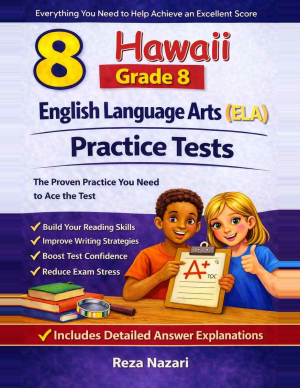 8 Hawaii Smarter Balanced Grade 8 English Language Arts (ELA) Practice Tests
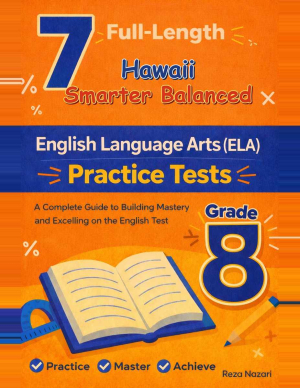 7 Hawaii Smarter Balanced Grade 8 English Language Arts (ELA) Practice Tests
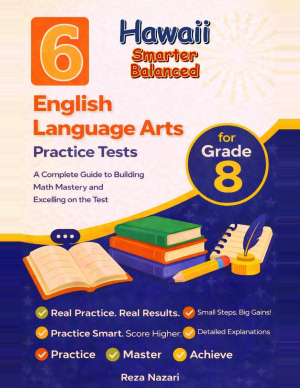 6 Hawaii Smarter Balanced Grade 8 English Language Arts (ELA) Practice Tests
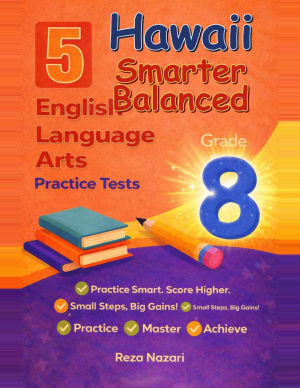 5 Hawaii Smarter Balanced Grade 8 English Language Arts (ELA) Practice Tests
More Grade 8 resources
A USEFUL NEXT STEP
Hawaii Grade 8 English: study questions
Can this scene show Jun’s opinion of the changed ending?
No. Jun does not speak in the passage. The scene shows Maya deciding to ask, but it does not give Jun’s response.
Where are the complete Hawaiʻi Grade 8 requirements?
Hawaiʻi’s current English document includes Grade 8 expectations across reading, writing, language, speaking, and listening. The expectations selected here support this activity; use the whole document and the school’s sequence for wider coverage.
Official source ↗Resources from Effortless Math · Editorial standards