LEARN · PRACTICE · EXPLORE
Virginia Grade 8 English
Virginia Grade 8 English: plan reading, writing, vocabulary, and discussion practice. Use learning references and the state curriculum source to choose a target.
Focused lessons · Useful practice · Clear next steps
What do Virginia 8th graders learn in ELA?
In 8th grade, Virginia English language arts centers on evaluating arguments, analyzing tone and word choice, and research-based writing. Students take the SOL grade 8 ELA test in the spring. This page explains each Virginia grade 8 ELA standard and pairs it with short lessons, printable worksheets and a full-length practice test.
Standards source: K-12 Standards & Instruction, Virginia Department of Education.
Virginia Grade 8 English is where students prepare for high-school literacy through close reading, argument writing, research, presentation, and precise language. This guide gives Virginia families and educators a practical reading and writing roadmap without the official-document fog: 72 rewritten skill targets across 19 ELA strands, with emphasis on reading, writing, language, speaking, and listening; word meaning, context clues, roots, affixes, and precise language; planning, drafting, revising, editing, and publishing clear writing. For classroom progress, tutoring, homeschool planning, or SOL review, the best practice uses small skill checks that connect reading, writing, language, and listening instead of treating them separately.
Use this Virginia Grade 8 English page for lesson planning, intervention groups, homework support, and family review. The explanations are written for planning and learning support, not copied from official standards language.
Free Grade 8 ELA Checklist + Practice Plan
Use this Virginia Grade 8 English language arts guide as a printable standards checklist. Start with the overview, mark the skills your student already handles, then choose one weak area for focused review before SOL or classroom assessments.
Virginia Grade 8 English Standards Overview
For Virginia, Grade 8 English helps students prepare for high-school literacy through close reading, argument writing, research, presentation, and precise language. This overview organizes Virginia Standards of Learning: English into plain-language strands so you can quickly see what to teach, review, or reteach.
Vocabulary
For Virginia Grade 8, this strand turns daily practice toward word meaning, context clues, roots, affixes, and precise language. Includes 5 quick skill targets.
Language and Conventions
For Virginia Grade 8, this strand makes room for short checks on reading, writing, language, speaking, and listening. Includes 3 quick skill targets.
Language and Conventions
For Virginia Grade 8, this strand turns daily practice toward reading, writing, language, speaking, and listening. Includes 5 quick skill targets.
Language and Conventions
For Virginia Grade 8, this strand turns daily practice toward reading, writing, language, speaking, and listening. Includes 4 quick skill targets.
Reading Comprehension
For Virginia Grade 8, this strand turns daily practice toward reading, writing, language, speaking, and listening. Includes 2 quick skill targets.
Reading Literature
For Virginia Grade 8, this strand turns daily practice toward reading, writing, language, speaking, and listening. Includes 7 quick skill targets.
Reading Informational Text
For Virginia Grade 8, this strand turns daily practice toward reading, writing, language, speaking, and listening. Includes 4 quick skill targets.
Reading Informational Text
For Virginia Grade 8, this strand turns daily practice toward reading, writing, language, speaking, and listening. Includes 3 quick skill targets.
Grade 8 SOL English Practice Plan
A useful Virginia Grade 8 plan should balance reading, writing, language, and speaking. Start with Vocabulary, Language and Conventions; then rotate shorter review tasks so skills stay connected.
For Virginia Grade 8, a strong weekly rhythm can be simple: a literature or nonfiction passage, a discussion prompt, a short written answer, and a focused editing minute.
Need Focused Grade 8 SOL English Practice?
Pair this Virginia Grade 8 standards guide with targeted ELA practice so students can move from knowing the expectations to answering reading, writing, vocabulary, and language questions with confidence.
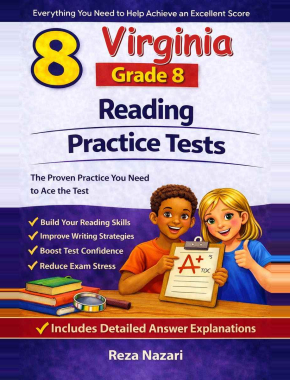
All Virginia Grade 8 English Standards, Rewritten
The codes below follow the Virginia Grade 8 source standards structure. Each skill label is intentionally short, original, and written for fast planning.
Virginia Grade 8 8.DSR Vocabulary
Use these Grade 8 expectations as learning references. Common Core-style codes refer to the Common Core standards; they do not certify a complete match to Virginia’s current curriculum. State-specific references also need to be checked against the current official document. Follow your teacher’s assigned targets when wording, codes, or grade placement differ.
| Code | Learning reference |
|---|---|
| 8.DSR.A | Read a variety of grade-level complex text with accuracy, automaticity, appropriate rate, and meaningful expression in successive readings to support comprehension. Monitor while reading to confirm or self-correct word recognition and understanding, as necessary |
| 8.DSR.B | Proficiently read and comprehend a variety of literary and informational texts that exhibit complexity at the higher range of the grades 6-8 band |
| 8.DSR.C | When responding to text through discussion and/or writing, draw several pieces of evidence from grade-level complex texts to support claims, conclusions, and inferences, including quoting or paraphrasing from texts accurately and tracing where relevant evidence is located |
| 8.DSR.D | Regularly engage in reading a series of conceptually related texts organized around topics of study to build knowledge and vocabulary (These texts should be at a range of complexity levels so students can read the texts independently, with peers, or with modest support.). Use this background knowledge as context for new learning |
| 8.DSR.E | Use reading strategies as needed to aid and monitor comprehension when encountering challenging sections of text. These sense-making strategies attend to text structure, common organizational structures, summarizing, asking questions of the text, and others |
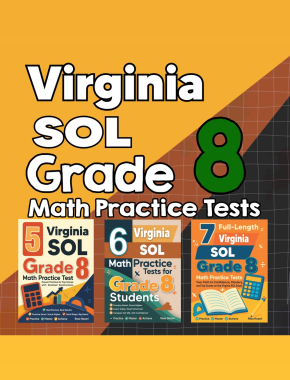
Also Reviewing Virginia Grade 8 Math?
Many Virginia families prepare English and math together. If your Grade 8 student also needs math support, this matching resource can help keep review organized.
Virginia Grade 8 8.LU Language and Conventions
| Code | Learning reference |
|---|---|
| 8.LU | Language Usage |
| 8.LU.1 | Grammar |
| 8.LU.2 | Mechanics |
Virginia Grade 8 8.LU.1 Language and Conventions
| Code | Learning reference |
|---|---|
| 8.LU.1.A | Construct simple, compound, complex, and compound-complex sentences to communicate ideas clearly and add variety to writing |
| 8.LU.1.B | Recognize and use pronoun-antecedent agreement, including indefinite, reflexive, and relative pronouns, when speaking and writing |
| 8.LU.1.C | Use specific adjectives and adverbs to enhance speech and writing |
| 8.LU.1.D | Arrange phrases and clauses within a sentence to improve meaning reader/listener interest, and style in writing |
| 8.LU.1.E | Maintain consistent verb tense across paragraphs in writing |
Virginia Grade 8 8.LU.2 Language and Conventions
| Code | Learning reference |
|---|---|
| 8.LU.2.A | Construct complete sentences with appropriate punctuation, avoiding comma splices and run-ons in writing |
| 8.LU.2.B | Use and punctuate dialogue and direct quotations appropriately in writing |
| 8.LU.2.C | Recognize and consistently spell frequently used words accurately |
| 8.LU.2.D | Consult reference materials to check and correct spelling |
Virginia Grade 8 8.R Reading Comprehension
| Code | Learning reference |
|---|---|
| 8.R | Research |
| 8.R.1 | Evaluation and Synthesis of Information |
Virginia Grade 8 8.R.1 Reading Literature
| Code | Learning reference |
|---|---|
| 8.R.1.A | Formulate and revise questions about a research topic, broadening or narrowing the inquiry as necessary |
| 8.R.1.B | Collect, organize, and synthesize information from multiple sources using various notetaking formats |
| 8.R.1.C | Evaluate and analyze the relevance, validity, and credibility of sources (primary, secondary, digital, and print) identifying main and supporting ideas, conflicting information, points of view, and any biases |
| 8.R.1.D | Quote, summarize, and paraphrase research findings from primary and secondary sources, avoiding plagiarism by using own words and following ethical and legal guidelines |
| 8.R.1.E | Organize and share findings in formal and informal oral or written formats |
| 8.R.1.F | Cite primary and secondary sources using the Modern Language Association (MLA) or American Psychological Association (APA) style |
| 8.R.1.G | Demonstrate ethical and responsible use of all sources, including the Internet, Artificial Intelligence (AI), and new technologies, as they develop |
Virginia Grade 8 8.RI Reading Informational Text
| Code | Learning reference |
|---|---|
| 8.RI | Reading Informational Text |
| 8.RI.1 | Key Ideas and Confirming Details |
| 8.RI.2 | Craft and Style |
| 8.RI.3 | Integration of Concepts |
Virginia Grade 8 8.RI.1 Reading Informational Text
| Code | Learning reference |
|---|---|
| 8.RI.1.A | Create a main idea statement and provide an accurate summary, clarifying the relationships among the key details and ideas or events |
| 8.RI.1.B | Analyze how the author unfolds a perspective or series of ideas or events in historical, scientific, or technical texts, including the order in which the points are made, how they are introduced and developed, and the connections drawn between them |
| 8.RI.1.C | Trace and evaluate the argument and specific claims in a text, assessing whether the reasoning and evidence are relevant and sufficient to support the claims |
Virginia Grade 8 8.RI.2 Reading Informational Text
| Code | Learning reference |
|---|---|
| 8.RI.2.A | Evaluate an author's use of text features (e.g., boldface and italics; type set in color; underlining; indentation; sidebars; illustrations, graphics, and photographs; headings and subheadings; footnotes and annotations) to enhance and support the reader's comprehension |
| 8.RI.2.B | Analyze how an author's word choice, organizational pattern, language structure, viewpoints, and qualifications impact meaning and credibility of a text |
| 8.RI.2.C | Analyze how an author establishes and conveys a perspective or purpose in a text and acknowledges and responds to conflicting evidence or viewpoints |
Virginia Grade 8 8.RI.3 Reading Informational Text
| Code | Learning reference |
|---|---|
| 8.RI.3.A | Analyze ideas within and between selections including how specific sentences, paragraphs, sections, and text features contribute to the development and refinement of the ideas presented |
| 8.RI.3.B | Compare and contrast how two or more authors present conflicting information on the same topic by assessing where the texts disagree in reasoning and evidence |
Virginia Grade 8 8.RL Reading Literature
| Code | Learning reference |
|---|---|
| 8.RL | Reading Literary Text |
| 8.RL.1 | Key Ideas and Plot Details |
| 8.RL.2 | Craft and Style |
| 8.RL.3 | Integration of Concepts |
Virginia Grade 8 8.RL.1 Reading Literature
| Code | Learning reference |
|---|---|
| 8.RL.1.A | Analyze and explain the development of theme(s) over the course of texts and their relationship to the characters, settings, plots, and overall messages |
| 8.RL.1.B | Explain how different plot patterns (e.g., comedy, drama, tragedy) and subplots create meaning and examine their influence on characters, theme, pacing, and point of view |
| 8.RL.1.C | Justify the decisions and actions of dynamic versus static characters using dialogue or specific events from the text |
Virginia Grade 8 8.RL.2 Reading Literature
| Code | Learning reference |
|---|---|
| 8.RL.2.A | Interpret the meaning and analyze the impact of poetic elements in prose and poetry (e.g., rhyme, rhythm, repetition, alliteration, and onomatopoeia) on the reader |
| 8.RL.2.B | Analyze how the elements of an author's style (e.g., dialogue, sentence structure and word choices) are used to influence and develop tone and voice |
| 8.RL.2.C | Analyze how an author develops and contrasts the points of view of different characters or narrators in a text |
| 8.RL.2.D | Analyze how an author's use of literary devices including foreshadowing, flashback, symbolism, and irony are used to build mystery, suspense, or surprise |
Virginia Grade 8 8.RL.3 Reading Literature
| Code | Learning reference |
|---|---|
| 8.RL.3.A | Compare and contrast the structure of two or more stories, poems, and plays and analyze how the differing structure of each literary text contributes to its meaning and style |
| 8.RL.3.B | Compare and contrast fictional portrayals of a time, place, or character with historical accounts of the same period as a means of understanding how authors of fiction use or alter history |
| 8.RL.3.C | Compare and contrast texts in different forms or genres (e.g., stories and poems; historical novels and fantasy stories; literary nonfiction and informational) in terms of their approaches to similar themes and topics |
Virginia Grade 8 8.RV Vocabulary
| Code | Learning reference |
|---|---|
| 8.RV | Reading and Vocabulary |
| 8.RV.1 | Vocabulary Development and Word Analysis |
Virginia Grade 8 8.RV.1 Vocabulary
| Code | Learning reference |
|---|---|
| 8.RV.1.A | Develop and accurately use general and academic language and content-specific vocabulary by listening to, reading, and discussing a variety of grade-eight texts and topics |
| 8.RV.1.B | Use context (e.g., the overall meaning of a sentence or paragraph; a word's position or function in a sentence) to determine the meaning of words or phrases |
| 8.RV.1.C | Apply knowledge of Greek and Latin roots and affixes to determine the meaning of unfamiliar words |
| 8.RV.1.D | Use the relationship between particular words, including synonyms, antonyms, and analogies to better understand each word |
| 8.RV.1.E | Analyze the construction and meaning of an author's use of symbols, analogy, and figurative language such as simile, metaphor, personification, hyperbole, and idiom |
| 8.RV.1.F | Discriminate between the meanings of connotative words and their denotative meanings |
| 8.RV.1.G | Use general and specialized word-reference materials, print and digital, to determine pronunciation, etymology, derivations, and parts of speech |
| 8.RV.1.H | Use newly learned words and phrases in multiple contexts, including in students' discussions and speaking and writing activities |
Virginia Grade 8 8.W Writing
| Code | Learning reference |
|---|---|
| 8.W.1 | Modes and Purposes for Writing |
| 8.W.2 | Organization and Composition |
| 8.W.3 | Usage and Mechanics |
Virginia Grade 8 8.W.1 Writing
| Code | Learning reference |
|---|---|
| 8.W.1.A | Write narratives to develop real or imagined experiences or to alter an existing text, using well-structured event sequences, precise words and phrases, and transitional words to develop the characters, convey sequence, and capture the action |
| 8.W.1.B | Write expository texts to examine a topic or concept that conveys ideas and information by maintaining a clear focus with relevant, well-chosen facts, definitions, concrete details, quotations, and examples from multiple credible sources, using structures and patterns (e.g., description, enumeration, classification, comparison, problem-solution, or cause-effect) to clarify relationships among ideas and concepts |
| 8.W.1.C | Write persuasively, supporting well-defined points of view effectively with relevant evidence and clear reasoning in ways that logically advance the claim(s) made |
| 8.W.1.D | Write reflectively in response to reading to demonstrate thinking with details, examples, and other evidence from the text(s) |
| 8.W.2.A | Generate and organize ideas using the writing process (planning, drafting, revising, editing) to develop multi-paragraph texts. This includes |
Virginia Grade 8 8.W.3 Writing
| Code | Learning reference |
|---|---|
| 8.W.3.A | Revise writing for clarity of content, word choice, sentence variety, and transition among paragraphs |
| 8.W.3.B | Self-and peer-edit writing for capitalization, spelling, punctuation, sentence structure, paragraphing, and Standard English |
Recommended Virginia Grade 8 resources
Build a Strong Virginia Grade 8 SOL English Practice Library
Use these Virginia Grade 8 resources for reading comprehension, language, writing, and full-length practice where available. Click any cover to open the resource page.


Free Virginia Grade 8 English Worksheets
Looking for printable practice that lines up with Virginia Grade 8 English standards? Our companion worksheets page collects 46 single-skill PDFs aligned to the SOL, reading, writing, grammar, vocabulary, and fluency, each with a Quick Review and an answer key. No login, no email required.
How to Use This Virginia Grade 8 English Checklist
- Choose one Grade 8 English strand. Start with the current Virginia unit, a recent assessment, or the skill that needs the most support.
- Use a real text. Practice Virginia Grade 8 reading standards with short stories, paired passages, classroom articles, poems, and practical nonfiction.
- Ask for evidence. Virginia Grade 8 students should point to words, sentences, or details that support the answer.
- Write a short response. Turn Virginia Grade 8 reading work into a short constructed response, a reading journal entry, or a polished paragraph.
- Spiral for Virginia SOL review. Revisit Grade 8 vocabulary, grammar, comprehension, and writing each week so skills stay active.
Virginia Grade 8 English Standards FAQ
What does this page cover?
This page provides Grade 8 English Language Arts learning references and links to Virginia curriculum resources in clear, original language for families, teachers, tutors, and homeschool planners.
Is this official standards wording?
No. This Virginia Grade 8 page is an independent, student-friendly guide for planning and practice. Use the official standards source for formal policy wording.
How should students practice English standards?
For Virginia Grade 8, read closely, answer with evidence, revise sentences, talk through ideas, and return to vocabulary often. Strong English practice connects skills instead of isolating them.
How does this connect to testing?
The Grade 8 standards describe what students learn; SOL is the assessment context students may encounter in Virginia. Strong preparation comes from careful reading, evidence-based answers, clear writing, and command of language conventions.
Source Note
This independent Virginia guide paraphrases Grade 8 English Language Arts expectations for readability and learning support. It is not official wording and is not affiliated with the state education agency. Always consult official standards documents for formal language, updates, and compliance decisions.
For more Virginia Grade 8 support, visit the Grade 8 Learning Center.
A USEFUL NEXT STEP
Virginia Grade 8 English: study questions
How should I choose a Grade 8 english study target?
Choose a current classroom target, find the matching learning reference, and use a lesson or available practice resource to check understanding. State documents control local wording and placement; shared reference codes are not a certified crosswalk.
Official source ↗Are these activities official state assessments?
These are independently published learning resources. A practice score does not predict or replace an official state score. Use the directions in each activity and consult your school for official testing and accommodation rules.
Resources from Effortless Math · Editorial standards