


LEARN · PRACTICE · EXPLORE
Indiana Grade 8 English
Compare drawing in original sentences, distinguish a gerund’s noun function from a progressive verb phrase, and study part of Indiana’s Grade 8 grammar expectation.
Focused lessons · Useful practice · Clear next steps
What do Indiana 8th graders learn in ELA?
In 8th grade, Indiana English language arts centers on evaluating arguments, analyzing tone and word choice, and research-based writing. Students take the ILEARN grade 8 ELA test in the spring. This page explains each Indiana grade 8 ELA standard and pairs it with short lessons, printable worksheets and a full-length practice test.
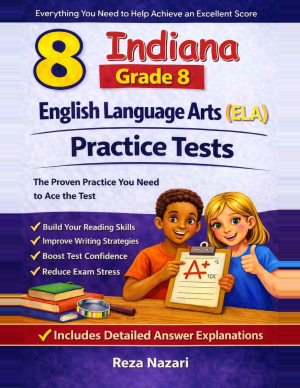
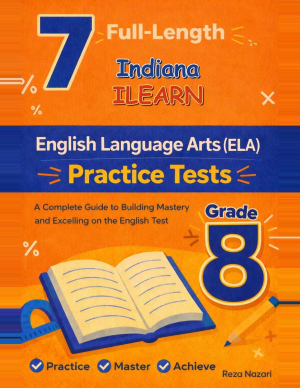
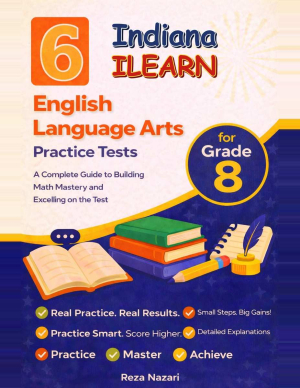
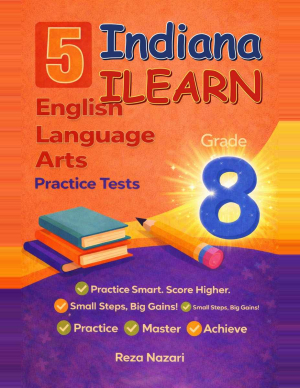
Printable Indiana grade 8 ELA books:

Indiana ILEARN Grade 8 ELA: Test Facts and Scores
Indiana 8th graders take ILEARN in English/language arts. It is a through-year test: three Checkpoints during the year and one summative test in spring. On the spring 2026 scale, 484 or higher is At Proficiency for Grade 8.
| Test | ILEARN Grade 8 English/Language Arts (computer adaptive) |
|---|---|
| Structure | Three Checkpoints plus a spring summative |
| Standards | 2023 Indiana Academic Standards |
Grade 8 ELA scale scores (updated spring 2026)
| Achievement level | Scale score |
|---|---|
| Below Proficiency | 318 to 430 |
| Approaching Proficiency | 431 to 483 |
| At Proficiency | 484 to 539 |
| Above Proficiency | 540 to 621 |
Practice on this page: Indiana standards
Indiana Grade 8 ELA testing questions
What ILEARN score is At Proficiency in Grade 8 ELA?
484. Above Proficiency starts at 540, and Approaching Proficiency starts at 431.
What are ILEARN Checkpoints?
Three shorter tests during the school year that each cover part of the standards. They inform teaching; the spring summative covers the full year.
Can Indiana ELA ILEARN scores be compared with earlier years?
Use care. IDOE updated the ELA and math performance standards starting with spring 2026, so the cut scores changed.
Facts from the Indiana Department of Education (IDOE), checked November 23, 2026: IDOE: ILEARN reporting scale, performance levels, and cut scores (published August 11, 2026); IDOE: ILEARN Through Year Assessment.
All 25 Indiana Grade 8 English/Language Arts Standards
Every Grade 8 standard in the 2023 Indiana Academic Standards for English/Language Arts, grouped by domain. ILEARN Grade 8 ELA measures these standards. Open a group to see its standards.
Reading Comprehension (11)
| 8.RC.1 | Analyze what a text says explicitly as well as draw inferences through strong and supportive textual evidence. |
|---|---|
| 8.RC.2 | Analyze the development of a theme or central idea over the course of a work of literature, including its relationship to the characters, setting, and plot; provide a detailed summary that supports the analysis. |
| 8.RC.3 | Compare and contrast the structure of two or more related works of literature (e.g., similar topic or theme), and analyze and evaluate how the differing structure of each text contributes to its meaning and style. |
| 8.RC.4 | Analyze the development of a central idea over the course of a text, including its relationship to supporting ideas; provide a detailed, objective summary of the text. |
| 8.RC.5 | Determine an author’s perspective or purpose in a text, and analyze how the author acknowledges and responds to conflicting evidence or viewpoints. |
| 8.RC.6 | Delineate and evaluate the argument and specific claims in a text, assessing whether the reasoning is sound and the evidence is relevant and sufficient; recognize when irrelevant evidence is introduced. |
| 8.RC.7 | Analyze a case in which two or more texts provide conflicting information on the same topic and identify where the texts disagree on matters of fact or interpretation. |
| 8.RC.8 | Use context to determine or clarify the meaning of words and phrases. |
| 8.RC.9 | Distinguish among the connotations of words with similar denotations. |
| 8.RC.10 | Use common, grade-appropriate Greek or Latin affixes and roots as clues to the meaning of a word (e.g., precede, recede, secede). |
| 8.RC.11 | Interpret figures of speech (e.g., verbal irony, puns) in context. |
Writing (6)
| 8.W.1 | a. Introduce claim(s), acknowledge and distinguish the claim(s) from alternate or opposing claims, and organize the reasons and evidence logically. b. Support claim(s) with logical reasoning and relevant evidence, using accurate, credible sources and demonstrating an understanding of the topic or text. c. Use effective transitions to create cohesion and clarify the relationships among claim(s), counterclaims, reasons, and evidence. d. Establish and maintain a consistent style and tone appropriate for the purpose and audience. e. Provide a concluding statement or section that follows and supports the argument presented. Write informative compositions in a variety of forms that:. |
|---|---|
| 8.W.2 | a. Introduce a topic clearly, previewing what is to follow; organize ideas, concepts, and information into broader categories; include formatting (e.g., headings), graphics (e.g., charts, tables), and multimedia when useful to aid comprehension. b. Develop the topic with relevant, well-chosen facts, definitions, concrete details, quotations, or other information and examples from various sources and texts. c. Use appropriate and varied transitions to create cohesion and clarify the relationships among ideas and concepts. d. Choose language and content-specific vocabulary that express ideas precisely and concisely, recognizing and eliminating wordiness and redundancy. e. Establish and maintain a style appropriate for the purpose and audience. f. Provide a concluding statement or section that follows and supports the information or explanation presented. Write narrative compositions in a variety of forms that:. |
| 8.W.3 | a. Engage and orient the reader by establishing a context and point of view and introducing a narrator and/or characters. b. Organize an event sequence (e.g., conflict, climax, resolution) that unfolds naturally and logically, using a variety of transition words, phrases, and clauses to convey sequence and signal shifts from one time frame or setting to another. c. Use narrative techniques, such as dialogue, pacing, description, and reflection, to develop experiences, events, and/or characters. d. Use precise words and phrases, relevant descriptive details, and sensory language to capture the action and convey experiences and events. e. Provide an ending that follows and reflects on the narrated experiences or events. Apply the writing process to all formal writing including but not limited to argumentative, informative, and narrative:. |
| 8.W.4 | a. Plan and develop, draft, and revise writing using appropriate reference materials. Rewrite, try a new approach, and edit to produce and strengthen writing that is clear and coherent with some guidance and support from peers and adults. b. Use technology to interact and collaborate with others to generate, produce, and publish writing and present information and ideas efficiently. |
| 8.W.5 | a. Formulate a research question. b. Gather relevant information from multiple sources, using search terms effectively, and annotate sources. c. Assess the credibility and accuracy of each source. d. Quote or paraphrase the information and conclusions of others. e. Avoid plagiarism and follow a standard format for citation. f. Present information, choosing from a variety of formats. Demonstrate command of English grammar and usage, focusing on:. |
| 8.W.7 | a. Verbs – Explaining the function of verbals (e.g., gerunds, participles, infinitives) in general and their function in particular sentences; forming and using active and passive voice; recognizing and correcting inappropriate shifts in verb voice. Demonstrate command of the conventions of standard English capitalization, punctuation, and spelling, focusing on: a. Punctuation – Using punctuation (e.g., comma, ellipsis, dash) to indicate a pause, break, or omission. |
Communication and Collaboration (8)
| 8.CC.1 | Engage effectively in a range of collaborative discussions (e.g., one-on-one, in groups, and teacher-led) on grade-appropriate topics, texts, and issues, building on others’ ideas and expressing personal ideas clearly. |
|---|---|
| 8.CC.2 | Pose questions that connect the ideas of several speakers and respond to others’ questions and comments with relevant evidence, observations, and ideas. |
| 8.CC.3 | Acknowledge new information expressed by others, and, when warranted, qualify or justify personal views in reference to the evidence presented. |
| 8.CC.4 | Analyze the purpose of information presented in diverse media and formats (e.g., visually, quantitatively, orally) and evaluate the motives (e.g., social, commercial, political) behind its presentation. |
| 8.CC.5 | Delineate a speaker’s argument and specific claims, evaluating the soundness of the reasoning and relevance and sufficiency of the evidence, and identifying when irrelevant evidence is introduced. |
| 8.CC.6 | Present claims and findings, emphasizing salient points in a focused, coherent manner with relevant evidence, sound valid reasoning, and well-chosen details; use appropriate eye contact, adequate volume, and clear pronunciation. |
| 8.CC.7 | Develop engaging presentations that integrate multimedia components and visual displays to clarify information, strengthen claims and evidence, and add interest. |
| 8.CC.8 | Identify and analyze persuasive and propaganda techniques used in visual and verbal messages by electronic, print, and mass media, and identify false or misleading information. |
Codes and wording from the IDOE standards document (examples and “E” essential markers are in the official document). Checked November 23, 2026: IDOE: 2023 Indiana Academic Standards, Grade 8 English/Language Arts; IDOE: Indiana Academic Standards for English/Language Arts (2023).
Standards source: Indiana English Language Arts, Indiana Department of Education.
Distinguish a gerund from a verb phrase in context
A word’s ending alone does not establish its job in a sentence. The same -ing form can participate in different grammatical structures. This activity compares the function of a whole phrase and then checks how the sentence expresses its action.
Curriculum reference: 2023 Indiana Academic Standards: Grade 8 English/Language Arts, from the Indiana Department of Education standards directory.
Indiana Grade 8 references for this activity
Indiana’s 2023 English document includes Grade 8 expectations in the grade’s reading, writing, and communication domains. The expectations selected here support this activity; use the whole document and the school’s sequence for wider coverage.
| Grade-level expectation | Activity focus | Official requirement |
|---|---|---|
| 8.W.6 | Explain the functions of verbals within the grammar expectation | Read the state document (PDF page 6) |
These are selected grade-level expectations from Indiana’s current English standards. Activity labels describe a teaching focus rather than reproduce complete requirements. Read the linked state document’s complete grade-level expectations, including its marked essential standards, alongside the school’s curriculum sequence.
A worked Grade 8 reading and writing activity
This original classroom example is separate from official assessment questions.
Drawing maps takes practice.
The student is drawing a map.
The student wants to draw a clearer map.
| Sentence feature | Function here | What to notice |
|---|---|---|
| Drawing maps | Subject phrase with a gerund | Names the activity that takes practice |
| is drawing | Progressive verb phrase | States the student’s action |
| to draw a clearer map | Infinitive phrase | Completes what the student wants |
Try the activity
Compare drawing in the first two sentences. Which phrase functions as the first sentence’s subject? Which sentence uses a progressive verb phrase? Identify the infinitive in the third sentence.
Follow the reasoning
In the first sentence, Drawing maps names the activity that takes practice. The phrase functions as the subject, and drawing is a gerund, a verb form used with a noun function. Takes is the finite verb. In the second sentence, is drawing forms the present progressive verb phrase: it describes the student’s action. Drawing is not the subject there. In the third sentence, to draw a clearer map is an infinitive phrase completing what the student wants. These explanations depend on each sentence’s structure, not simply the letters ing or the presence of a drawing-related word.
Notice what needs more practice
A gerund can retain verbal features such as an object: maps is what is drawn within the subject phrase. That does not prevent the entire phrase from functioning as a subject. Conversely, not every -ing word is a gerund. The helper is matters when analyzing the progressive verb phrase. Not every to begins an infinitive either; “to the classroom” uses a preposition followed by a noun phrase. The selected expectation also includes participles, voice, and other functions, which need further examples.
Grade 8 English worksheets
Choose printable practice that matches the skill being taught. Check the task, reading difficulty, and directions before assigning it; the collection is independently published.
Use the next session to build independence
- Locate the finite verb and identify the sentence’s subject.
- Explain the role of the -ing form or infinitive phrase.
- Check the interpretation by comparing the complete sentence structures.
Replace Drawing maps with another activity, such as Reading stories, and explain why the whole phrase still functions as a subject in “Reading stories takes practice.” Compare it with “The student is reading a story.” Then find teacher-selected examples of participles modifying nouns and distinguish that function from the two uses studied here. When reviewing a draft, explain what the whole phrase contributes before applying a grammatical label. Correct labels are useful when they help a writer understand and revise a sentence.
For more general reading and writing resources, visit the Grade 8 English Online Center.
Indiana Grade 8 English: useful planning questions
Is every word ending in -ing a gerund?
No. Determine its function in the sentence. Drawing maps is the subject in the first example, while is drawing is a progressive verb phrase in the second.
Where are the complete state requirements?
Indiana’s 2023 English document includes Grade 8 expectations in the grade’s reading, writing, and communication domains. The expectations selected here support this activity; use the whole document and the school’s sequence for wider coverage. The school’s sequence also includes reading, writing, speaking, listening, and language work beyond this example.
Official sources checked October 6, 2026. Grade 8 is within the ILEARN English language arts testing range. This original lesson is independent practice. Read the Indiana assessment overview and use the school’s guidance for preparation. ILEARN’s through-year system measures English language arts and mathematics in Grades 3–8 with checkpoints and an end-of-year summative assessment. Follow the school’s current assessment assignment, accommodations, and guidance; this classroom activity is independent practice and does not predict a state performance level. This site’s practice and books are independently published. Check their editions and contents against current standards and assessment guidance.
Grade 8 English in other states
When moving between school systems, compare the official curriculum and the school’s learning sequence. Use the national Online Center’s map to find another state’s resources.
Recommended Indiana Grade 8 resources
Build a Strong Indiana Grade 8 ILEARN English Practice Library
These independently published resources have their own coverage and editions. Check the contents alongside Indiana’s current English standards before choosing assessment preparation.
Use these Indiana Grade 8 resources for reading comprehension, language, writing, and full-length practice where available. Click any cover to open the resource page.
More Grade 8 resources
Choose another state
Grade 8 English in Every State
Select a state on the map to open its Grade 8 English page. You are viewing Indiana.
All states A–Z
A USEFUL NEXT STEP
Indiana Grade 8 English: study questions
Is every word ending in -ing a gerund?
No. Determine its function in the sentence. Drawing maps is the subject in the first example, while is drawing is a progressive verb phrase in the second.
Where are the complete Indiana Grade 8 requirements?
Indiana’s 2023 English document includes Grade 8 expectations in the grade’s reading, writing, and communication domains. The expectations selected here support this activity; use the whole document and the school’s sequence for wider coverage.
Official source ↗Resources from Effortless Math · Editorial standards