LEARN · PRACTICE · EXPLORE
Washington Grade 8 English
Explain how analogy and repetition shape meaning. Follow an original Grade 8 reading activity and a selected reference from Washington’s adopted 2026 English standards.
Focused lessons · Useful practice · Clear next steps
What do Washington 8th graders learn in ELA?
In 8th grade, Washington English language arts centers on evaluating arguments, analyzing tone and word choice, and research-based writing. Students take the Smarter Balanced (SBA) grade 8 ELA test in the spring. This page explains each Washington grade 8 ELA standard and pairs it with short lessons, printable worksheets and a full-length practice test.
Printable Washington grade 8 ELA books:
- 5 Washington Smarter Balanced Grade 8 English Language Arts (ELA) Practice Tests
- 6 Washington Smarter Balanced Grade 8 English Language Arts (ELA) Practice Tests
- 7 Washington Smarter Balanced Grade 8 English Language Arts (ELA) Practice Tests
- 8 Washington Smarter Balanced Grade 8 English Language Arts (ELA) Practice Tests
- Washington Grade 8 ELA Preparation Bundle
Standards source: Washington adopted content standards.
Explain an Analogy and Its Limits
Explain how analogy and repetition shape meaning. Work through the short reading below, explain your response, and try the skill in a fuller classroom text. The selected reference comes from the adopted 2026 standards; the school’s implementation sequence matters during the transition.
Curriculum reference: Washington State Learning Standards for English Language Arts, adopted 2026, from the Washington English language arts standards page.
Washington Grade 8 references for this activity
Washington OSPI’s English directory links the adopted 2026 standards. The PDF records adoption on August 6, 2026. OSPI says educators can explore, learn about, and begin using them in 2026–27, with required use with students in 2027–28. Ask the school which sequence it is following during that transition. The selected Grade 8 indicator on this page is a focus for this original activity, not a complete curriculum or a certification of every independent resource.
| Selected Washington reading reference | Activity focus | State-linked standards document |
|---|---|---|
| ELA.8.R.4.h | Explain how analogy and repetition shape meaning | Read the state-linked document (PDF page 69) |
These selected reference labels identify an activity focus, with the correct grade and PDF page linked separately. Read the complete standards selected by the school and its learning sequence, including reading, writing, language, speaking, and listening. This short original example does not fulfill the entire curriculum or establish a student’s grade-level proficiency.
A map for the revision
This original classroom example is separate from official assessment questions.
Think of the essay outline as a route map, not a fence. A route map can help a traveler see where a journey begins, which stops connect, and where a turn may be needed. In the same way, an outline can show how an introduction leads through reasons to a conclusion. Keep the route when it serves the argument. Change the route when new evidence requires another connection. The comparison does not mean that an essay has only one possible destination or that its reasons are places on a real road.
Try the activity
Explain which relationships the route-map analogy transfers to outlining. How do “Keep the route” and “Change the route” work together? Identify a limit that prevents a literal or overly rigid reading.
Follow the reasoning
The analogy connects a traveler’s starting point, linked stops, and possible turns with an essay’s introduction, sequence of reasons, and revisions. It emphasizes guidance that can be reconsidered, while “not a fence” rejects the idea of an unchangeable boundary. Repeating “the route” in the paired instructions makes keeping and changing the plan equally available, with the decision depending on whether the argument is served or new evidence requires a connection. The final qualification prevents treating reasons as physical locations or assuming only one possible conclusion. Explain the specific transferred relationships and limits; saying an outline is useful captures a topic but not how the language develops it.
Notice what needs more practice
The paragraph is original. An analogy illuminates selected relationships; it does not make two things identical. No actual travel instructions or findings about revision success are supplied. The selected standard also includes language features beyond the analogy and repetition used here.
Grade 8 English worksheets
Choose printable practice that matches the skill being taught. Check the task, reading difficulty, and directions before assigning it; the collection is independently published.
Use the next session to build independence
- Identify the two things being compared.
- Explain the relationships and repeated wording that develop the idea.
- Name a boundary beyond which the comparison would mislead.
Find an analogy in a fuller informational classroom text. Explain which relationships it clarifies and which it leaves out. Analyze repeated words in their context rather than assuming repetition always emphasizes the same kind of idea.
For more general reading and writing resources, visit the Grade 8 English Online Center.
Washington Grade 8 English: useful planning questions
Does an analogy prove that its two subjects are alike in every way?
No. Explain the relationships the text selects and retain the limits that matter to its meaning.
Which standards does the school use?
Washington OSPI’s English directory links the adopted 2026 standards. The PDF records adoption on August 6, 2026. OSPI says educators can explore, learn about, and begin using them in 2026–27, with required use with students in 2027–28. Ask the school which sequence it is following during that transition. The selected Grade 8 indicator on this page is a focus for this original activity, not a complete curriculum or a certification of every independent resource. The school’s sequence also includes reading, writing, speaking, listening, and language work beyond this example.
Sources checked October 6, 2026. OSPI’s state-testing overview lists Smarter Balanced English and mathematics in Grades 3–8 and 10. Grade 8 is included in that listed English range; follow current school directions and accommodations. OSPI distinguishes standards implementation from assessment updates: changes for new media-literacy, digital-citizenship, and data-science standards are planned no earlier than 2028–29, beginning with pilots. This does not establish a changed current test format, timing, or item count. Read the Washington English assessment overview, English standards guidance, and standards and assessment transition guidance. Independently published practice has its own directions and scoring. Its result does not predict a state performance level, and this original activity is not an official assessment item.
Grade 8 English in other states
When moving between school systems, compare the official curriculum and the school’s learning sequence. Use the national Online Center’s map to find another state’s resources.
Recommended Washington Grade 8 resources
Choose Washington Grade 8 English practice resources
These independently published resources have their own coverage and editions. Check the contents alongside Washington’s current English standards before choosing assessment preparation.
Use these Washington Grade 8 resources for reading comprehension, language, writing, and full-length practice where available. Click any cover to open the resource page.
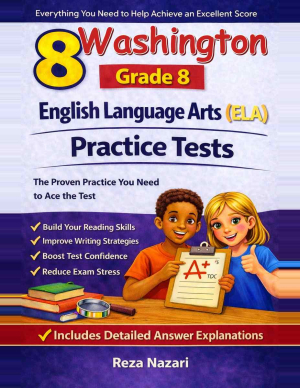 8 Washington Smarter Balanced Grade 8 English Language Arts (ELA) Practice Tests
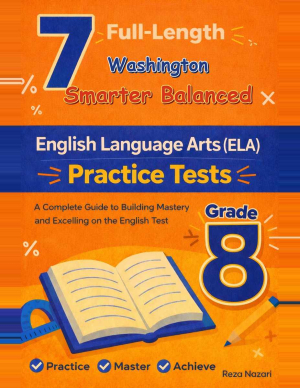 7 Washington Smarter Balanced Grade 8 English Language Arts (ELA) Practice Tests
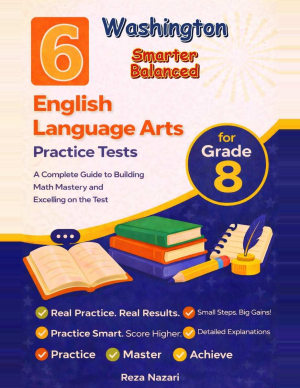 6 Washington Smarter Balanced Grade 8 English Language Arts (ELA) Practice Tests
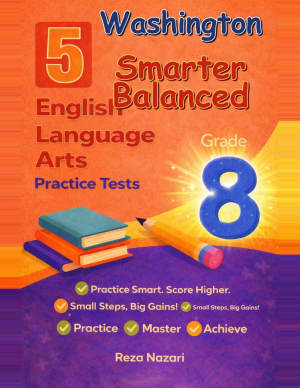 5 Washington Smarter Balanced Grade 8 English Language Arts (ELA) Practice Tests
More Grade 8 resources
A USEFUL NEXT STEP
Washington Grade 8 English: study questions
Does an analogy prove that its two subjects are alike in every way?
No. Explain the relationships the text selects and retain the limits that matter to its meaning.
Where are the complete Washington Grade 8 requirements?
Washington OSPI’s English directory links the adopted 2026 standards. The PDF records adoption on August 6, 2026. OSPI says educators can explore, learn about, and begin using them in 2026–27, with required use with students in 2027–28. Ask the school which sequence it is following during that transition. The selected Grade 8 indicator on this page is a focus for this original activity, not a complete curriculum or a certification of every independent resource.
Official source ↗Resources from Effortless Math · Editorial standards