LEARN · PRACTICE · EXPLORE
New York Grade 8 English
Compare two original Grade 8 information texts, analyze how structure changes their emphasis, and practice with New York English worksheets and references.
Focused lessons · Useful practice · Clear next steps
What do New York 8th graders learn in ELA?
In 8th grade, New York English language arts centers on evaluating arguments, analyzing tone and word choice, and research-based writing. Students take the New York State grade 8 ELA test in the spring. This page explains each New York grade 8 ELA standard and pairs it with short lessons, printable worksheets and a full-length practice test.
Printable New York grade 8 ELA books:
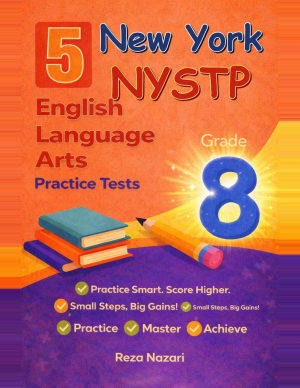
- 5 New York NYSTP Grade 8 English Language Arts (ELA) Practice Tests
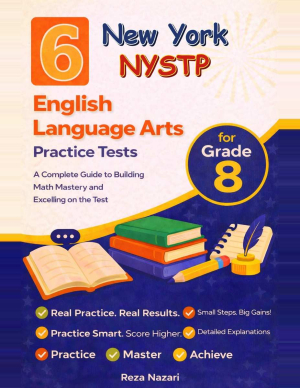
- 6 New York NYSTP Grade 8 English Language Arts (ELA) Practice Tests
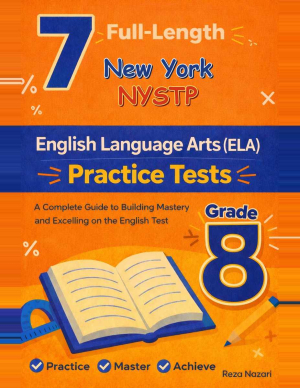
- 7 New York NYSTP Grade 8 English Language Arts (ELA) Practice Tests
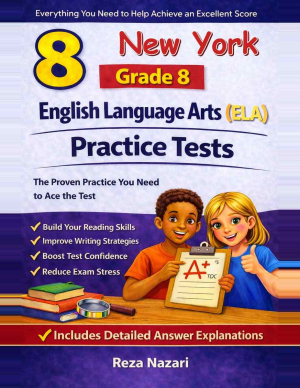
- 8 New York NYSTP Grade 8 English Language Arts (ELA) Practice Tests
- New York Grade 8 ELA Preparation Bundle
Standards source: New York adopted content standards.
Comparing Text Structures
Compare two original Grade 8 information texts, analyze how structure changes their emphasis, and practice with New York English worksheets and references. Use this focused activity alongside the school’s wider reading, writing, speaking, listening, and language sequence.
Curriculum reference: 2017 New York State Next Generation English Language Arts Learning Standards, from the New York English Language Arts standards page.
New York Grade 8 references for this activity
New York’s English Language Arts page links the 2017 Next Generation ELA Learning Standards. The state’s implementation timeline places Pre-K–8 instruction under those standards from September 2022, with Grades 3–8 assessment first aligned in Spring 2023. The selected reading references below identify this activity’s focus; use the complete grade requirements and the school’s broader literacy program.
| Selected New York reading reference | Activity focus | State-hosted standards document |
|---|---|---|
| 8R1 | Use strong textual evidence for analysis | Read the state-hosted document (PDF page 90) |
| 8R5 | Compare structures and their contribution to meaning | Read the state-hosted document (PDF page 90) |
These selected reference labels identify an activity focus, with the correct grade and PDF page linked separately. Read the complete standards selected by the school and its learning sequence, including reading, writing, language, speaking, and listening. This short original example does not fulfill the entire curriculum or establish a student’s grade-level proficiency.
One repair session, two ways to explain it
This original classroom example is separate from official assessment questions.
Text A — A sequence of events
First, volunteers laid out the tools on the repair table. Next, visitors placed small broken objects beside the sign-in sheet. During the first half hour, the queue blocked the cupboard. Volunteers moved the sign-in sheet to the doorway, and the next three visitors reached the cupboard without crossing the queue. At closing, the team recorded the change and planned another trial.
Text B — A problem and response
The repair session faced an access problem: its queue blocked the cupboard where tools were kept. Moving the sign-in sheet to the doorway separated arriving visitors from the cupboard route. The next three visitors could reach the cupboard without crossing the queue. This limited observation suggests a promising arrangement, but a later trial is needed to see how it works with a larger group.
Try the activity
Describe the main structure of each text and cite the details that reveal it. How does each structure shape the reader’s understanding? Identify a shared result and explain why Text B’s extra caution does not contradict Text A.
Follow the reasoning
Text A mainly orders events in time. “First,” “Next,” “During the first half hour,” and “At closing” place preparation, difficulty, change, observation, and planning within the session. This structure helps readers reconstruct what happened and when. Text B mainly organizes the same issue as a problem, a response, and a limited evaluation. It begins with blocked access, explains the changed position, and qualifies what the three observed visitors can show. Both report that the next three visitors reached the cupboard without crossing the queue. Text A reports a planned trial; Text B explains why a larger-group trial would be useful. The caution adds interpretive emphasis rather than denying the observed result. Neither account establishes performance with every group size.
Notice what needs more practice
A problem/response text can include time words, and a chronological account can contain a problem. Identify the dominant organization and explain its effect using several parts, rather than labeling a structure from one word. These are invented information texts, not actual repair instructions or historical documents. The structural analysis is a selected activity within the wider Grade 8 reading program.
Grade 8 English worksheets
Choose printable practice that matches the skill being taught. Check the task, reading difficulty, and directions before assigning it; the collection is independently published.
Use the next session to build independence
- Mark the order signals and the problem/response parts.
- Compare the result both texts state.
- Explain how the different organizations change emphasis while preserving shared facts.
Reorganize another teacher-approved information text as a sequence and then as a problem/response account. Preserve its evidence and uncertainties. Explain which version better answers a question about timing and which better answers a question about why a change was tried.
For more general reading and writing resources, visit the Grade 8 English Online Center.
New York Grade 8 English: useful planning questions
Can two structures present the same facts differently?
Yes. A sequence can emphasize when events happened, while problem/response organization emphasizes a difficulty and what addressed it. Compare actual evidence before deciding that different emphasis is a contradiction.
Which standards does the school use?
New York’s English Language Arts page links the 2017 Next Generation ELA Learning Standards. The state’s implementation timeline places Pre-K–8 instruction under those standards from September 2022, with Grades 3–8 assessment first aligned in Spring 2023. The selected reading references below identify this activity’s focus; use the complete grade requirements and the school’s broader literacy program. The school’s sequence also includes reading, writing, speaking, listening, and language work beyond this example.
Sources checked October 6, 2026. The 2026–2027 NYSED schedule places Grades 3–8 ELA, including Grade 8, in an April 5–May 14, 2027 window. Each school sets its grade/subject administration dates within that window; ELA uses two consecutive school days. Confirm the learner’s assigned pathway, accommodations, and current school directions. Read the official 2026–2027 testing schedule (PDF), NYSED schedules page, ELA standards page, and instruction and assessment implementation timeline (PDF). Independently published practice has its own directions and scoring. Its result does not predict a state performance level, and this original activity is not an official assessment item.
Grade 8 English in other states
When moving between school systems, compare the official curriculum and the school’s learning sequence. Use the national Online Center’s map to find another state’s resources.
Recommended New York Grade 8 resources
Build a Strong New York Grade 8 NYSTP English Practice Library
These independently published resources have their own coverage and editions. Check the contents alongside New York’s current English standards before choosing assessment preparation.
Use these New York Grade 8 resources for reading comprehension, language, writing, and full-length practice where available. Click any cover to open the resource page.
More Grade 8 resources
A USEFUL NEXT STEP
New York Grade 8 English: study questions
Can two structures present the same facts differently?
Yes. A sequence can emphasize when events happened, while problem/response organization emphasizes a difficulty and what addressed it. Compare actual evidence before deciding that different emphasis is a contradiction.
Where are the complete New York Grade 8 requirements?
New York’s English Language Arts page links the 2017 Next Generation ELA Learning Standards. The state’s implementation timeline places Pre-K–8 instruction under those standards from September 2022, with Grades 3–8 assessment first aligned in Spring 2023. The selected reading references below identify this activity’s focus; use the complete grade requirements and the school’s broader literacy program.
Official source ↗Resources from Effortless Math · Editorial standards