


LEARN · PRACTICE · EXPLORE
Georgia Grade 8 English
Paraphrase a short NASA statement about the Moon, distinguish source credit from quotation marks, and use current Georgia Grade 8 evidence-and-citation expectations.
Focused lessons · Useful practice · Clear next steps
What do Georgia 8th graders learn in ELA?
In 8th grade, Georgia English language arts centers on evaluating arguments, analyzing tone and word choice, and research-based writing. Students take the Georgia Milestones grade 8 ELA test in the spring. This page explains each Georgia grade 8 ELA standard and pairs it with short lessons, printable worksheets and a full-length practice test.
Printable Georgia grade 8 ELA books:
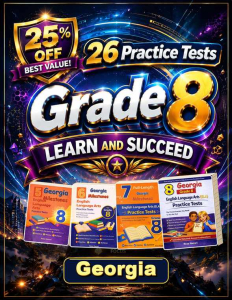
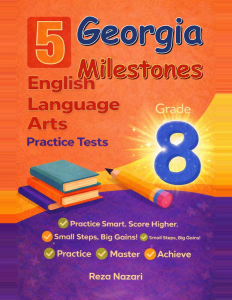
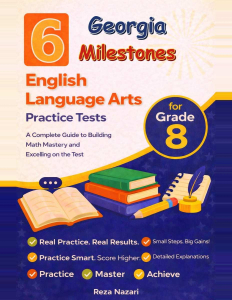
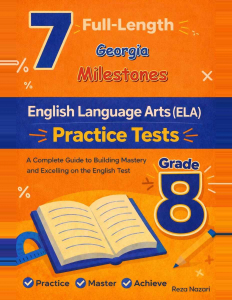
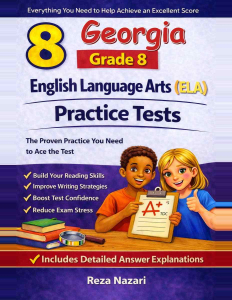
Georgia Milestones Grade 8 ELA: Test Facts and Scores
Georgia 8th graders take the Georgia Milestones End-of-Grade (EOG) test in English language arts each spring. A scale score of 675 or higher is Proficient Learner. Grade 8 reading results also inform local promotion decisions, with a summer retest if needed. Georgia set new ELA scales and cut scores for 2025–2026, so ELA scores cannot be compared with earlier years.
| Test | Georgia Milestones End-of-Grade, Grade 8 English Language Arts |
|---|---|
| When | Spring, on dates your district sets inside the state window |
| Format | Online, with paper forms for students who need them |
| Achievement levels | Beginning, Developing, Proficient and Distinguished Learner |
Grade 8 ELA scale score ranges
| Achievement level | Scale score |
|---|---|
| Beginning Learner | 300 to 624 |
| Developing Learner | 625 to 674 |
| Proficient Learner | 675 to 720 |
| Distinguished Learner | 721 to 999 |
Practice on this page: Georgia standards
Facts from the Georgia Department of Education, checked November 23, 2026: GaDOE: Georgia Milestones Interpretive Guide for Score Reports (scale score ranges, 2025–2026); GaDOE: Georgia Milestones Questions and Answers for Parents (2026–2027); GaDOE: Georgia Milestones Assessment System.
All 27 Georgia Grade 8 English Language Arts Standards
Every Grade 8 standard in Georgia’s K-12 English Language Arts Standards (in use since 2025–2026), grouped by domain and big idea. Each standard has grade-level expectations in the official document. The Georgia Milestones Grade 8 ELA test measures these standards. Open a group to see its standards.
Practices: Engagement & Intention for Comprehension & Composition (4)
| 8.P.EICC.1 | Reader & Writer Identity: Build an identity as a reader and writer, developing a repertoire of resources and tools to continuously expand participation as an active consumer and producer of texts. |
|---|---|
| 8.P.EICC.2 | Engagement & Intention: Engage in written or spoken dialogue as author and audience for a variety of tasks and purposes, making intentional connections within, between, and beyond texts. |
| 8.P.EICC.3 | Comprehension Strategies: Engage with a range of complex texts for a variety of tasks and purposes, accessing and using strategies for comprehension* before, during, and after reading as part of the meaning-making process. |
| 8.P.EICC.4 | Writing Processes: Compose a range of texts for a variety of purposes and audiences, flexibly engaging in writing processes to plan, draft, evaluate, revise, and edit texts. |
Practices: Situating Texts (2)
| 8.P.ST.1 | Context: Develop and apply knowledge of key components of context such as background information, geographic location, cultural influences, time period, and contemporary events when interpreting and constructing texts. |
|---|---|
| 8.P.ST.2 | Author, Audience, & Purpose: Interpret and construct texts by developing and applying knowledge of the strategies and techniques authors use to accommodate the target audience and achieve the text’s purpose. |
Practices: Author’s Craft (3)
| 8.P.AC.1 | Reading like a Writer: Interpret texts through the author’s lens by identifying, analyzing, and evaluating craft techniques that are connected to the responses, thoughts, decisions, and questions triggered by the text. |
|---|---|
| 8.P.AC.2 | Writing like a Reader: Construct texts with the audience’s experience in mind, basing decisions about craft techniques on context and purpose. |
| 8.P.AC.3 | Text Design: Consider the impact of text design on audience and purpose when consuming and producing texts across modes and genres. |
Practices: Collaboration & Presentation (2)
| 8.P.CP.1 | Collaboration: Collaborate with others to accomplish shared goals and projects. |
|---|---|
| 8.P.CP.2 | Presentation: Use presentation skills to tailor communication to target audiences for specific purposes. |
Language: Grammar Conventions (2)
| 8.L.GC.1 | Grammar, Usage, & Mechanics: Draw from knowledge of the conventions of Standard English grammar, usage, and mechanics when analyzing and constructing texts. |
|---|---|
| 8.L.GC.2 | Syntax: Apply understanding of syntax to comprehend, analyze, condense, and combine ideas and information, enhancing clarity, style, and meaning. |
Language: Vocabulary (3)
| 8.L.V.1 | General, Academic, & Specialized Vocabulary: Use a variety of approaches to continuously build vocabulary across a range of real-life, academic, and disciplinary contexts and apply those understandings to analyze texts and to communicate effectively. |
|---|---|
| 8.L.V.2 | Word Analysis: Use word knowledge and word analysis skills to determine the meaning of unfamiliar words and phrases and to communicate effectively for a variety of purposes. |
| 8.L.V.3 | Meaning & Purpose: Analyze the denotative and connotative meanings of words and phrases and strategically apply those understandings when interpreting and constructing texts. |
Texts: Context (2)
| 8.T.C.1 | Purpose & Audience: Analyze the impact of purpose and audience on a wide variety of texts. |
|---|---|
| 8.T.C.2 | Authors & Speakers: Analyze how authors’ and/or speakers’ perspectives influence texts and how circumstances shape their creation. |
Texts: Structure & Style (2)
| 8.T.SS.1 | Organization: Analyze and use organizational structures to craft meaning. |
|---|---|
| 8.T.SS.2 | Craft: Interpret and use language to craft engaging texts. |
Texts: Techniques (4)
| 8.T.T.1 | Narrative Techniques: Analyze and apply narrative techniques. |
|---|---|
| 8.T.T.2 | Expository Techniques: Analyze and apply expository techniques. |
| 8.T.T.3 | Argumentative Techniques: Analyze and apply argumentative techniques. |
| 8.T.T.4 | Poetic Techniques: Analyze and apply poetic techniques. |
Texts: Research & Analysis (2)
| 8.T.RA.1 | Research & Inquiry: Conduct research, generating questions to guide investigations of complex topics of interest and using credible sources to support analyses. |
|---|---|
| 8.T.RA.2 | Curating Sources & Evidence: Utilize multiple print and digital texts to address a specific topic or question, assessing source credibility and relevance and integrating evidence properly to avoid plagiarism. |
Texts: Periods & Movements (1)
| 8.T.PM.1 | Periods & Movements: Demonstrate knowledge of dominant themes, genres, and verbal styles of literature from a particular time period. |
|---|
Codes and wording from GaDOE’s official standards repository (standard titles and statements; grade-level expectations are in the official document). Checked November 23, 2026: GaDOE: Georgia’s K-12 English Language Arts Standards (Standards Satchel); GaDOE: English Language Arts.
Standards source: Georgia English Language Arts, Georgia Department of Education.
Preserve a source’s meaning and give readers a way to check it
A paraphrase changes the wording and sentence structure while preserving the source’s meaning. It still uses someone else’s information, so it needs source credit. Work with one short, verifiable statement before trying to integrate several sources into an argument.
Curriculum source: Georgia’s K-12 English Language Arts Standards, approved May 2023 and fully implemented in 2025–26, from the GaDOE English standards directory.
Georgia Grade 8 references for this activity
Georgia’s current Grade 8 English document contains grade-level expectations alongside broader standards and practices. The expectations selected here support this activity; use the whole document and the school’s sequence for wider coverage.
| Grade-level expectation | Activity focus | Official requirement |
|---|---|---|
| 8.T.RA.2.a | Locate evidence and identify documentation details | Read the primary standards document, page 23 |
| 8.T.RA.2.c | Integrate evidence with MLA attribution and a works-cited entry | Read the primary standards document, page 23 |
These are selected grade-level expectations from Georgia’s current English standards. Activity labels describe a teaching focus rather than reproduce complete requirements. Read the linked grade-level document, including its broader standards and practices, alongside the school’s curriculum sequence.
A worked Grade 8 reading and writing activity
This original classroom example is separate from official assessment questions.
NASA’s “Moon Facts” states: “The Moon has a very thin and tenuous atmosphere called an exosphere.” The page also explains that the atmosphere is not breathable. Read the source through the link below before writing.
Check the works-cited entry
“Moon Facts.” NASA Science, NASA, 12 Feb. 2026, science.nasa.gov/moon/facts/. Accessed 5 Oct. 2026.
This example uses the page’s displayed update date. The MLA guide explains the online-work entry’s elements. Confirm which details apply to a new source rather than copying this entry for a different page.
Try the activity
Write a paraphrase that accurately conveys these two points. Identify the source in the response and match it with a works-cited entry. Explain why neither a few synonym changes nor a source link alone settles every attribution requirement.
Follow the reasoning
One paraphrase is: The Moon has extremely little surrounding gas, and its natural atmosphere cannot provide breathable air (“Moon Facts”). This changes the sentence’s structure while retaining the two selected ideas and crediting the page by title. A direct quotation would instead reproduce the source’s exact words inside quotation marks and also cite it. The page labels Caela Barry as an editor; that label does not automatically establish that person as the passage’s author. With no individual author identified for this page, the example entry begins with its title.
Notice what needs more practice
Adding a citation does not turn nearly unchanged wording into a paraphrase. Exact borrowed wording needs quotation marks. Conversely, rewriting the wording does not make the information the student’s own discovery. Do not expand the source into a claim that the Moon has absolutely no atmosphere; its description identifies a very sparse one. Do not invent a page number for an unpaginated web page. Check that the in-text title leads the reader to the matching works-cited entry.
Grade 8 English worksheets
Choose printable practice that matches the skill being taught. Check the task, reading difficulty, and directions before assigning it; the collection is independently published.
Use the next session to build independence
- Read the source and note its meaning and the identifying details displayed on the page.
- Draft without copying the source sentence, then compare both wording and meaning with the original.
- Add the in-text citation and works-cited entry, checking the current MLA guidance and the teacher’s assignment directions.
Choose another short passage from a credible source and record its author if supplied, title, container, date, and location. Decide whether a quotation or paraphrase better serves the explanation. Integrate the evidence with a sentence that explains its relevance instead of dropping it into a paragraph without comment. A later research task should compare multiple sources; this one-source exercise practices documentation and accurate integration first.
For more general reading and writing resources, visit the Grade 8 English Online Center.
Georgia Grade 8 English: useful planning questions
Does a paraphrase still need a citation?
Yes. A paraphrase uses information from a source even though its wording changes. Credit the source and supply the matching works-cited entry.
Where are the complete state requirements?
Georgia’s current Grade 8 English document contains grade-level expectations alongside broader standards and practices. The expectations selected here support this activity; use the whole document and the school’s sequence for wider coverage. The school’s sequence also includes reading, writing, speaking, listening, and language work beyond this example.
Official sources checked October 5, 2026. Grade 8 is within the Georgia Milestones English language arts testing range. This original lesson is independent practice. Read the Georgia Milestones overview and use the school’s guidance for preparation. Georgia’s new English standards were fully implemented in 2025–26, alongside revised assessments. This site’s practice and books are independently published. Check their editions and contents against current standards and assessment guidance.
Grade 8 English in other states
When moving between school systems, compare the official curriculum and the school’s learning sequence. Use the national Online Center’s map to find another state’s resources.
Recommended Georgia Grade 8 resources
Build a Strong Georgia Grade 8 Milestones English Practice Library
These independently published resources may use earlier Georgia English standards. Check the edition and contents alongside GaDOE’s current English standards before choosing assessment preparation.
Use these Georgia Grade 8 resources for reading comprehension, language, writing, and full-length practice where available. Click any cover to open the resource page.
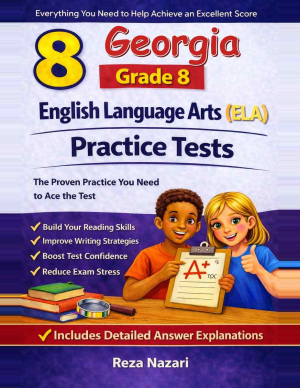 8 Georgia Georgia Milestones Grade 8 English Language Arts (ELA) Practice Tests
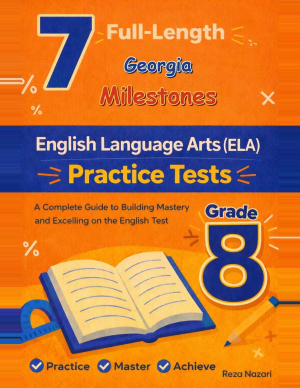 7 Georgia Georgia Milestones Grade 8 English Language Arts (ELA) Practice Tests
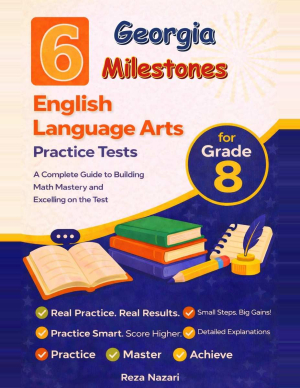 6 Georgia Georgia Milestones Grade 8 English Language Arts (ELA) Practice Tests
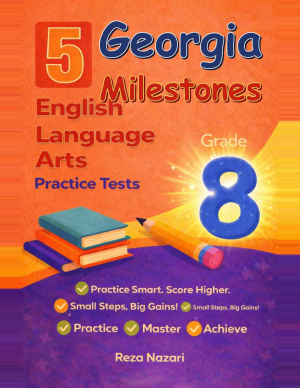 5 Georgia Georgia Milestones Grade 8 English Language Arts (ELA) Practice Tests
More Grade 8 resources
Georgia Grade 8 English: 10-Question Challenge
Ten questions on reading, grammar, vocabulary, and writing for Georgia 8th graders, each with a short explanation.
The subjunctive expresses wishes or conditions contrary to fact.
The rain was not walking. The modifier should refer to the person.
Choose another state
Grade 8 English in Every State
Select a state on the map to open its Grade 8 English page. You are viewing Georgia.
All states A–Z
A USEFUL NEXT STEP
Georgia Grade 8 English: study questions
Does a paraphrase still need a citation?
Yes. A paraphrase uses information from a source even though its wording changes. Credit the source and supply the matching works-cited entry.
Where are the complete Georgia Grade 8 requirements?
Georgia’s current Grade 8 English document contains grade-level expectations alongside broader standards and practices. The expectations selected here support this activity; use the whole document and the school’s sequence for wider coverage.
Official source ↗Resources from Effortless Math · Editorial standards