LEARN · PRACTICE · EXPLORE
Iowa Grade 8 English
Listen to an original chess-club proposal, test a generalization against its limited survey, and distinguish relevant from irrelevant evidence using an Iowa Grade 8 expectation.
Focused lessons · Useful practice · Clear next steps
What do Iowa 8th graders learn in ELA?
In 8th grade, Iowa English language arts centers on evaluating arguments, analyzing tone and word choice, and research-based writing. Students take the ISASP grade 8 ELA test in the spring. This page explains each Iowa grade 8 ELA standard and pairs it with short lessons, printable worksheets and a full-length practice test.
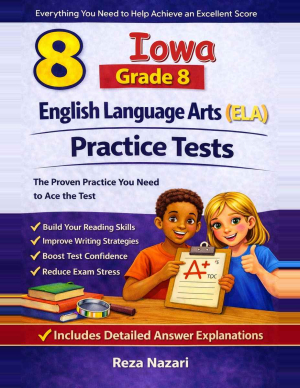
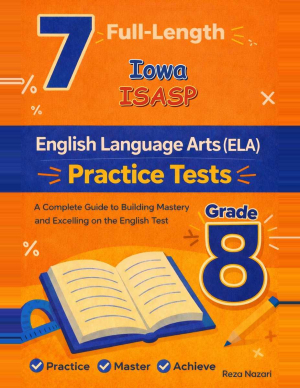
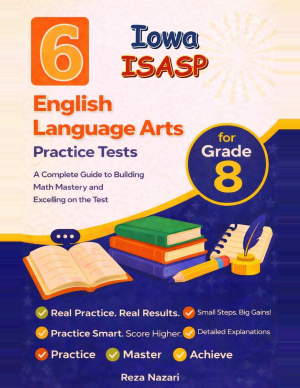
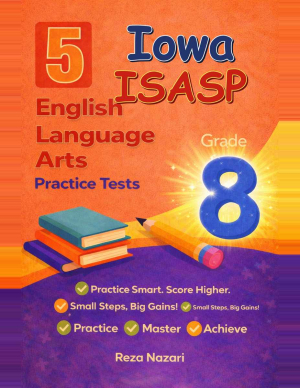
Printable Iowa grade 8 ELA books:
Standards source: Iowa English Language Arts, Iowa Department of Education.
Evaluate how far a speaker’s evidence supports a claim
Evidence can concern the right topic while still being too limited for the claim a speaker makes. An adult reads this original imagined proposal aloud. Listen for the conclusion, the group actually surveyed, and information that does not support the proposal.
Curriculum reference: 2024 Iowa Academic Standards: English Language Arts, from the Iowa Department of Education standards directory.
Iowa Grade 8 references for this activity
Iowa adopted its current English Language Arts standards on June 20, 2024. Read the Grade 8 expectations in the full state document. The selected reference supports this activity; use the school’s sequence and the remaining expectations for wider coverage.
| Grade-level expectation | Activity focus | Official requirement |
|---|---|---|
| SL.8.3 | Evaluate reasoning and the relevance and sufficiency of a speaker’s evidence | Read the state document (PDF page 63) |
These are selected grade-level expectations from Iowa’s current English standards. Activity labels describe a teaching focus rather than reproduce complete requirements. Read the linked state document’s complete grade-level expectations, including its grade-specific details, alongside the school’s curriculum sequence.
A worked Grade 8 reading and writing activity
This original classroom example is separate from official assessment questions.
Our school should add another chess-club meeting each week because everyone wants more chess. I asked eight friends who already attend the club, and seven said they would come to an extra meeting. Our team also won a spelling contest last month. The new meeting would surely double club attendance.
| Statement | Evidence check |
|---|---|
| Seven of eight respondents express interest | Supported within the invented survey |
| Everyone wants more chess | Schoolwide conclusion exceeds the sample |
| Attendance would double | No defined or tested attendance result |
| Spelling-contest win | Does not establish demand for a chess meeting |
Try the activity
Identify the speaker’s proposal and two claims that go beyond the evidence. Explain what the survey supports, what it leaves unknown, and why the spelling-contest detail does not establish demand for a chess meeting.
Follow the reasoning
The survey suggests interest among seven of the eight current club members who were asked. It does not establish what everyone in the school wants, because the sample consists of selected friends who already attend. It also does not show that total attendance would double: a willingness to attend another session is different from a count of additional students or attendance visits under a defined measure. The spelling result does not supply evidence about demand, schedules, or space for the proposed meeting. The proposal might still be worth considering, but its strong conclusions need better support.
Notice what needs more practice
Do not reject all survey evidence because its scope is limited. A bounded statement about the respondents is more defensible than the universal claim. Likewise, distinguish relevant evidence from sufficient evidence: existing members’ interest is relevant, but it is not sufficient to establish schoolwide demand. The survey and contest are invented classroom details, not records from an Iowa school. A listener should name the gap in reasoning rather than infer that the speaker intentionally misled anyone. Assess the stated argument and evidence before speculating about motives.
Grade 8 English worksheets
Choose printable practice that matches the skill being taught. Check the task, reading difficulty, and directions before assigning it; the collection is independently published.
Use the next session to build independence
- State the proposal and separate it from the stronger attendance claims.
- Match each offered detail with the claim it could actually support.
- Revise overbroad conclusions and identify further information needed.
Revise the speech to say what seven respondents reported and present an extra meeting as a proposal to investigate. Specify a useful next step, such as collecting interest from a wider group and checking the available meeting space, without inventing its result. Have a partner read the revision aloud and ask listeners whether the new conclusion fits the evidence. Define what attendance would mean before comparing counts across weeks. Iowa’s broader Grade 8 speaking-and-listening work includes collaborative discussion and presentation; this exercise concentrates on evaluating the argument heard.
For more general reading and writing resources, visit the Grade 8 English Online Center.
Iowa Grade 8 English: useful planning questions
Can relevant evidence still be insufficient for a claim?
Yes. Current members’ interest is relevant to an extra meeting, but the small selected survey does not establish what everyone in the school wants.
Where are the complete state requirements?
Iowa adopted its current English Language Arts standards on June 20, 2024. Read the Grade 8 expectations in the full state document. The selected reference supports this activity; use the school’s sequence and the remaining expectations for wider coverage. The school’s sequence also includes reading, writing, speaking, listening, and language work beyond this example.
Official sources checked October 6, 2026. Grade 8 is within the ISASP English language arts testing range. This original lesson is independent practice. Read the Iowa assessment overview and use the school’s guidance for preparation. Iowa’s 2026–27 required-assessments overview identifies ISASP reading, language/writing, and mathematics in Grades 3–11 and science in Grades 5, 8, and 11. Eligible students use the assigned alternate-assessment pathway. Follow the school’s current assessment assignment, accommodations, and guidance; this classroom activity is independent practice and does not predict a state performance level. This site’s practice and books are independently published. Check their editions and contents against current standards and assessment guidance.
Grade 8 English in other states
When moving between school systems, compare the official curriculum and the school’s learning sequence. Use the national Online Center’s map to find another state’s resources.
Recommended Iowa Grade 8 resources
Build a Strong Iowa Grade 8 ISASP English Practice Library
These independently published resources have their own coverage and editions. Check the contents alongside Iowa’s current English standards before choosing assessment preparation.
Use these Iowa Grade 8 resources for reading comprehension, language, writing, and full-length practice where available. Click any cover to open the resource page.
More Grade 8 resources
A USEFUL NEXT STEP
Iowa Grade 8 English: study questions
Can relevant evidence still be insufficient for a claim?
Yes. Current members’ interest is relevant to an extra meeting, but the small selected survey does not establish what everyone in the school wants.
Where are the complete Iowa Grade 8 requirements?
Iowa adopted its current English Language Arts standards on June 20, 2024. Read the Grade 8 expectations in the full state document. The selected reference supports this activity; use the school’s sequence and the remaining expectations for wider coverage.
Official source ↗Resources from Effortless Math · Editorial standards