


LEARN · PRACTICE · EXPLORE
California Grade 8 English
Compare two invented filter offers, identify what the terms leave uncertain, and write a precise business inquiry using California Grade 8 English references.
Focused lessons · Useful practice · Clear next steps
What do California 8th graders learn in ELA?
In 8th grade, California English language arts centers on evaluating arguments, analyzing tone and word choice, and research-based writing. Students take the CAASPP grade 8 ELA test in the spring. This page explains each California grade 8 ELA standard and pairs it with short lessons, printable worksheets and a full-length practice test.
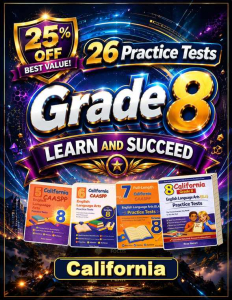
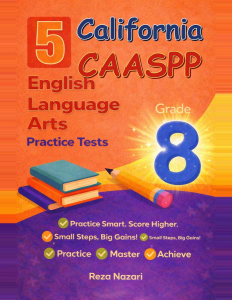
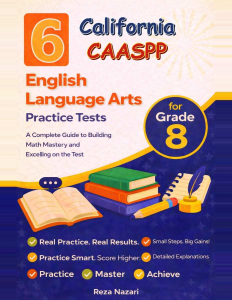
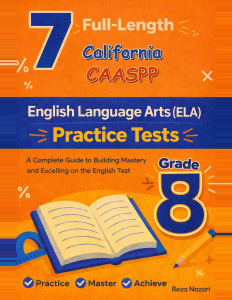
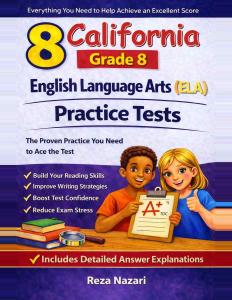
Printable California grade 8 ELA books:
CAASPP Grade 8 ELA: Test Facts and Scores
California 8th graders take the Smarter Balanced English Language Arts/Literacy test, part of the CAASPP. It is computer adaptive, includes a performance task and is untimed. Scores fall on a scale of 2290 to 2850 for Grade 8, and a score of 2567 or higher meets the standard.
| Test | Smarter Balanced English Language Arts/Literacy (CAASPP) |
|---|---|
| Who takes it | Students in grades 3 through 8 and grade 11 |
| Format | Computer adaptive test plus a performance task; question types include multiple choice, constructed response and technology-enhanced items |
| Time | Untimed; the state estimates about 5 to 6 hours for each content area |
| When | Each district picks a window of at least 25 instructional days inside the statewide window (January 20 to June 30 in 2025–26). Ask your school for its dates. |
| Official practice | CAASPP practice and training tests (free, open to anyone) |
Grade 8 ELA scale score ranges
| Achievement level | Scale score range |
|---|---|
| Level 1: Standard Not Met (Minimal) | 2290 to 2486 |
| Level 2: Standard Nearly Met (Developing) | 2487 to 2566 |
| Level 3: Standard Met (Proficient) | 2567 to 2667 |
| Level 4: Standard Exceeded (Advanced) | 2668 to 2850 |
Practice on this page: California standards
Facts from the California Department of Education, checked November 23, 2026: CAASPP: Smarter Balanced ELA and math; CAASPP: Smarter Balanced scale score ranges; CDE: California Assessment System chart (last reviewed Sept 24, 2026); CAASPP: official practice and training tests.
All 41 California Grade 8 English Language Arts Standards
Every Grade 8 English language arts standard in the California Common Core State Standards, grouped by strand, with a one-line explanation of what each one asks. Open a group to see its standards. Lettered sub-standards (such as 1a) sit under each numbered standard in the official document.
Reading: Literature (9)
| RL.8.1 | Cite the textual evidence that most strongly supports analysis of what a text says explicitly and inferences drawn from it. |
|---|---|
| RL.8.2 | Determine a theme or central idea, analyze its development including its relationship to characters, setting and plot, and summarize objectively. |
| RL.8.3 | Analyze how particular lines of dialogue or incidents propel the action, reveal a character or provoke a decision. |
| RL.8.4 | Determine the meaning of words and phrases and analyze the impact of word choice on meaning and tone, including analogies or allusions. |
| RL.8.5 | Compare and contrast the structure of two or more texts and analyze how each structure contributes to meaning and style. |
| RL.8.6 | Analyze how differences in the points of view of characters and the audience or reader create suspense or humor. |
| RL.8.7 | Analyze how a filmed or live production of a story or drama stays faithful to or departs from the text. |
| RL.8.9 | Analyze how a modern work of fiction draws on themes, patterns of events or character types from myths, traditional stories or religious works. |
| RL.8.10 | By the end of the year, read and understand literature at the high end of the grades 6–8 band independently. |
Reading: Informational Text (10)
| RI.8.1 | Cite the textual evidence that most strongly supports analysis of an informational text. |
|---|---|
| RI.8.2 | Determine a central idea, analyze its development including its relationship to supporting ideas, and summarize objectively. |
| RI.8.3 | Analyze how a text makes connections and distinctions between individuals, ideas or events, through comparisons, analogies or categories. |
| RI.8.4 | Determine the meaning of words and phrases and analyze the impact of word choice, including analogies or allusions to other texts. |
| RI.8.5 | Analyze in detail the structure of a specific paragraph; CA adds 5a: analyze text features in consumer materials. |
| RI.8.6 | Determine an author’s point of view or purpose and analyze how the author responds to conflicting evidence or viewpoints. |
| RI.8.7 | Evaluate the advantages and disadvantages of using different mediums, such as print, digital text, video or multimedia, to present an idea. |
| RI.8.8 | Delineate and evaluate the argument in a text, recognizing when irrelevant evidence is introduced. |
| RI.8.9 | Analyze a case in which two or more texts give conflicting information on the same topic and identify where they disagree. |
| RI.8.10 | By the end of the year, read and understand literary nonfiction at the high end of the grades 6–8 band independently. |
Writing (10)
| W.8.1 | Write arguments that distinguish claims from opposing claims, support them with logical reasoning and credible evidence, and conclude. |
|---|---|
| W.8.2 | Write informative texts, including career development documents such as simple business letters and job applications (CA addition), with a clear thesis and organization. |
| W.8.3 | Write narratives with a point of view, narrative techniques, varied transitions, sensory language and a reflective conclusion. |
| W.8.4 | Produce clear and coherent writing in which the development, organization and style fit the task, purpose and audience. |
| W.8.5 | With guidance, develop and strengthen writing by planning, revising, editing and rewriting, focusing on purpose and audience. |
| W.8.6 | Use technology to produce and publish writing, present relationships between information and ideas, and collaborate with others. |
| W.8.7 | Conduct short research projects to answer a question, drawing on several sources and generating additional focused questions. |
| W.8.8 | Gather information using search terms effectively, assess credibility, quote or paraphrase without plagiarism, and follow a standard citation format. |
| W.8.9 | Draw evidence from literary or informational texts to support analysis, reflection and research. |
| W.8.10 | Write routinely over extended and short time frames for a range of tasks, purposes and audiences. |
Speaking and Listening (6)
| SL.8.1 | Engage in collaborative discussions, coming prepared, posing questions that connect ideas, and qualifying or justifying their own views. |
|---|---|
| SL.8.2 | Analyze the purpose of information presented in diverse media and evaluate the social, commercial or political motives behind it. |
| SL.8.3 | Delineate a speaker’s argument, evaluating reasoning and evidence and identifying when irrelevant evidence is introduced. |
| SL.8.4 | Present claims and findings with relevant evidence, sound reasoning and good delivery; CA adds 4a: plan and present a narrative. |
| SL.8.5 | Integrate multimedia and visual displays into presentations to clarify information, strengthen claims and add interest. |
| SL.8.6 | Adapt speech to a variety of contexts and tasks, showing command of formal English when appropriate. |
Language (6)
| L.8.1 | Use standard grammar: explain verbals (gerunds, participles, infinitives), use active and passive voice, and use verb moods. |
|---|---|
| L.8.2 | Use capitalization, punctuation and spelling correctly, including commas, ellipses and dashes to indicate a pause or break. |
| L.8.3 | Use knowledge of language: use active and passive voice and verb moods to achieve particular effects. |
| L.8.4 | Find the meaning of unknown words using context, Greek and Latin affixes and roots, and reference materials; CA adds tracing word etymology (4c). |
| L.8.5 | Interpret figures of speech such as verbal irony and puns, and distinguish connotations of words with similar definitions. |
| L.8.6 | Acquire and use grade-appropriate general academic and domain-specific words and phrases. |
Mentions of CA mark California additions to the national Common Core.
Codes as published by the California Department of Education; descriptions are our plain-English summaries, not the official wording. Checked November 23, 2026: California Common Core State Standards: English Language Arts (CDE).
Standards source: Content Standards, California Department of Education.
Read consumer terms carefully and write a useful business inquiry
Consumer information often puts an attractive offer first and important conditions farther down the page. California’s Grade 8 additions connect reading consumer materials with practical writing, including business letters. This activity uses invented offers so students can investigate the text without buying anything or sharing personal information.
Curriculum source: California Common Core State Standards for ELA/Literacy (modified March 2013), from the California Department of Education resource directory.
California Grade 8 references for this activity
California’s official English language arts document contains the Grade 8 expectations across its subject strands. These are two selected references for the activity below; use the full document for curriculum planning.
| California code | Activity focus | Official requirement |
|---|---|---|
| RI.8.5a (CA) | Consumer-material text features | Read the state document, page 57 |
| W.8.2 (CA) | Informative business correspondence | Read the state document, page 63 |
California additions are marked CA in the official document. The labels here identify the activity’s focus; they do not reproduce the complete requirements. For teaching support, consult the state ELA/ELD Framework.
A worked Grade 8 reading and writing activity
This original classroom example is separate from official assessment questions.
Mock Offer A: “Two filters for $12.” Terms: “Shipping is $4 per order. One-time purchase.” Mock Offer B: “First filter: $5, shipping included.” Terms: “Enrollment sends one additional filter each month for $9. Cancellation timing and later shipping charges are not stated.”
Try the activity
Identify how the headline and terms contribute different information. Explain why the first-payment prices do not settle which offer is better over time. Draft a short business inquiry asking Offer B’s provider for the missing terms, with a subject, a courteous opening, specific questions, and a closing.
Follow the reasoning
Offer A’s first order costs $16 for two filters: the $12 headline price plus $4 shipping. Offer B’s first filter costs $5, but enrollment creates later monthly charges. The text does not establish cancellation timing or later shipping, so a long-term total would depend on assumptions. A useful letter might ask: “Please confirm the total price of each later delivery, including shipping, and explain when cancellation must be received to prevent the next charge.” This requests information instead of accusing the provider of a fact the offer does not establish.
Notice what needs more practice
Do not compare $16 for two filters with $5 for one as if they describe the same quantity and time period. Also distinguish an unclear term from a proven deceptive practice. A precise inquiry names what is known, what remains unknown, and why the answer matters. It does not include a student’s real address or payment details.
Grade 8 English worksheets
Choose printable practice that matches the skill being taught. Check the task, reading difficulty, and directions before assigning it; the collection is independently published.
Use the next session to build independence
- Separate headline promises from terms and record the quantity covered by each price.
- Explain what can be calculated now and which future costs remain uncertain.
- Revise the inquiry so each question asks for a concrete term and the tone suits a business recipient.
For extension, compare two teacher-selected consumer documents that offer the same quantity over the same period. Organize facts in a table and cite where each comes from. Write an explanatory paragraph before making a recommendation, and acknowledge any terms the documents do not supply.
For more general reading and writing resources, visit the Grade 8 English Online Center.
California Grade 8 English: useful planning questions
What makes a business inquiry more useful than “Please explain your offer”?
Specific questions identify the missing information: the full later-delivery price and the cancellation deadline. A provider can answer them directly, and the reader can use those answers to compare the offers fairly.
Where are the complete state requirements?
California’s official English language arts document contains the Grade 8 expectations across its subject strands. These are two selected references for the activity below; use the full document for curriculum planning. The school’s sequence also includes reading, writing, speaking, listening, and language work beyond this example.
State sources checked October 5, 2026. Grade 8 is within the Smarter Balanced summative ELA testing range. This original lesson is independent practice. Read the official assessment overview and use the school’s guidance for preparation.
Grade 8 English in other states
When moving between school systems, compare the official curriculum and the school’s learning sequence. Use the national Online Center’s map to find another state’s resources.
Recommended California Grade 8 resources
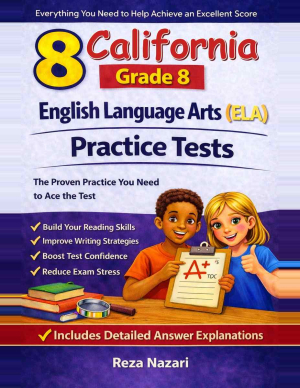
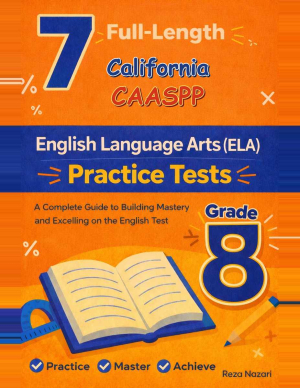
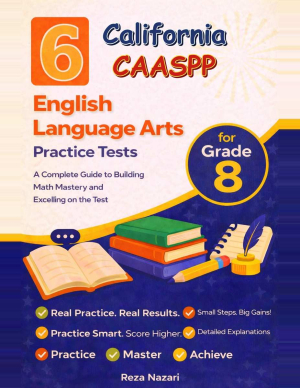
Build a Strong California Grade 8 CAASPP English Practice Library
Use these California Grade 8 resources for reading comprehension, language, writing, and full-length practice where available. Click any cover to open the resource page.
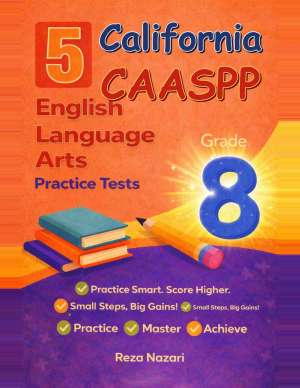
California Grade 8 English: 10-Question Challenge
Ten questions on reading, grammar, vocabulary, and writing for California 8th graders, each with a short explanation.
The rain was not walking. The modifier should refer to the person.
Tone comes from the author. Mood is the atmosphere readers experience.
Situational irony is when the outcome is the opposite of what is expected.
The subjunctive expresses wishes or conditions contrary to fact.
Choose another state
Grade 8 English in Every State
Select a state on the map to open its Grade 8 English page. You are viewing California.
All states A–Z
A USEFUL NEXT STEP
California Grade 8 English: study questions
What makes a business inquiry more useful than “Please explain your offer”?
Specific questions identify the missing information: the full later-delivery price and the cancellation deadline. A provider can answer them directly, and the reader can use those answers to compare the offers fairly.
Where are the complete California Grade 8 requirements?
California’s official English language arts document contains the Grade 8 expectations across its subject strands. These are two selected references for the activity below; use the full document for curriculum planning.
Official source ↗Resources from Effortless Math · Editorial standards