LEARN · PRACTICE · EXPLORE
New Mexico Grade 8 English
Compare conflicting facts and interpretations in original Grade 8 reports, identify needed evidence, and use New Mexico English resources for further practice.
Focused lessons · Useful practice · Clear next steps
What do New Mexico 8th graders learn in ELA?
In 8th grade, New Mexico English language arts centers on evaluating arguments, analyzing tone and word choice, and research-based writing. Students take the NM-MSSA grade 8 ELA test in the spring. This page explains each New Mexico grade 8 ELA standard and pairs it with short lessons, printable worksheets and a full-length practice test.
Printable New Mexico grade 8 ELA books:
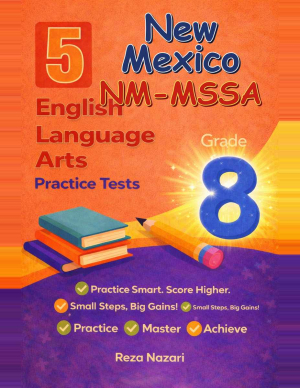
- 5 New Mexico NM-MSSA Grade 8 English Language Arts (ELA) Practice Tests
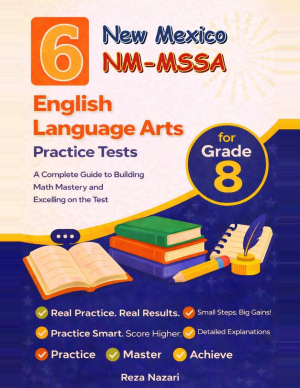
- 6 New Mexico NM-MSSA Grade 8 English Language Arts (ELA) Practice Tests
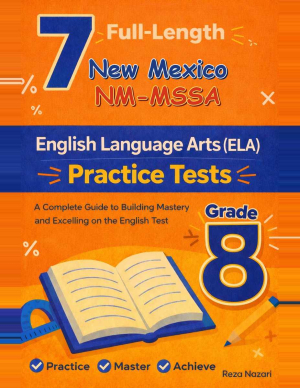
- 7 New Mexico NM-MSSA Grade 8 English Language Arts (ELA) Practice Tests
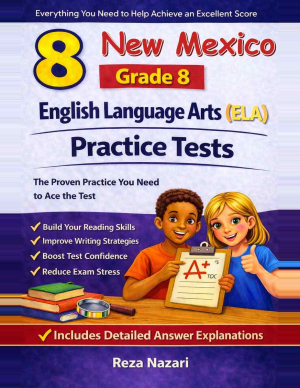
- 8 New Mexico NM-MSSA Grade 8 English Language Arts (ELA) Practice Tests
- New Mexico Grade 8 ELA Preparation Bundle
Standards source: New Mexico adopted content standards.
Find the disagreement before deciding how to resolve it
Compare conflicting facts and interpretations in original Grade 8 reports, identify needed evidence, and use New Mexico English resources for further practice. New Mexico uses Common Core English expectations together with state additions. This activity addresses selected skills; use the full requirements and the school’s sequence for broader planning.
Curriculum reference: 2010 Common Core ELA/literacy standards, current New Mexico state-hosted copy, from the New Mexico adopted content standards directory.
New Mexico Grade 8 references for this activity
New Mexico uses the Common Core English language arts standards together with additional state expectations in NMAC 6.29.13. The selected Common Core references below identify this activity’s focus. The linked state additions include further cultural, oral-source, writing, and discussion work appropriate to each grade; read the full requirements and the school’s sequence.
| Selected Common Core reference | Activity focus | State-hosted standards document |
|---|---|---|
| RI.8.1 | Use the strongest evidence for an explanation | Read the state-hosted document (PDF page 39) |
| RI.8.9 | Identify disagreements about facts or interpretation across texts | Read the state-hosted document (PDF page 39) |
NMAC 6.29.13.9(D)(1)–(2) adds source-type and media-influence work. This activity selects source tracing and pressure alongside RI.8.9. The state’s additional cultural and historical-literature expectations in 6.29.13.9(B)(3) and (C) require further appropriately selected reading. Read New Mexico’s additional English requirements (NMAC 6.29.13, PDF).
These selected reference labels identify an activity focus, with the grade column and PDF page linked separately. Read the complete standards selected by the school and its learning sequence, including reading, writing, language, speaking, and listening. This short original example does not fulfill the entire curriculum or establish a student’s grade-level proficiency.
Two reports of the repair workshop
This original classroom example is separate from official assessment questions.
Source A — Invented participant log
At closing time on Thursday, our log counted eighteen repaired items. We counted each item only after the team had checked its repair. Two objects were waiting for that final check. Volunteers said the extra worktable helped them spread out tools, but we did not compare completed items per hour with an earlier workshop.
Source B — Invented later newsletter report
The Thursday repair workshop completed twenty items. An organizer’s early message listed twenty objects at the worktables. The extra table clearly doubled the workshop’s speed. Everyone should now agree that the room needs twice as many tables.
Try the activity
Identify a factual disagreement and a separate disagreement about interpretation. Trace the sources behind the counts. Does the participant log fully establish why the newsletter reported twenty completed items? Explain what evidence would help settle the count and test the speed claim.
Follow the reasoning
The factual disagreement is eighteen checked repairs at closing versus twenty completed repairs. Source A gives a counting rule and identifies two objects awaiting checks. Source B relies on an early organizer message about objects at worktables, which is not necessarily a final count of completed repairs. This suggests a possible reason for the different totals, but does not prove exactly how the newsletter writer produced its number. Verify the original message, final log, counting definition, and time of each count. The separate interpretation concerns speed: Source B says the extra table doubled it, while Source A reports a perceived benefit and explicitly lacks a comparison of items per hour. Testing that claim requires comparable before-and-after rate data and attention to other changed conditions. The participant log is a primary record for the event; the later newsletter is secondary for that question. Those labels help trace evidence but do not settle accuracy by themselves.
Notice what needs more practice
Do not resolve the conflict merely by adding eighteen and two: unfinished checks are not checked completions under Source A’s rule. The early and final records may count different things at different times. More table space and doubled speed are different claims. “Everyone should agree” applies pressure without resolving the missing evidence. The workshop, records, and numbers are invented for reading analysis.
Grade 8 English worksheets
Choose printable practice that matches the skill being taught. Check the task, reading difficulty, and directions before assigning it; the collection is independently published.
Use the next session to build independence
- Name the conflicting factual claims precisely.
- Trace the original record behind each claim.
- Separate the count dispute from the causal interpretation and request suitable evidence.
Write a correction note that distinguishes confirmed information, a possible explanation, and a still-untested claim. Then compare contextualized real reports chosen by the teacher. New Mexico also requires broader cultural reading and significant literature in Grade 8; an informational source task cannot replace that reading program.
For more general reading and writing resources, visit the Grade 8 English Online Center.
New Mexico Grade 8 English: useful planning questions
Can apparently conflicting counts both use real observations?
Yes, if they refer to different times or define completion differently. Check the original records and counting rules before deciding whether either published claim is accurate.
Which standards does the school use?
New Mexico uses the Common Core English language arts standards together with additional state expectations in NMAC 6.29.13. The selected Common Core references below identify this activity’s focus. The linked state additions include further cultural, oral-source, writing, and discussion work appropriate to each grade; read the full requirements and the school’s sequence. The school’s sequence also includes reading, writing, speaking, listening, and language work beyond this example.
Sources checked October 6, 2026. The current NM-MSSA resource page describes statewide ELA and mathematics assessment at the end of Grades 3–8, including Grade 8. Results are one measure and should be considered alongside classroom and other assessment evidence. Confirm the learner’s assigned pathway and current school directions. Read the official NM-MSSA resource page, state standards directory, and additional New Mexico English requirements. The state assessment directory is updating resources for 2026–2027; this page does not claim later-year timing, tool, or administration details from a Spring 2026 manual. Independently published practice has its own directions and scoring and does not predict a state performance level. This original activity is not an official assessment item.
Grade 8 English in other states
When moving between school systems, compare the official curriculum and the school’s learning sequence. Use the national Online Center’s map to find another state’s resources.
Recommended New Mexico Grade 8 resources
Build a Strong New Mexico Grade 8 NM-MSSA English Practice Library
These independently published resources have their own coverage and editions. Check the contents alongside New Mexico’s current English standards before choosing assessment preparation.
Use these New Mexico Grade 8 resources for reading comprehension, language, writing, and full-length practice where available. Click any cover to open the resource page.
More Grade 8 resources
A USEFUL NEXT STEP
New Mexico Grade 8 English: study questions
Can apparently conflicting counts both use real observations?
Yes, if they refer to different times or define completion differently. Check the original records and counting rules before deciding whether either published claim is accurate.
Where are the complete New Mexico Grade 8 requirements?
New Mexico uses the Common Core English language arts standards together with additional state expectations in NMAC 6.29.13. The selected Common Core references below identify this activity’s focus. The linked state additions include further cultural, oral-source, writing, and discussion work appropriate to each grade; read the full requirements and the school’s sequence.
Official source ↗Resources from Effortless Math · Editorial standards