LEARN · PRACTICE · EXPLORE
New Jersey Grade 8 English
Analyze New Jersey Grade 8 English arguments with an original rehearsal proposal, relevant and irrelevant evidence, a worked critique, and further reading practice.
Focused lessons · Useful practice · Clear next steps
What do New Jersey 8th graders learn in ELA?
In 8th grade, New Jersey English language arts centers on evaluating arguments, analyzing tone and word choice, and research-based writing. Students take the NJSLA grade 8 ELA test in the spring. This page explains each New Jersey grade 8 ELA standard and pairs it with short lessons, printable worksheets and a full-length practice test.
Printable New Jersey grade 8 ELA books:
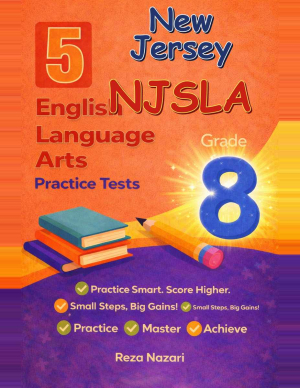
- 5 New Jersey NJSLA Grade 8 English Language Arts (ELA) Practice Tests
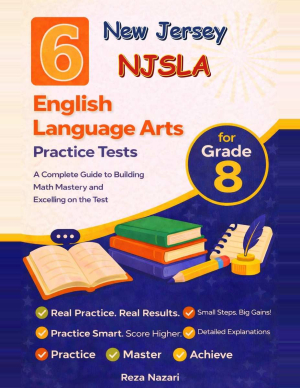
- 6 New Jersey NJSLA Grade 8 English Language Arts (ELA) Practice Tests
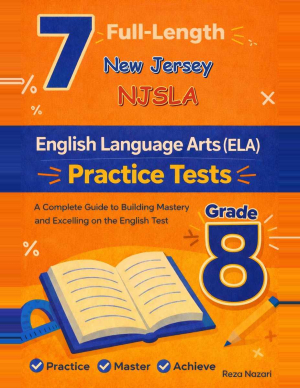
- 7 New Jersey NJSLA Grade 8 English Language Arts (ELA) Practice Tests
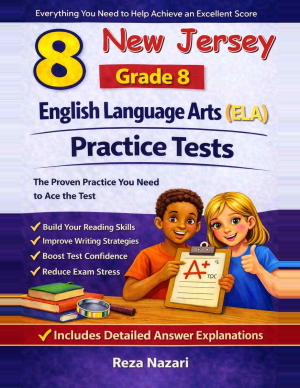
- 8 New Jersey NJSLA Grade 8 English Language Arts (ELA) Practice Tests
- New Jersey Grade 8 ELA Preparation Bundle
Standards source: 2023 New Jersey ELA standards.
Evaluate relevant evidence and identify an unsupported generalization
Analyze New Jersey Grade 8 English arguments with an original rehearsal proposal, relevant and irrelevant evidence, a worked critique, and further reading practice. The selected 2023 New Jersey standards identify this activity’s focus; use the complete grade expectations and the school’s teaching sequence for broader planning.
Curriculum reference: 2023 New Jersey Student Learning Standards for English Language Arts, official grade page, from the official New Jersey ELA standards directory.
New Jersey Grade 8 references for this activity
The 2023 New Jersey Student Learning Standards for English Language Arts define grade-specific end-of-year expectations. These selected references point to the activity’s reading focus; the complete grade page also includes language, writing, speaking, and listening. Use the full expectations and the school’s teaching sequence when planning instruction.
| Selected state reference | Activity focus | Official grade page |
|---|---|---|
| RI.CR.8.1 | Use a range of evidence to support informational analysis | Read the complete grade expectations |
| RI.AA.8.7 | Evaluate reasoning, relevance, and sufficiency in an argument | Read the complete grade expectations |
These selected reference labels identify an activity focus, with links to the official grade page. Read the complete New Jersey standards and the school’s learning sequence, including reading, writing, language, speaking, and listening. This short original example does not fulfill the entire curriculum or establish a student’s grade-level proficiency.
Should every rehearsal use the same room?
This original classroom example is separate from official assessment questions.
The drama club should hold every rehearsal in Room B. During our last two rehearsals there, actors could hear directions without the hallway noise that interrupted the previous rehearsal in Room A. Room B also had enough space for the scenes we practiced that week. Those observations make it worth testing the room for more rehearsals.
Some members favor Room A because its chairs can be moved easily and the door is close to the storage cupboard. We can bring the needed props to Room B before practice, but we have not tried the large group scene there yet.
Our club won a poster-design prize last month, which proves this room proposal is right. Since the two rehearsals in Room B went well, every scene for every future production will work there. We should decide now without checking any other needs.
Try the activity
Evaluate the argument for using Room B for every rehearsal. Identify evidence relevant to a narrower claim, an irrelevant piece of evidence, and a generalization that goes beyond the record. Explain what evidence is still missing.
Follow the reasoning
The reported reduction in interruptions and the space available for the scenes rehearsed are relevant to trying Room B again. They support a limited claim about those rehearsals and a proposal for further testing. The poster-design prize does not show anything about acoustics, room size, storage access, or rehearsal needs, so it is irrelevant to whether this room choice works. The claim that every scene in every future production will fit generalizes far beyond two rehearsals. The writer even acknowledges that the large group scene has not been tried. The storage concern receives a proposed response, bringing props in advance, but the text supplies no completed trial showing that this arrangement meets the club’s needs. A critique should therefore distinguish useful observations from insufficient support for the word “every.” Further evidence would include the large group scene, access and setup needs, and a broader set of rehearsal conditions.
Notice what needs more practice
Relevant evidence is not automatically sufficient evidence. Two reported successful rehearsals bear on the proposal, yet they cannot establish an unrestricted guarantee about future productions. A prize can be genuine and still be irrelevant to the particular claim. Do not assume Room A is therefore the better choice; the task asks what the argument supports, not which room must win. All club events and observations in the passage are invented for critical reading practice.
Grade 8 English worksheets
Choose printable practice that matches the skill being taught. Check the task, reading difficulty, and directions before assigning it; the collection is independently published.
Use the next session to build independence
- Separate the main claim from its narrower testable version.
- Identify relevant observations, unanswered concerns, and irrelevant evidence.
- Revise the conclusion so its scope matches the available evidence.
Write a revised conclusion proposing a limited trial of Room B and specifying what the club should observe. Keep the useful noise and space evidence, remove the prize as support, and address the untested group scene. Then critique a different assigned argument for relevance and sufficiency rather than looking only for an obvious false statement.
For more general reading and writing resources, visit the Grade 8 English Online Center.
New Jersey Grade 8 English: useful planning questions
Can evidence be relevant but still insufficient?
Yes. Observations from two rehearsals may justify trying a room again while remaining insufficient for a claim about every future production. Evaluate the evidence’s connection and its scope separately.
Which standards does the school use?
The 2023 New Jersey Student Learning Standards for English Language Arts define grade-specific end-of-year expectations. These selected references point to the activity’s reading focus; the complete grade page also includes language, writing, speaking, and listening. Use the full expectations and the school’s teaching sequence when planning instruction. The school’s sequence also includes reading, writing, speaking, listening, and language work beyond this example.
Sources checked October 6, 2026. The official 2026–2027 schedule lists NJSLA-A ELA for Grades 3–9, including Grade 8. NJDOE describes ELA and mathematics as adaptive assessments. Confirm the learner’s assigned pathway and school directions. Read the official adaptive assessment overview, 2026–2027 statewide schedule, and 2023 ELA standards directory. Independently published practice has its own timing and scoring and does not predict a state performance level. Use the teacher’s sequence for further reading, writing, speaking, listening, and language work. This original activity is not an official assessment item.
Grade 8 English in other states
When moving between school systems, compare the official curriculum and the school’s learning sequence. Use the national Online Center’s map to find another state’s resources.
Recommended New Jersey Grade 8 resources
Build a Strong New Jersey Grade 8 NJSLA English Practice Library
These independently published resources have their own coverage and editions. Check the contents alongside New Jersey’s current English standards before choosing assessment preparation.
Use these New Jersey Grade 8 resources for reading comprehension, language, writing, and full-length practice where available. Click any cover to open the resource page.
More Grade 8 resources
A USEFUL NEXT STEP
New Jersey Grade 8 English: study questions
Can evidence be relevant but still insufficient?
Yes. Observations from two rehearsals may justify trying a room again while remaining insufficient for a claim about every future production. Evaluate the evidence’s connection and its scope separately.
Where are the complete New Jersey Grade 8 requirements?
The 2023 New Jersey Student Learning Standards for English Language Arts define grade-specific end-of-year expectations. These selected references point to the activity’s reading focus; the complete grade page also includes language, writing, speaking, and listening. Use the full expectations and the school’s teaching sequence when planning instruction.
Official source ↗Resources from Effortless Math · Editorial standards