


LEARN · PRACTICE · EXPLORE
Illinois Grade 8 English
Compare punctuation in original dialogue, explain a hesitation and interruption, and practice a selected Illinois Grade 8 language expectation.
Focused lessons · Useful practice · Clear next steps
What do Illinois 8th graders learn in ELA?
In 8th grade, Illinois English language arts centers on evaluating arguments, analyzing tone and word choice, and research-based writing. Students take the IAR grade 8 ELA test in the spring. This page explains each Illinois grade 8 ELA standard and pairs it with short lessons, printable worksheets and a full-length practice test.
Printable Illinois grade 8 ELA books:

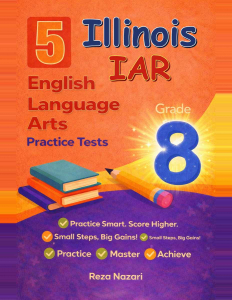
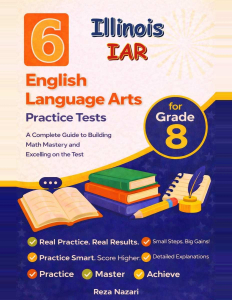
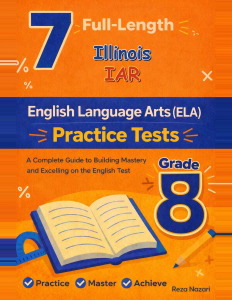
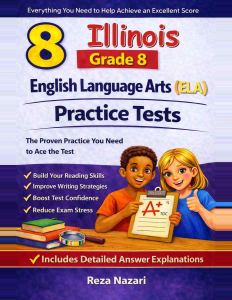
IAR Grade 8 ELA: Test Facts and Scores
Illinois 8th graders take the Illinois Assessment of Readiness (IAR) in English language arts each spring. Scores run from 650 to 850. Under the performance levels Illinois adopted in August 2025, 745 or higher is Proficient for Grade 8.
| Test | Illinois Assessment of Readiness (IAR), Grade 8 English Language Arts |
|---|---|
| 2027 testing window | Online: March 1–April 16, 2027; paper: March 1–April 2, 2027 |
| Performance levels | Below Proficient, Approaching Proficient, Proficient, Above Proficient (four levels since 2025) |
| Official information | ISBE IAR page |
Grade 8 ELA score ranges
| Performance level | Score range |
|---|---|
| Below Proficient | 650 to 709 |
| Approaching Proficient | 710 to 744 |
| Proficient | 745 to 794 |
| Above Proficient | 795 to 850 |
Practice on this page: Illinois standards
Facts from the Illinois State Board of Education, checked November 23, 2026: ISBE: Illinois Assessment of Readiness (IAR); ISBE: 2026–27 Illinois state assessment dates; ISBE: ELA cut scores and score ranges (August 2025); ISBE: Right-Sizing Illinois’ Benchmarks for Proficiency FAQ.
All 41 Illinois Grade 8 English Language Arts Standards
Every Grade 8 standard in the Common Core State Standards for English Language Arts, which Illinois uses as its state ELA standards, grouped by strand. Lettered sub-standards sit under each numbered standard in the official document. Open a strand to see its standards.
Reading: Literature (9)
| RL.8.1 | Cite the textual evidence that most strongly supports analysis of what a text says explicitly and inferences drawn from it. |
|---|---|
| RL.8.2 | Determine a theme or central idea, analyze its development including its relationship to characters, setting and plot, and summarize objectively. |
| RL.8.3 | Analyze how particular lines of dialogue or incidents propel the action, reveal a character or provoke a decision. |
| RL.8.4 | Determine the meaning of words and phrases and analyze the impact of word choice on meaning and tone, including analogies or allusions. |
| RL.8.5 | Compare and contrast the structure of two or more texts and analyze how each structure contributes to meaning and style. |
| RL.8.6 | Analyze how differences in the points of view of characters and the audience or reader create suspense or humor. |
| RL.8.7 | Analyze how a filmed or live production of a story or drama stays faithful to or departs from the text. |
| RL.8.9 | Analyze how a modern work of fiction draws on themes, patterns of events or character types from myths, traditional stories or religious works. |
| RL.8.10 | By the end of the year, read and understand literature at the high end of the grades 6–8 band independently. |
Reading: Informational Text (10)
| RI.8.1 | Cite the textual evidence that most strongly supports analysis of an informational text. |
|---|---|
| RI.8.2 | Determine a central idea, analyze its development including its relationship to supporting ideas, and summarize objectively. |
| RI.8.3 | Analyze how a text makes connections and distinctions between individuals, ideas or events, through comparisons, analogies or categories. |
| RI.8.4 | Determine the meaning of words and phrases and analyze the impact of word choice, including analogies or allusions to other texts. |
| RI.8.5 | Analyze in detail the structure of a specific paragraph. |
| RI.8.6 | Determine an author’s point of view or purpose and analyze how the author responds to conflicting evidence or viewpoints. |
| RI.8.7 | Evaluate the advantages and disadvantages of using different mediums, such as print, digital text, video or multimedia, to present an idea. |
| RI.8.8 | Delineate and evaluate the argument in a text, recognizing when irrelevant evidence is introduced. |
| RI.8.9 | Analyze a case in which two or more texts give conflicting information on the same topic and identify where they disagree. |
| RI.8.10 | By the end of the year, read and understand literary nonfiction at the high end of the grades 6–8 band independently. |
Writing (10)
| W.8.1 | Write arguments that distinguish claims from opposing claims, support them with logical reasoning and credible evidence, and conclude. |
|---|---|
| W.8.2 | Write informative texts that introduce a topic clearly, organize ideas into broader categories, develop them with relevant evidence, and conclude. |
| W.8.3 | Write narratives with a point of view, narrative techniques, varied transitions, sensory language and a reflective conclusion. |
| W.8.4 | Produce clear and coherent writing in which the development, organization and style fit the task, purpose and audience. |
| W.8.5 | With guidance, develop and strengthen writing by planning, revising, editing and rewriting, focusing on purpose and audience. |
| W.8.6 | Use technology to produce and publish writing, present relationships between information and ideas, and collaborate with others. |
| W.8.7 | Conduct short research projects to answer a question, drawing on several sources and generating additional focused questions. |
| W.8.8 | Gather information using search terms effectively, assess credibility, quote or paraphrase without plagiarism, and follow a standard citation format. |
| W.8.9 | Draw evidence from literary or informational texts to support analysis, reflection and research. |
| W.8.10 | Write routinely over extended and short time frames for a range of tasks, purposes and audiences. |
Speaking and Listening (6)
| SL.8.1 | Engage in collaborative discussions, coming prepared, posing questions that connect ideas, and qualifying or justifying their own views. |
|---|---|
| SL.8.2 | Analyze the purpose of information presented in diverse media and evaluate the social, commercial or political motives behind it. |
| SL.8.3 | Delineate a speaker’s argument, evaluating reasoning and evidence and identifying when irrelevant evidence is introduced. |
| SL.8.4 | Present claims and findings with relevant evidence, sound reasoning and good delivery. |
| SL.8.5 | Integrate multimedia and visual displays into presentations to clarify information, strengthen claims and add interest. |
| SL.8.6 | Adapt speech to a variety of contexts and tasks, showing command of formal English when appropriate. |
Language (6)
| L.8.1 | Use standard grammar: explain verbals (gerunds, participles, infinitives), use active and passive voice, and use verb moods. |
|---|---|
| L.8.2 | Use capitalization, punctuation and spelling correctly, including commas, ellipses and dashes to indicate a pause or break. |
| L.8.3 | Use knowledge of language: use active and passive voice and verb moods to achieve particular effects. |
| L.8.4 | Find the meaning of unknown words using context, Greek and Latin affixes and roots, and reference materials. |
| L.8.5 | Interpret figures of speech such as verbal irony and puns, and distinguish connotations of words with similar definitions. |
| L.8.6 | Acquire and use grade-appropriate general academic and domain-specific words and phrases. |
Codes follow the Common Core numbering; descriptions are our plain-English summaries. Checked November 23, 2026: ISBE: Illinois Learning Standards (standards and courses).
Standards source: Illinois English Language Arts, Illinois State Board of Education.
Distinguish hesitation from an abrupt interruption
Punctuation can help readers interpret how a spoken line unfolds. A pause, a trailing hesitation, and an abrupt break may call for different choices. The examples below supply context so students can explain the effect rather than inserting marks only because a speaker pauses while reading.
Curriculum reference: Illinois Learning Standards incorporating Common Core English Language Arts/Literacy, from the Illinois State Board of Education standards directory.
Illinois Grade 8 references for this activity
Illinois’s current English document includes Grade 8 expectations across reading, writing, language, speaking, and listening. The expectations selected here support this activity; use the whole document and the school’s sequence for wider coverage.
| Grade-level expectation | Activity focus | Official requirement |
|---|---|---|
| L.8.2a | Use punctuation to indicate a pause or break | Read the state document (PDF page 52) |
These are selected grade-level expectations from Illinois’s current English standards. Activity labels describe a teaching focus rather than reproduce complete requirements. Read the linked state document, including the reading, writing, language, speaking, and listening sections and grade-level progression, alongside the school’s curriculum sequence.
A worked Grade 8 reading and writing activity
This original classroom example is separate from official assessment questions.
Scene A: “I think the key is…perhaps in the top drawer,” Ren said, still trying to remember.
Scene B: “The key is in the—” Ren began, but the alarm sounded before the sentence was finished.
| Example | Mark | Effect in this scene |
|---|---|---|
| Searching for an answer | Ellipsis | Hesitation before continuing |
| Alarm cuts off the line | Dash | Abrupt interruption |
| Ren, please check the drawer | Comma | Separates direct address |
Try the activity
Explain what the ellipsis suggests in Scene A and what the dash signals in Scene B. Connect each mark with the surrounding narration. Then write a complete line using a comma for a brief pause, and explain why that choice should still fit the sentence’s grammar.
Follow the reasoning
In Scene A, the ellipsis marks a hesitation while Ren searches for the answer; the sentence continues with a possible location. In Scene B, the dash marks an abrupt break: the alarm interrupts the line before Ren gives the location. The surrounding descriptions support these different effects. A comma in “Ren, please check the drawer” separates the person addressed from the request, and may also guide a brief pause. That grammatical role matters; punctuation is not simply a written record of every breath.
Notice what needs more practice
The ellipsis in Scene A represents hesitation in original dialogue. It does not indicate that a researcher omitted quoted source words, which is a different use addressed elsewhere in the full Grade 8 expectations. Do not claim the alarm proves the key is missing or dangerous; the scene says only that it interrupts the sentence. A dash can have other functions in other contexts. Explain the chosen mark’s effect in this particular line and keep the surrounding narrative evidence in view.
Grade 8 English worksheets
Choose printable practice that matches the skill being taught. Check the task, reading difficulty, and directions before assigning it; the collection is independently published.
Use the next session to build independence
- Identify the kind of pause or break the scene establishes.
- Choose a mark whose use fits the sentence and intended effect.
- Explain the choice using both the punctuation and context.
Rewrite Scene B so Ren gradually loses confidence rather than being interrupted. Replace the narration as well as the punctuation so the new version is coherent. Then compare the two versions and explain how the reader’s understanding changes. Mark the revision as a new fictional scene. In a later editing task, check commas against the grammatical relationship instead of adding one wherever a reader happens to slow down. This activity introduces selected pause-and-break uses; complete classroom instruction should also address other punctuation functions and accurate spelling.
For more general reading and writing resources, visit the Grade 8 English Online Center.
Illinois Grade 8 English: useful planning questions
Does every spoken pause require a comma?
No. A punctuation choice should fit the sentence’s structure and intended meaning. The comma in Ren, please check the drawer marks direct address, rather than simply recording a breath.
Where are the complete state requirements?
Illinois’s current English document includes Grade 8 expectations across reading, writing, language, speaking, and listening. The expectations selected here support this activity; use the whole document and the school’s sequence for wider coverage. The school’s sequence also includes reading, writing, speaking, listening, and language work beyond this example.
Official sources checked October 6, 2026. Grade 8 is within the IAR English language arts testing range. This original lesson is independent practice. Read the Illinois assessment overview and use the school’s guidance for preparation. IAR measures English language arts and mathematics in Grades 3–8. Follow the school’s current assessment assignment, accommodations, and guidance; this classroom activity is independent practice and does not predict a state performance level. This site’s practice and books are independently published. Check their editions and contents against current standards and assessment guidance.
Grade 8 English in other states
When moving between school systems, compare the official curriculum and the school’s learning sequence. Use the national Online Center’s map to find another state’s resources.
Recommended Illinois Grade 8 resources
Build a Strong Illinois Grade 8 IAR English Practice Library
These independently published resources have their own coverage and editions. Check the contents alongside Illinois’s current English standards before choosing assessment preparation.
Use these Illinois Grade 8 resources for reading comprehension, language, writing, and full-length practice where available. Click any cover to open the resource page.
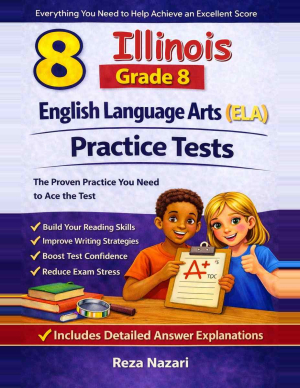
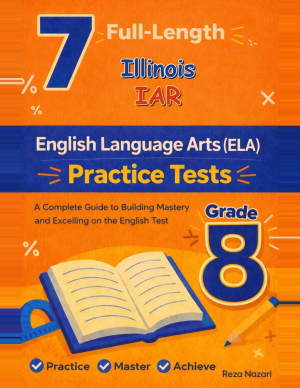
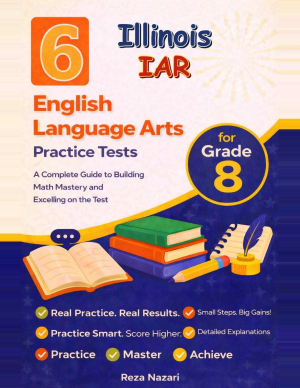
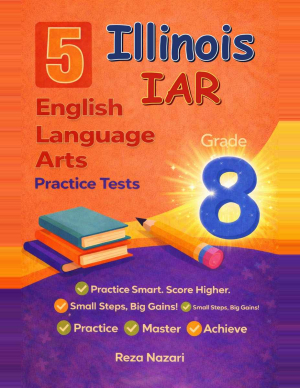
More Grade 8 resources
Illinois Grade 8 English: 10-Question Challenge
Ten questions on reading, grammar, vocabulary, and writing for Illinois 8th graders, each with a short explanation.
The rain was not walking. The modifier should refer to the person.
The phrase ‘Exhausted from the hike’ correctly describes Sam.
Situational irony is when the outcome is the opposite of what is expected.
The subjunctive expresses wishes or conditions contrary to fact.
Choose another state
Grade 8 English in Every State
Select a state on the map to open its Grade 8 English page. You are viewing Illinois.
All states A–Z
A USEFUL NEXT STEP
Illinois Grade 8 English: study questions
Does every spoken pause require a comma?
No. A punctuation choice should fit the sentence’s structure and intended meaning. The comma in Ren, please check the drawer marks direct address, rather than simply recording a breath.
Where are the complete Illinois Grade 8 requirements?
Illinois’s current English document includes Grade 8 expectations across reading, writing, language, speaking, and listening. The expectations selected here support this activity; use the whole document and the school’s sequence for wider coverage.
Official source ↗Resources from Effortless Math · Editorial standards