Free Grade 8 English Worksheets for New York Students
46 free printable 8th grade English worksheets for New York State ELA test practice: literature and informational text, writing, speaking and listening, grammar, punctuation and spelling, language and style, and vocabulary. Each topic opens a PDF you can print and use right away.
Quick answer: The New York State Testing Program (NYSTP) Grade 8 English Language Arts test is a computer-based test given each spring in two sessions over two days. It has no time limit. Students read literary and informational passages, answer multiple-choice questions, write short evidence-based responses and one longer essay. The 46 free worksheets below practice those same skills.
By eighth grade, a student in Buffalo or Brooklyn has read plenty of passages, but the questions waiting under them have quietly raised the stakes. They are no longer satisfied with a student who followed the story. They want to know which sentence gives the *strongest* support for an inference, and why that line outweighs the one next to it. Grade 8 reading is the move from comprehension to analysis: every reading has to be pinned to specific text and defended on purpose.
Writing makes the same shift. In Grade 8, an argument essay is the year the counterclaim must be answered, genuinely engaged and pushed back against, not just named and dropped. The reading work climbs alongside it: eighth graders are expected to notice when two sources disagree and to study how an author handles evidence that cuts against their own claim. Grammar follows the same arc toward precision, verbals, active and passive voice, and verb mood, the controls that let a writer say one exact thing rather than something roughly like it.
These worksheets are made for that real work. They are free, printable, and need no signup, equally useful in a Rochester classroom or on a kitchen table in Yonkers, ready whenever a few quiet minutes appear.
What’s on this page
Each PDF here focuses on one skill and stays there. The first page is a Quick Review, the skill explained plainly with one example worked all the way through, so your student is never guessing at the target. Practice items follow, rising from approachable to genuinely demanding. The closing page is a student-facing answer key with explanations: why the correct answer is correct, and where the convincing wrong answers fall apart.
Forty-six single-skill PDFs, aligned to the New York Next Generation ELA Learning Standards at Grade 8, organized into the eight strands below. There is no required order. Find the skill your student needs this week and start there.
Reading: Literature
- Citing Strong Evidence and Making Inferences, [RL.8.1] pick the strongest support and reason past what the text says outright
- Theme and Objective Summary, [RL.8.2] name the lesson and retell it without sliding into opinion
- Dialogue, Incidents, and Character Decisions, [RL.8.3] trace how a line of dialogue or one event turns a character
- Word Choice, Figurative Meaning, and Tone, [RL.8.4] how a single word choice sets the mood and reveals attitude
- Comparing Literary Structure and Style, [RL.8.5] two texts, two structures, and why each author built it that way
- Point of View, Suspense, and Humor, [RL.8.6] how what the reader knows but a character doesn’t creates tension or comedy
- Evaluating Text and Film Versions, [RL.8.7] what a director kept, cut, or changed, and the effect of each choice
- Modern Stories and Traditional Patterns, [RL.8.9] spot the old myth or pattern living inside a new story
Reading: Informational Text
- Citing Evidence in Informational Text, [RI.8.1] pull the strongest article evidence for both stated and inferred ideas
- Central Idea and Objective Summary, [RI.8.2] find the main idea and summarize without leaking judgment
- Connections Among Ideas and Events, [RI.8.3] how a text links people, events, and ideas through comparison and cause
- Technical, Figurative, and Connotative Meaning, [RI.8.4] three different jobs one word can do in nonfiction
- Text Structure and the Role of Sentences, [RI.8.5] how one sentence or paragraph holds up the author’s larger point
- Author Point of View and Conflicting Evidence, [RI.8.6] find the author’s stance and how they handle evidence that disagrees
- Evaluating Mediums and Formats, [RI.8.7] weigh print, video, and audio for what each does best
- Evaluating Arguments, Claims, and Evidence, [RI.8.8] sort sound reasoning from weak, and relevant evidence from filler
- Conflicting Information Across Texts, [RI.8.9] two texts disagree on fact or interpretation, figure out where and why
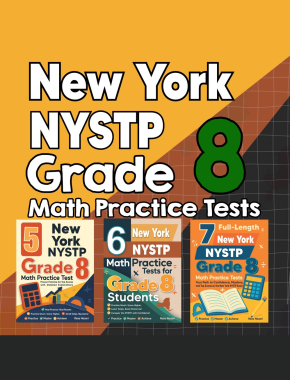
Working on Math Too? Try the New York NYSTP Grade 8 Math Bundle
Many eighth graders are getting ready for the NYSTP in both subjects. If your child also needs math practice that matches the same standards, this companion bundle is the shortest path, workbook, study guide, and full practice tests in one download.
Writing
- Argument Writing: Claims, Reasons, and Evidence, [W.8.1] Grade 8 is the year the counterclaim must be answered, not just named
- Informative and Explanatory Writing, [W.8.2] teach a reader with a thesis, ordered sections, and clean transitions
- Narrative Writing, [W.8.3] pacing, dialogue, sensory detail, and an ending that lands
- Writing for Task, Purpose, and Audience, [W.8.4] same idea, reshaped for three different readers and goals
- Planning, Revising, and Editing, [W.8.5] sometimes the real revision is starting the paragraph over
- Short Research Projects, [W.8.7] ask a focused question, then let the findings sharpen it
- Gathering, Evaluating, and Citing Sources, [W.8.8] judge a source’s credibility, then cite it the way a teacher expects
Speaking & Listening
- Collaborative Discussions, [SL.8.1] come prepared, build on others, and disagree without dismissing
- Analyzing Media Purpose and Motive, [SL.8.2] name what a piece of media wants from you and how it is trying to get it
- Evaluating a Speaker’s Argument, [SL.8.3] find the claim, the reasoning, the evidence, and the soft spots
- Presenting Claims and Findings, [SL.8.4] open with the point, preview the order, and stay in it
- Using Digital Media in Presentations, [SL.8.5] make slides, audio, and visuals carry weight, not just decorate
- Adapting Speech to Context, [SL.8.6] the register you use with friends is not the register a presentation needs
Grammar
- Verbals: Gerunds, Participles, and Infinitives, [L.8.1a] verb forms doing the work of nouns, adjectives, and adverbs
- Active and Passive Voice, [L.8.1b] choose the voice on purpose instead of by accident
- Verb Mood: Indicative, Imperative, Interrogative, Conditional, Subjunctive, [L.8.1c] five moods and the meaning each one signals
- Correcting Shifts in Voice and Mood, [L.8.1d] catch the sentence that changes voice or mood mid-thought
Conventions: Punctuation, Spelling
- Punctuation for Pauses and Breaks: Comma, Ellipsis, Dash, [L.8.2a] the three marks that control how a sentence breathes
- Ellipses for Omitted Text, [L.8.2b] trim a quotation honestly without changing what it meant
- Spelling Grade-Appropriate Words, [L.8.2c] homophones, doubled letters, and the words eighth graders miss most
Knowledge of Language and Style
- Voice and Mood for Effect, [L.8.3a] use active or passive voice and verb mood as deliberate style tools
Vocabulary and Word Study
- Using Context Clues, [L.8.4a] name the kind of clue, then use it on purpose
- Greek and Latin Roots and Affixes, [L.8.4b] one root unlocks ten unrelated words
- Using Reference Materials Effectively, [L.8.4c] match the tool, dictionary, thesaurus, glossary, to the question
- Verifying Word Meaning, [L.8.4d] confirm the guess in context before committing to it
- Figures of Speech: Verbal Irony and Puns, [L.8.5a] catch the meaning that runs opposite the words
- Word Relationships and Nuance, [L.8.5b] sort synonyms by the small differences that actually matter
- Connotation: Shades of Meaning, [L.8.5c] same fact, different feeling, different word
- Academic and Domain-Specific Vocabulary, [L.8.6] words that travel across subjects and words tied to one field
How to use these worksheets at home
New York families are practiced at using time that does not look like study time, a subway ride, the wait before a lesson, the half hour between dinner and homework. Eighth-grade English practice slots right into those windows. It does not ask for a dedicated study hour; it asks for a habit. A couple of PDFs on a weeknight, one over the weekend, kept up steadily from September to spring, outpaces any frantic April review.
A pairing that works well: take one reading PDF and one writing PDF that connect. The informational-text worksheet on evaluating arguments, claims, and evidence sits naturally beside the argument-writing PDF, your student first judges someone else’s reasoning, then builds reasoning that has to survive the same test, including a counterclaim that gets answered rather than waved at. Each PDF is built for about twelve to fifteen minutes, so a reading-and-writing pair is a real but manageable evening, even after a long day across Queens or upstate.
Hand the answer key to your student. The explanations are written for an eighth grader to read on their own, and the genuine learning happens in the moment a student sees not just that they missed one but exactly why. Your role is mostly keeping the printer stocked and asking, over dinner, what the passage was really arguing.
A note about NYSTP at Grade 8
New York’s Grade 8 ELA assessment is the New York State Testing Program, NYSTP, administered in the spring and built on the Next Generation ELA Learning Standards. It is a computer-based test that leans heavily on evidence: students read literary and informational passages and answer questions that send them back into the text rather than rewarding a loose recollection.
NYSTP also asks students to write in response to what they read, including extended written responses built directly on the passages, the read-closely-then-build-an-argument sequence that defines Grade 8 ELA. It measures reading comprehension across genres, writing, and the language and vocabulary skills these PDFs are designed to strengthen.
To be clear, none of these worksheets is a practice NYSTP, and they are not built to imitate the test. They are single-skill builders, one focused page at a time. But a student who can cite the strongest evidence, answer a counterclaim cleanly, and handle verbals and verb mood without hesitation is exactly the student who walks into the spring assessment ready for what it asks.
Want everything in one bundle?
If a single organized resource suits your family better than printing one page at a time, the bundle pulls full-length practice and complete answer keys into one place.
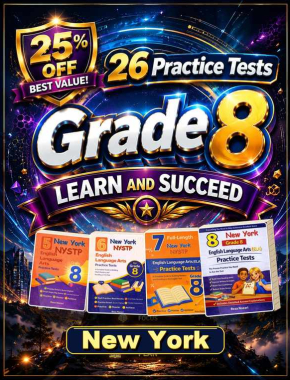
New York Grade 8 ELA Preparation Bundle, four practice-test books, full-length practice tests, complete answer keys with explanations.
A short closing
Strong reading and writing are not built overnight. They are built the way the city builds, block by block, floor by floor, until what stands there is solid. Bookmark this page so it is easy to reach on a busy weeknight. Then print just one PDF, set a fifteen-minute timer, and let your eighth grader work it through and check it themselves. One honest page is a real start, and the next one is already here when you need it.
Best Bundle to Ace the New York NYSTP Grade 8 ELA
Looking for the best resource to help your kid ace the New York NYSTP? Try this bundle, four full practice-test books (5 + 6 + 7 + 8 tests) covering the same Grade 8 reading, writing, and language skills your child is already learning. Instant PDF download, answer keys included.
What is on the NYS Grade 8 ELA test?
According to the New York State Education Department’s educator guide for the Grades 3 to 8 ELA tests (updated November 2024), the Grade 8 test is built like this:
| Part | Session 1 | Session 2 | Total |
|---|---|---|---|
| Reading passages | 4 | 4 | 8 |
| Multiple-choice questions (1 credit each) | 26 | 14 | 40 |
| Short constructed responses (2 credits) | 2 | 3 | 5 |
| Extended essay (4 credits) | 0 | 1 | 1 |
A few things to know:
- The test is untimed. Schools give students the time they need within the school day.
- The test is taken on a computer. Paper is used only as an accommodation for students who need it.
- Short responses ask for an inference backed by evidence from the passage. The essay asks students to write from sources, often using two texts.
- Scores are reported in four levels, from Level 1 (below proficient) to Level 4 (excels).
- Speaking and Listening is not tested on the state test, but it is still part of the Grade 8 standards, so our Speaking and Listening worksheets are best used for classroom and home practice.
Test details can change from year to year, so check the latest guide on the NYSED website before test day.
Frequently Asked Questions
Are there free printable English worksheets for 8th grade?
Yes. There are 46 free printable 8th grade English worksheets here, grouped by skill, from reading literature and informational text to grammar, punctuation, spelling and vocabulary. Each one opens as a PDF you can print right away. A New York eighth grader might start with a verbals sheet or an active and passive voice sheet, two grammar points that come up often at this level.
Are the 8th grade English worksheets available as a PDF?
Yes. Every worksheet in the New York Grade 8 set opens as a PDF, so it prints cleanly at home or school and also works on a tablet. Pick a topic, print one or two pages, and keep finished sheets in a folder so your child can look back at mistakes before the spring NYS ELA test.
What topics do grade 8 English worksheets cover?
Eighth grade English is about analysis: choosing the strongest evidence for an inference, comparing sources that disagree, and answering a counterclaim in an argument essay. Grammar turns to precision, with verbals, active and passive voice, and verb mood. The New York worksheets cover these skills along with spelling, punctuation, vocabulary, language and style, and speaking and listening.
How do 8th grade English worksheets help with the New York State ELA test?
They practice the same skills the test measures. The Grade 8 NYS ELA test is taken on a computer over two sessions, with literary and informational passages, multiple-choice questions, short evidence-based responses and one longer essay. After a reading worksheet, have your child write a short answer that cites one detail from the passage and explains it in two sentences.

Related to This Article
More math articles
- Hard and soft money
- The Ultimate MTEL Mathematics (Elementary) (68) Course (+FREE Worksheets & Tests)
- ASVAB Math: Complete Guide and Study Tips
- The Quotient Rule: Not Just Dividing Derivatives But Simple Enough
- Free Grade 7 English Worksheets for Mississippi Students
- How to Master the Road to Achievement: “Praxis Core Math for Beginners” Comprehensive Answer Guide”
- Disasters and Collective Response
- ISEE Middle-Level Math FREE Sample Practice Questions
- Best Laptop for High School Students in 2026
- Top 10 Websites to Learn About Scholarships, Federal Aid, and Student Funding








What people say about "NY State Grade 8 ELA Test: 46 Free Practice Worksheets"?
No one replied yet.